

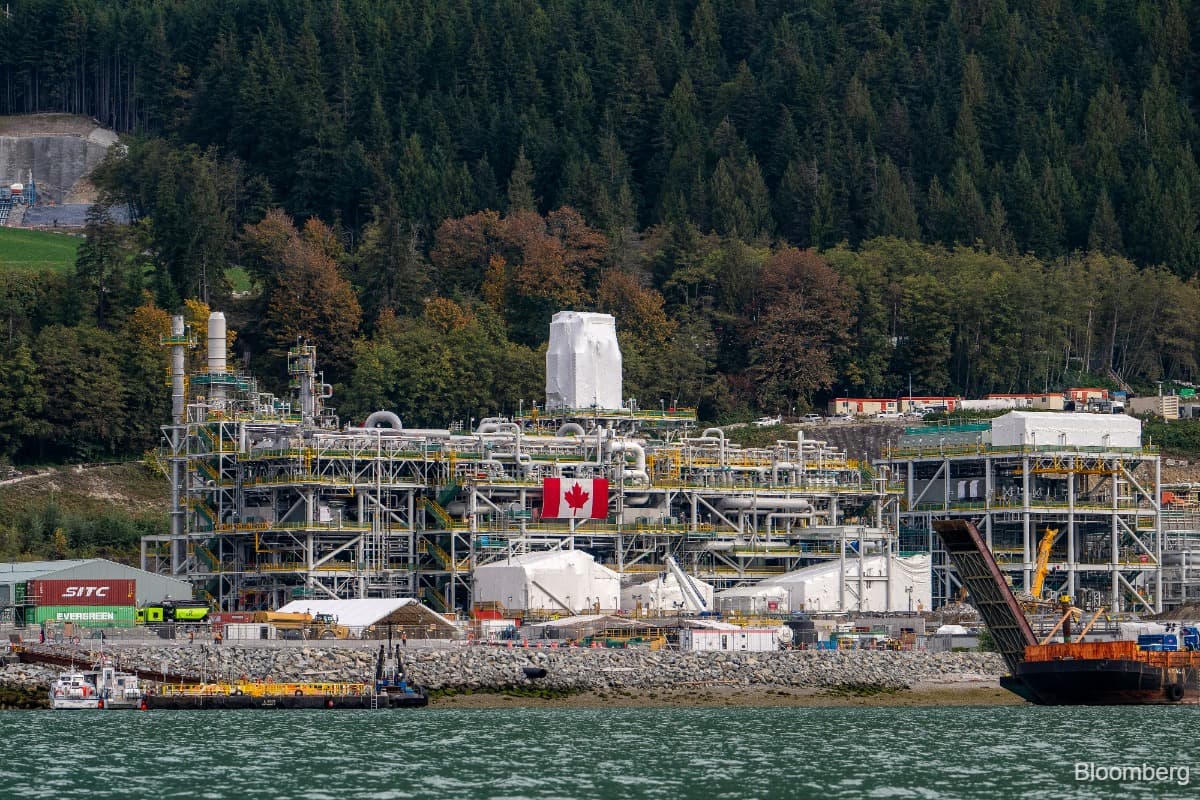
(Nov 14): Canada’s government injected C$200 million (US$140 million or RM573 million) into a west coast liquefied natural gas project backed by Indonesia’s richest person, as Prime Minister Mark Carney pushes to diversify exports away from the US.
The facility, Woodfibre LNG, is based in Squamish, British Columbia, just north of Vancouver. It’s about 75% complete and scheduled to start operations next year. Canadian Energy Minister Tim Hodgson announced the funding in Vancouver on Friday.
Woodfibre LNG is 70% owned by Pacific Energy Corp, a unit of closely held, Singapore-headquartered conglomerate RGE Pte Ltd, which also operates forestry and oil palm plantations. It has assets of more than US$40 billion and 80,000 employees, according to its website. Founder and Chairman Sukanto Tanoto is worth US$21.5 billion, according to the Bloomberg Billionaires Index.
The rest of Woodfibre is owned by Calgary-based oil and gas pipeline company Enbridge Inc.
The government touted Woodfibre’s emissions efficiency — it’s powered by hydroelectricity — and how its environmental assessment process was led by local Indigenous people, the Squamish Nation.
The facility is designed to produce 2.1 million tonnes of LNG per year, and its backers are exploring an expansion to increase its capacity to at least 2.5 million tonnes.
Though its timeline has slipped over the years, Woodfibre LNG was one of the earliest in a series of BC projects now tapping western Canada’s large gas reserves to ship over the Pacific to Asian buyers.
In September, the companies behind LNG Canada, the country’s largest export facility, decided to double its capacity to 28 million tonnes — a US$23 billion expansion.
Last month, BC elected a Conservative provincial government, which promised to double the region’s natural gas production by 2032.
The federal investment in Woodfibre attracted some criticism for putting taxpayer money into the project.
“This is not government’s lane,” said Heather Exner-Pirot, director of energy, natural resources and environment at the Macdonald-Laurier Institute think tank, in a post on X, based on an earlier report by Reuters. “It crowds out private sector investment and distorts the free market.”
Energy Minister Hodgson said the funding would come in the form of a conditional grant doled out if the company hits certain benchmarks for investing in Canada.
“Canada has made a decision that we’ll have the lowest carbon intensity LNG in the world,” Hodgson said in an interview. “This plant will be the first net-zero plant in the world.”
The plant’s net zero commitment covers its own emissions, known as scope 1, and those from the electricity it purchases, scope 2, according to the company’s marketing materials.
“We are asking investors to lead the world, and that costs money,” Hodgson said. “And we want to incent Canadian producers to do the right thing, and this project in particular is a first in so many ways.”
Uploaded by Chng Shear Lane