


A weekly round-up of tanker and dry bulk market (Nov 13, 2026)
The Baltic Exchange, a wholly-owned subsidiary of Singapore Exchange, is the world's only independent source of maritime market information for the trading and settlement of physical and derivative contracts.
Its international community of over 650 members encompasses the majority of world shipping interests and commits to a code of business conduct overseen by the Baltic.
For daily freight market reports and assessments, please visit www.balticexchange.com.
Capesize
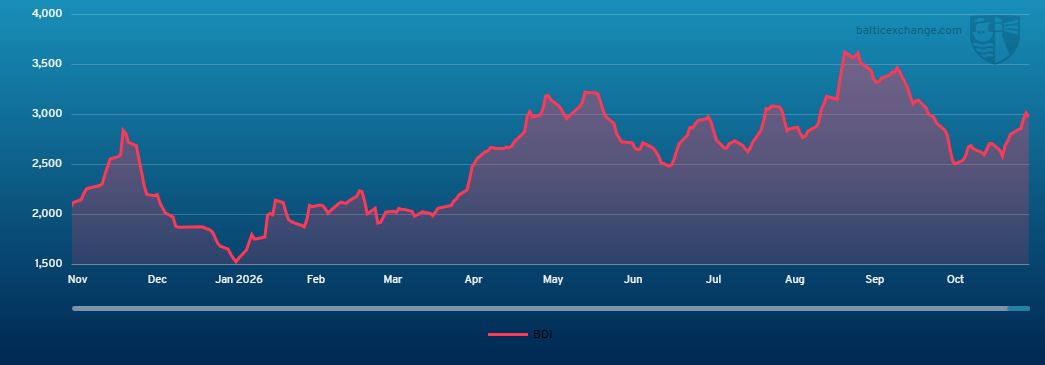
The Capesize market maintained a positive trajectory throughout the week, with the Pacific emerging as the clear driver of overall gains. Despite some midweek volatility, improving miner demand and increasingly competitive fixing levels saw C5 recover strongly, climbing from US$13.80 on Monday to US$15.20 by Thursday, before easing back to US$14.50–US$14.60 towards the end of the week. Activity picked up considerably, particularly from Wednesday onwards, with both Port Hedland and Dampier miners covering multiple cargoes and operators increasingly willing to pay into the low-mid US$15s. The Atlantic presented a more mixed picture. North Atlantic sentiment remained positive, supported by improving demand on the Transatlantic and Fronthaul routes, while the South Brazil and West Africa to China markets struggled to establish similar momentum. C3 levels softened as the week progressed, with fixtures slipping from around US$36 to US$35, reflecting limited index-date demand and a widening gap between bids and offers. Overall, the BCI 182 5TC built on its US$40,000 level, reaching a high of US$43,860 before closing the week at US$42,798. Pacific strength and North Atlantic resilience ultimately outweighed continued pressure in the South Atlantic.
Panamax-Kamsarmax
The market delivered contrasting performances this week, with the Atlantic maintaining a firm tone while the Pacific struggled to gain momentum. Strong transatlantic demand and limited prompt tonnage supported rates, with an 82,000-dwt fixing around US$18,000 for a US East Coast round trip and another at US$22,250 basis South Africa for an East Coast South America transatlantic trip. Increasing North Continent tonnage availability offered charterers greater flexibility, while an 82,000-dwt secured US$27,350 for a US Gulf fronthaul to China. East Coast South America remained supported by tighter early December tonnage, with an 83,000-dwt fixing at US$18,750 plus US$875,000 ballast bonus to the Far East and an 81,000-dwt at US$18,500 basis retroactive East Coast India delivery. Meanwhile, growing Pacific tonnage availability outweighed Australian mineral demand, with an 82,000-dwt fixing at US$22,500 early in the week compared with a 77,000-dwt at US$19,000 towards the close. North Pacific and Indonesian activity remained subdued, with an 82,000-dwt fixing at US$19,500 and a 76,000-dwt at US$17,000 respectively. Period activity included an 83,000-dwt fixing five to seven months at US$17,000 and an 81,000-dwt for one year at US$18,000, both basis Pacific delivery.
Ultramax/Supramax
After declining for two weeks, the 11TC average showed positive returns in the second half of the week due to an improving Atlantic market. The North American market saw extremely limited tonnage for November dates, with transatlantic rates flying to new highs as a 63,000-dwt fixed for grains US Gulf to Continent/Mediterranean at US$39,000 and a 64,000-dwt fixed for similar business at US$40,000. A 61,000-dwt fixed petcoke to the East Mediterranean at US$42,000, and a 64,000-dwt was said to have fixed on voyage on the same route in the mid US$40,000s. There were modest gains in the South Atlantic, whilst the Continent and Mediterranean markets remained steady in light trading. Rates slowly softened in Asia as NoPac grains slowed, with a 64,000-dwt fixed for a round voyage at US$21,000 and a 63,000-dwt concluded at US$27,000 basis North China via NoPac to Bangladesh, whilst backhaul demand remained strong. Further south, the market was affected by a weak Indian Ocean market with ballasting tonnage competing for Indonesian stems, with larger units switching attention to Australian cargoes for better returns. With a falling spot market in the East, there was limited period activity, however a modern 63,000-dwt still managed to fix a strong US$24,500 for 6 to 8 months basis delivery CJK.
Handysize
The week completed on a steady-to-firmer note, with sentiment largely positional across both basins. Across the Continent and Mediterranean, activity remained limited, although rates began to show signs of firmness towards the end of the week. The 37,000-dwt open Italy fixed for a trip to South Africa with charterers’ option WC India at low US$20,000. The US Gulf and South Atlantic showed healthier momentum, supported by fresh demand and a balanced cargo-to-tonnage position, with a number of fixtures reported, particularly from the US Gulf. A 39,000-dwt open Mobile fixed for a trip to UK with pellets at US$23,000, while a 37,000-dwt open Santos fixed via Brazil to Singapore–Japan range with parcels at US$24,000. Across Asia, sentiment remained positive, with activity gaining pace and several fixtures concluded above previous levels, supported by a generally healthy balance between tonnage availability and cargo demand. A 40,000-dwt open Tomakomai 14-16 Nov fixed via Japan to Taiwan with slag at US$19,500.
Clean
LR2
The TC1 75kt MEG/Japan index ultimately ticked up by 8 points this week to WS1016, while the corresponding Baltic round-trip TCE edged up by US$3,061 to US$298,000/day. For the TC20 90kt MEG/UK-Continent run, the index rose by US$264,000 to US$19.23 million, corresponding to US$297,300/day on Baltic round trip. The TC15 80kt Mediterranean/East index shed a further US$820,000 to settle at US$7.9 million, with the Baltic round-trip TCE falling by US$10,100 to US$63,400/day.
LR1
The TC5 55kt MEG/Japan index eased by 13 points this week to WS1005, converting to US$209,900/day on Baltic round trip. For a trip westward on the TC8 65kt MEG/UK-Continent route, the index fell by US$60,700 to US$14.63 million, while the Baltic round-trip TCE return declined by US$498 to US$223,200/day.
MR
The TC17 35kt MEG/East Africa index strengthened by 27 points this week to WS924. Additionally, the TCE increased by US$4,700 to US$119,500/day. On the UK-Continent, the TC2 37kt ARA/US Atlantic Coast index firmed a modest 4 points to WS198, with the corresponding Baltic round-trip TCE climbing by US$1,500 to US$13,800/day. In the US Gulf, the TC14 38kt US Gulf/UK-Continent index was shot down by 37 points to WS397 and the round-trip TCE declined by US$7,200 to US$55,700/day. The TC21 38kt US Gulf/Caribbean was cut down by US$201,000 to US$1.31 million, with the corresponding Baltic TCE falling by US$11,500 to US$48,100/day. The MR Atlantic Triangulation Basket TCE dropped from US$72,700/day to US$67,100/day.
Handymax
In the Mediterranean, the TC6 30kt Cross-Mediterranean index fell off by 54 points to WS363 this week, with the corresponding Baltic round-trip TCE dropping by US$15,000 to US$65,200/day. The TC23 30kt Cross UK-Continent index dipped down to WS382 then back up again this week to WS406, while the run’s TCE followed this to finally end back up at US$76,100/day.
VLCC
VLCC rates on the Baltic Exchange routes headed downwards again this week. The TD3C route (270,000 mt Middle East Gulf/China) has fallen 188 points since last Friday to WS1014.38, producing a daily round-trip TCE of US$1,078,714 for the standard Baltic VLCC. TD34 (Gulf of Oman/China) fell more sharply, losing 234 points to WS310.71, giving a round-trip TCE of US$307,160/day.
In the Atlantic market, the rate for the 260,000 mt West Africa/China route (TD15) lost 210 points to WS288.57, producing a round-trip TCE of US$267,748/day. Meanwhile, the US Gulf/China route (TD22) fell by over US$19.6 million to about the US$33.8 million mark, resulting in a daily round-trip TCE of US$247,973/day.
Suezmax
In the Suezmax sector, the market has fallen again this week across all the Baltic Exchange routes. The rate for the 130,000 mt Nigeria/UK Continent voyage (TD20) fell by 92 points to WS307.22, giving a daily round-trip TCE of about US$151,300. The TD27 route (Guyana/UK Continent, basis 130,000 mt) dropped 47 points to WS313.33, producing a daily round-trip TCE of just under US$157,600. The 145,000 mt USG/UKC route (TD33) fell over 20 points to WS267.22, giving a round-trip TCE of a little over US$155,600/day.
In the Black Sea, the 135,000 mt CPC/Augusta route (TD6) tumbled another 192 points to just below WS425, producing a daily round-trip TCE of just below US$305,000.
Aframax
In the North Sea, the rate for the 80,000 mt Cross-UK Continent route (TD7) fell 78 points to WS247.5, giving a daily round-trip TCE of just below US$141,300 basis Hound Point/Wilhelmshaven.
In the Mediterranean, the rate for the 80,000 mt Cross-Mediterranean route (TD19) fell by 15 points to WS267.78. Basis Ceyhan/Lavera, this produces a daily round-trip TCE of about US$86,000.
Across the Atlantic, rates fell again but not as heavily as a week ago. The 70,000 mt East Coast Mexico/US Gulf route (TD26) fell almost 36 points to WS310, giving a daily round-trip TCE of just over US$83,000. The 70,000 mt Covenas/US Gulf route (TD9) dropped 34 points to about WS302, producing a daily round-trip TCE of just over US$77,300.
The 70,000 mt US Gulf/UK Continent route (TD25) dropped 33 points to just below WS295, giving a round-trip TCE, basis Houston/Rotterdam, of about US$71,700/day.
On the Vancouver export routes, rates weakened again. The TD28 route (80,000 mt crude oil Vancouver to China) fell by US$1.115 million to US$8.565 million, producing a round-trip TCE of under US$171,300/day. The TD29 route (80,000 mt crude oil Vancouver to Pacific Area Lightering point off the USWC) fell 55 points to WS686.
LNG
The LNG spot market saw a mixed week, with the East remaining active and rates holding at a premium to the Atlantic. In the Atlantic, activity picked up across the US Gulf and West Africa, but extensive vessel availability and subdued cargo liquidity continue to limit upside.
On the BLNG1 Australia–Japan route, 174k cbm vessels edged up US$200 week-on-week to settle at US$54,600/day, supported by continued enquiry and a tighter tonnage list, especially for 2-Stroke vessels.
The BLNG2 US Gulf–Continent route weakened by US$5,200 to settle at US$29,900/day. Similarly, the BLNG3 US Gulf–Japan route saw a larger correction, falling US$8,200 to close at US$56,000/day. Although fixing activity has improved from the quieter levels, extensive tonnage availability and subdued liquidity continue to weigh on Atlantic sentiment.
In the time-charter market, the six-month rate held steady at US$44,200/day, while the one-year term eased US$1,167 to US$52,900/day. Further out the curve, the three-year period edged up US$500 to US$71,000/day.
LPG
The LPG market came under pressure this week, with narrowing arbitrage economics and a lengthening tonnage list weighing on sentiment across the board. Reduced cargo economics and softer fixing interest contributed to a general downward correction in freight rates.
The BLPG1 Ras Tanura–Chiba route settled at US$251.20/tonne, with TCE earnings closing at US$245,894/day.
The BLPG2 Houston–Flushing route weakened by US$6.33 week-on-week to settle at US$174.50/tonne, with TCE earnings falling US$8,401 to US$205,311/day. Growing vessel availability contributed to the downward pressure.
Similarly, the BLPG3 Houston–Chiba route declined by US$11.86 to close at US$310.86/tonne, while TCE returns dropped US$8,172 to settle at US$190,386/day, reflecting the weakening sentiment in the Atlantic market.
Container
The container shipping market experienced a relatively subdued week, with the Baltic Exchange’s four main east-west trades recording an average decline of 0.52%. Transpacific rates edged lower, with China/US West Coast falling 0.77%, while the East Coast remained unchanged. Asia–Europe rates also weakened slightly, with North Europe down 0.53% and the Mediterranean declining 0.79%. More broadly, spot rates remain under pressure, particularly on the Transpacific trades, where relatively subdued demand is making it increasingly difficult for carriers to maintain pricing levels.
Carriers continue to manage available capacity through blank sailings in an effort to limit further rate reductions. There are also attempts to introduce higher rates and surcharges during the second half of November, although it remains to be seen whether these increases can be sustained. Attention will now turn to booking levels as the market moves towards the end of the year, with carriers looking to build momentum ahead of the traditional pre-Lunar New Year shipping period. The extent to which demand improves will be an important factor in determining whether freight rates can stabilise or face further downward pressure.
Disclaimer:
While reasonable care has been taken by the Baltic Exchange Information Services Limited (BEISL) and The Baltic Exchange (Asia) Pte. Ltd. (BEA, and together with BEISL being Baltic) in providing this information, all such information is for general use, provided without warranty or representation, is not designed to be used for or relied upon for any specific purpose, and does not infringe upon the legitimate rights and interests of any third party including intellectual property. The Baltic will not accept any liability for any loss incurred in any way whatsoever by any person who seeks to rely on the information contained herein.
All intellectual property and related rights in this information are owned by the Baltic. Any form of copying, distribution, extraction or re-utilisation of this information by any means, whether electronic or otherwise, is expressly prohibited. Persons wishing to do so must first obtain a licence to do so from the Baltic.