

This article first appeared in The Edge Malaysia Weekly on November 16, 2026 - November 22, 2026

Francis Fukuyama became famous for announcing “the end of history”. That claim came in his 1989 essay, “The End of History?”, later expanded into the 1992 book, The End of History and the Last Man. As their titles helpfully give away, Fukuyama argued that history’s great ideological struggle was approaching its conclusion. With communist regimes across Eastern Europe under pressure and the Cold War nearing its end, liberal democracy appeared to have emerged as the victor.
History, of course, did not end there. Over the following decades, Fukuyama, too, revisited and qualified his argument, progressing beyond the finish line in The End of History and the Last Man.
In The Origins of Political Order, Fukuyama shifted his attention from the apparent endpoint of political development to the difficult process of building political order, asking how the state, the rule of law and political accountability come into being. In Political Order and Political Decay, he explored what happens when institutions become rigid, captured by powerful interests or unable to meet changing demands.
His later writing offered a different way of reading The End of History. Namely, the apparent triumph of a political ideal does not resolve the institutional problem of sustaining it. Even without a convincing rival, the institutions meant to uphold an order can weaken, become rigid or fail to adapt to changing conditions.
The same problem extends into economic development. Daron Acemoglu and James A. Robinson are among the economists most closely associated with the idea that institutions shape prosperity. Their seminal work, Why Nations Fail, places institutions at the heart of economic development.
Nations prosper, they argue, when political and economic institutions are inclusive, allowing people to participate broadly in economic activity and benefit from it. Conversely, they struggle when institutions become extractive, allowing elites to extract wealth and exclude others.
This is a powerful insight. Property rights matter, as does the ability to start and grow a business. And so, too, does the distribution of political power. Acemoglu and Robinson show why these institutional foundations can determine whether societies achieve prosperity.
That account, however, leaves a further question: what happens after a country develops institutions that seem to work?
A market can remain legally open while new firms find it increasingly difficult to enter. A regulator can retain its formal mandate while growing closer to the companies it regulates. An industrial policy that once helped young firms develop can become a permanent shield for companies that have stopped improving.
The institutional structure may look familiar but the incentives operating within it have changed.
Success makes this especially likely. Growing industries give rise to established firms with more to lose. Prosperity creates assets and livelihoods that people understandably want to protect. A country that once welcomed disruption may become more cautious about allowing it.
The point is not that prosperity carries an inherent danger, but that it changes the society that produced it and, in doing so, changes the conditions under which prosperity must be sustained.
This applies in the other direction too. Why do countries with mature legal systems, established rights and sophisticated public institutions sometimes lose economic momentum?
The answer is not necessarily that their institutions have become extractive overnight. It is that the arrangements created under one set of conditions are operating under another. The institutions may remain intact, but the incentives they generate can change as the economy around them changes. For instance, the pressure they generate for firms to improve might have weakened while barriers facing challengers have grown.
China presents another challenge to tidy explanations. Its political institutions do not fit a straightforward model of liberal inclusion, yet its economic transformation has been extraordinary. The question is not whether institutions mattered. They plainly did. The crucial distinction is whether the institutional arrangements that existed allowed firms to compete, invest, learn and expand, and how those arrangements changed over time.
Institutions therefore cannot be judged by the circumstances in which they were created or the labels attached to them. What matters is how they shape the behaviour of people and firms:
- Do they allow new entrants to challenge established firms?
- Do they reward investment in better methods?
- Do they expose failure instead of concealing it?
- Do they allow society to change arrangements that once worked but no longer do?
These questions give Fukuyama’s later work particular force. Political order has to be built, but it can also decay. Institutions that once served their purpose can become less effective as circumstances change. An institution cannot simply be judged by the circumstances in which it was created; it must also be judged by what it enables now.
The same principle applies to economic capability. A country may accumulate factories, skills, infrastructure and wealth without creating the conditions for firms to keep learning. Yesterday’s achievements can provide the foundations for tomorrow’s progress. But they can also become interests organised against change.
This is why the search for a single optimal institutional arrangement misses something essential. Even a good arrangement operates in an economy that it helps to transform. Its success alters the conditions under which it must work next.
Fukuyama was right to ask how political order develops and decays. Acemoglu and Robinson were right to insist that institutions shape prosperity. The question that follows is more demanding: why do some societies keep learning and adapting after they succeed, while others preserve the appearance of success but lose the forces that created it?
The difficulty, as we have seen here and explore further in The Economic Evolution, is that success itself changes the conditions that produced it. History does not stand still long enough for yesterday’s answer to remain sufficient.
Portfolio commentary
The Malaysian Portfolio fell 0.4% for the week ended Nov 11, faring better than the benchmark FBM KLCI, which declined 1.3%. The winners were Hong Leong Industries (+3.3%), United Plantations (+0.8%) and Maybank (+0.5%). On the other hand, Public Bank (-5%), OCK Group (-2.4%), Kim Loong Resources (-2%) and LPI Capital (-0.2%) ended in negative territory. Total portfolio returns now stand at 202.8% since inception. This portfolio is outperforming the benchmark FBM KLCI, which is down 12.8% over the same period, by a long, long way.
The Absolute Returns Portfolio too ended in the red last week, down 0.2%. As a result, total portfolio returns were marginally lower at 28.6% since inception. The top gainers were Talen Energy Corp (+15.9%), Schneider Electric (+3.6%) and Thermo Fisher Scientific (+1.6%) while Nvidia Corp (-13.2%), Microsoft Corp (-6.2%) and Singapore Tech Engineering Ltd (-1.6%) were among the biggest losers.
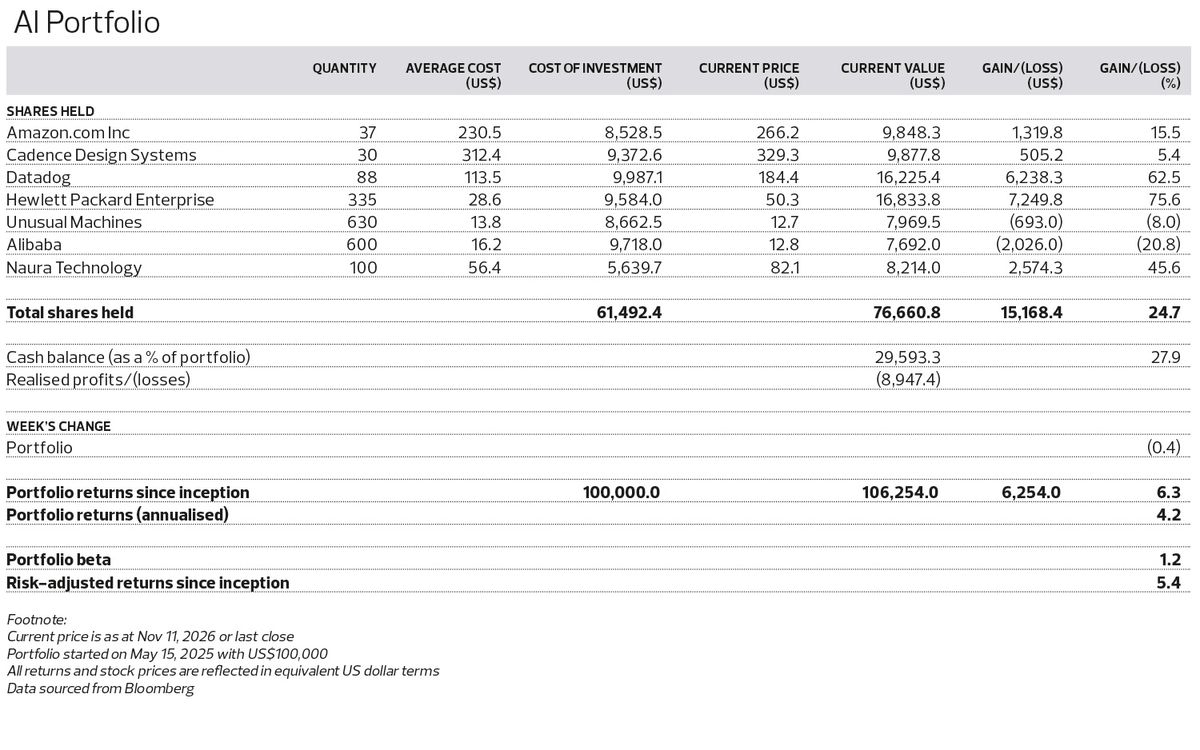
Meanwhile, the AI Portfolio was down 0.4%. Total portfolio returns now stand at 6.3% since inception following the recent tech sell-off. The big gainers last week were Naura Technology (+2.3%), Hewlett Packard Enterprise (+0.3%) and Amazon.com Inc (+0.1%) while the top losers were Unusual Machines (-2.9%), Datadog (-2.3%) and Cadence Design Systems (-0.1%).
Save by subscribing to us for your print and/or digital copy.
P/S: The Edge is also available on Apple's App Store and Android's Google Play.