

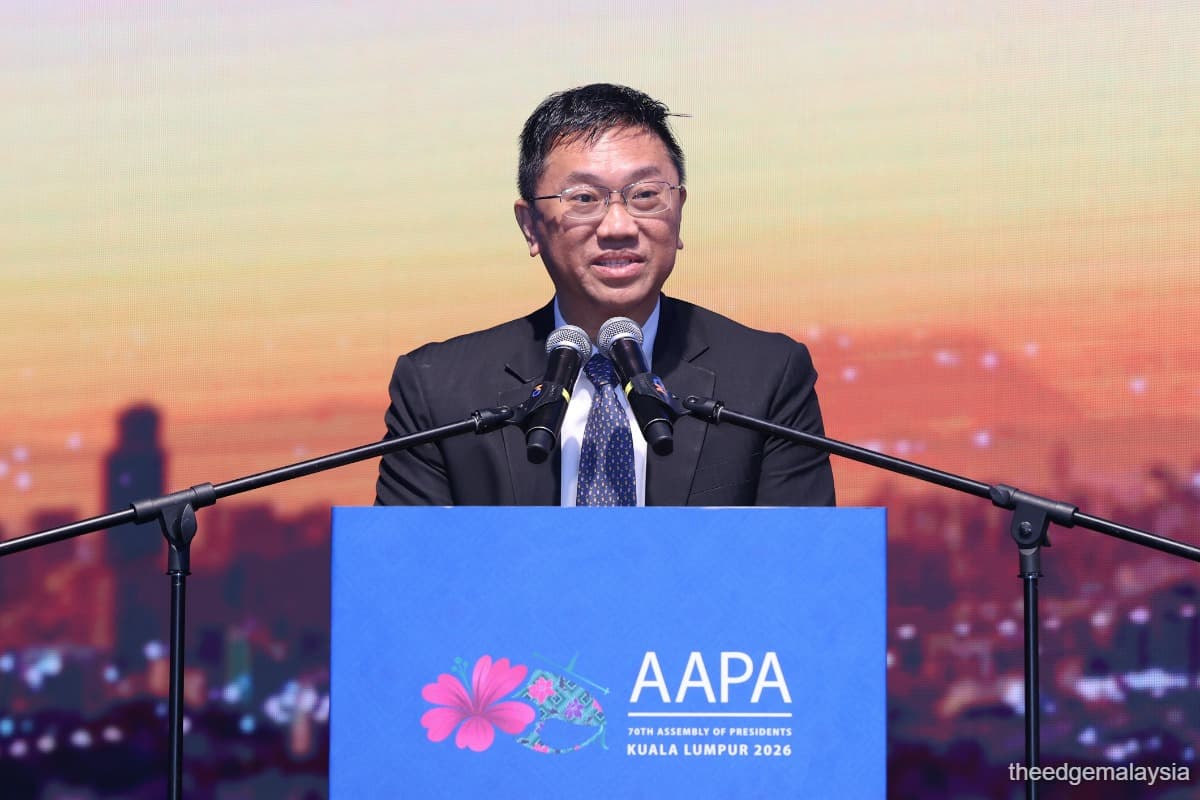
KUALA LUMPUR (Nov 13): The high cost and limited availability of sustainable aviation fuel (SAF) remain major barriers to the aviation industry's decarbonisation efforts, said Association of Asia Pacific Airlines director general Wong Hong.
To make the transition commercially viable, Wong said governments, fuel producers, airports, investors and other players in the aviation ecosystem must share the responsibility of supporting the shift to greener fuel, rather than leaving airlines to shoulder the costs alone.
"The reality is that the transition remains difficult, expensive and uneven. SAF is central to our industry's ambitions, but production capacity, availability and pricing remain significant barriers.
"Of course, we all want to fly greener. But at today's SAF prices, the challenge is to make sure we don't end up flying greener while our (airlines') financial performance turns redder," he said at the association's 70th Assembly of Presidents, hosted by Malaysia Airlines on Friday.
SAF is an alternative to conventional jet fuel that can be produced from sustainably sourced materials, including used cooking oil, biomass waste and agricultural residues, as well as renewable energy and captured carbon.
The International Air Transport Association estimates that it could contribute up to 65% of the emissions reductions needed for the aviation industry to achieve net-zero carbon emissions by 2050.
However, SAF typically costs two to five times more than conventional jet fuel, making its adoption a costly undertaking for airlines.
The industry's transition to greener fuel comes amid mounting cost pressures, particularly from soaring jet fuel prices amid the prolonged conflict in Iran. This has further squeezed airline margins, as carriers grapple with higher operating costs and limited ability to fully pass on the increases to passengers.
Beyond fuel costs, airlines are also facing supply-chain constraints that threaten their fleet expansion and operational efficiency.
Meanwhile, aircraft deliveries remain constrained, while engine availability and maintenance bottlenecks are affecting fleet utilisation. Prolonged delivery delays are also making capacity planning increasingly difficult, said Wong.
"The geopolitical landscape may evolve, but the underlying demand for connectivity across our region remains strong. We should therefore be realistic about the risks of today, without losing sight of the opportunities of tomorrow.
"We need the confidence to pursue growth despite uncertainty, the resilience to withstand shocks that may come our way, and the innovation to ensure that we emerge stronger rather than simply survive.
"Equally, when we collaborate, share knowledge and align our efforts, the strength of the whole industry becomes greater than the sum of its individual parts,” he added.