

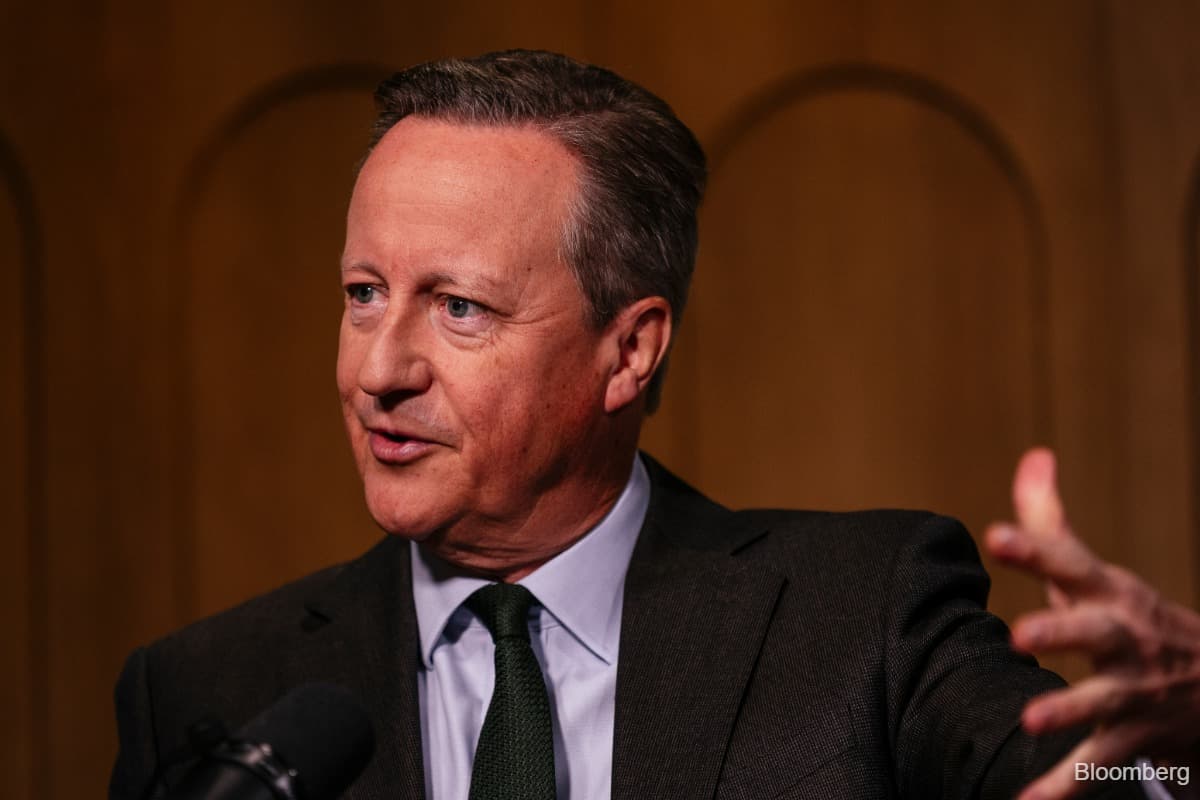
(Nov 12): David Cameron, the former prime minister who led Britain’s unsuccessful campaign to stay in the European Union, warned Prime Minister Andy Burnham against seeking to rejoin the bloc, arguing that it would undermine talks for closer ties.
Cameron, the Conservative Party leader who called the Brexit referendum in 2016 under pressure from the Euro-sceptic right, told Bloomberg’s Mishal Husain that he was “desperately disappointed” when Britain voted to leave the EU 10 years ago. Still, he said that seeking to reverse voters’ decision a decade later was the wrong approach.
“Instead of launching an argument about rejoining — which I think would be a very long and painful argument and who knows where it would end up — instead of that, focus on how do we be the best friend, best neighbour, best partner,” Cameron said in an interview on The Mishal Husain Show, due to be published in full on Friday.
The remarks by Cameron, who resigned as prime minister after his Remain campaign failed, come as Burnham rekindles the contentious debate about Britain’s relationship with the bloc. In a speech at the Labour Party’s annual conference in September, Burnham said “Brexit has done more harm than good”, subsequently adding that all options, including rejoining, were on the table.
Burnham’s move was seen as an effort to both unite a pro-European left while appealing to so-called One Nation Tories, who favoured remaining in the EU and made up Cameron’s base of support. The former Tory leader’s opposition to rejoining raises questions about how easy it will be for Burnham to use Brexit to split the center-right vote.
“I’m a democrat, a believer in democracy,” Cameron said. “We voted to leave.”
Cameron’s comments were countered by Labour Pensions Minister Torsten Bell, who told Bloomberg Radio: “I think most business leaders — particularly those that are exporters — will take with a pinch of salt anything from David Cameron, who of course went to Bloomberg to make his speech promising a referendum on the EU more than a decade ago.”
“He’s left the country with a Brexit deal that I don’t think anybody thinks works for British firms or for British workers,” Bell said on Thursday.
Cameron set Britain on the path to leaving the EU in a 2013 speech at Bloomberg’s European headquarters in London, pledging to hold a plebiscite if reelected. After winning a majority in 2015, Cameron secured reforms from Brussels, including an “emergency brake” on welfare payments to European nationals, saying improved terms were needed if he were to persuade Britons to stay.
On June 23, 2016, the electorate rejected Cameron’s package and voted to leave, by 52% to 48%. The departure cost Britain between 2% and 4% of gross domestic product, according to a Bloomberg Economics analysis published in June, and recent polls show majorities in favour of rejoining.
Cameron’s resignation also ushered in a period of political instability for Britain, as it grappled with economic shocks, tense negotiations with Brussels and fraught debates about the country’s future outside of the EU. The UK has seen six prime ministers enter 10 Downing St since he left.
Burnham is gearing up for a UK-EU summit in Brussels later this month during which envoys are hoping to seal deals on a youth mobility programme, an agrifood deal and linking emissions markets. Britain is also seeking access to the EU’s “Made in Europe” drive.
In addition, the premier has promised to make an intervention “around” the time of the summit to spell out proposals for further EU rapprochement. He and his office have made clear that options on the table include joining the EU’s customs union, its single market, or even accepting uncapped immigration as a full member of the bloc again, a prospect that’s contentious with the electorate.
Burnham reaffirmed his desire for closer ties with Europe during his weekly question session in the House of Commons on Wednesday, saying he was focused first on a deal that could add 0.4% to GDP. “Any growth on that scale is worth taking,” he said, adding, “we will take it and we will seek that deal”.
But Cameron, who served as foreign secretary under Prime Minister Rishi Sunak from 2023 to 2024 and holds a seat in the House of Lords, warned that “flirting with rejoining” could have the opposite effect.
“You’re in danger of getting a less good partnership deal because of course the EU countries will just think: ‘Well, these guys are going to rejoin anyway, so what’s the point in giving them a good partnership deal,’” Cameron said.
The former premier’s remarks chime with those of Business Secretary Jonathan Reynolds, who the day before Burnham’s intervention at the conference had warned against the uncertainty reopening the debate on Europe could create. Reynolds’ cabinet colleague, Lisa Nandy, also hinted at wariness about the premier’s approach.
“I do not believe that anybody wants to repeat circular arguments about ‘in or out?’ ‘leave or remain?’” Nandy told the BBC on Sunday. However, she added that “I really don’t think you can put a piece of paper between me and Andy Burnham, who is a good friend of mine, on this.”
Cameron also pushed back against options that stop short of rejoining the EU, disagreeing with his former chancellor, George Osborne, who has advocated rejoining the customs union. That would require the UK to scrap all other trade deals it has negotiated since Brexit, Cameron said. He argued the EU was not the answer to all of Britain’s economic woes.
“If you look at the economic problems we have today, I don’t really think they’ve got anything to do with Brexit at all,” Cameron said. “Our economic problems are: we are overspending, over-borrowing, over-taxing, over-regulated, and far too much being spent on working age welfare. Those are a set of problems that have nothing to do with Brexit.”
Uploaded by Chng Shear Lane