

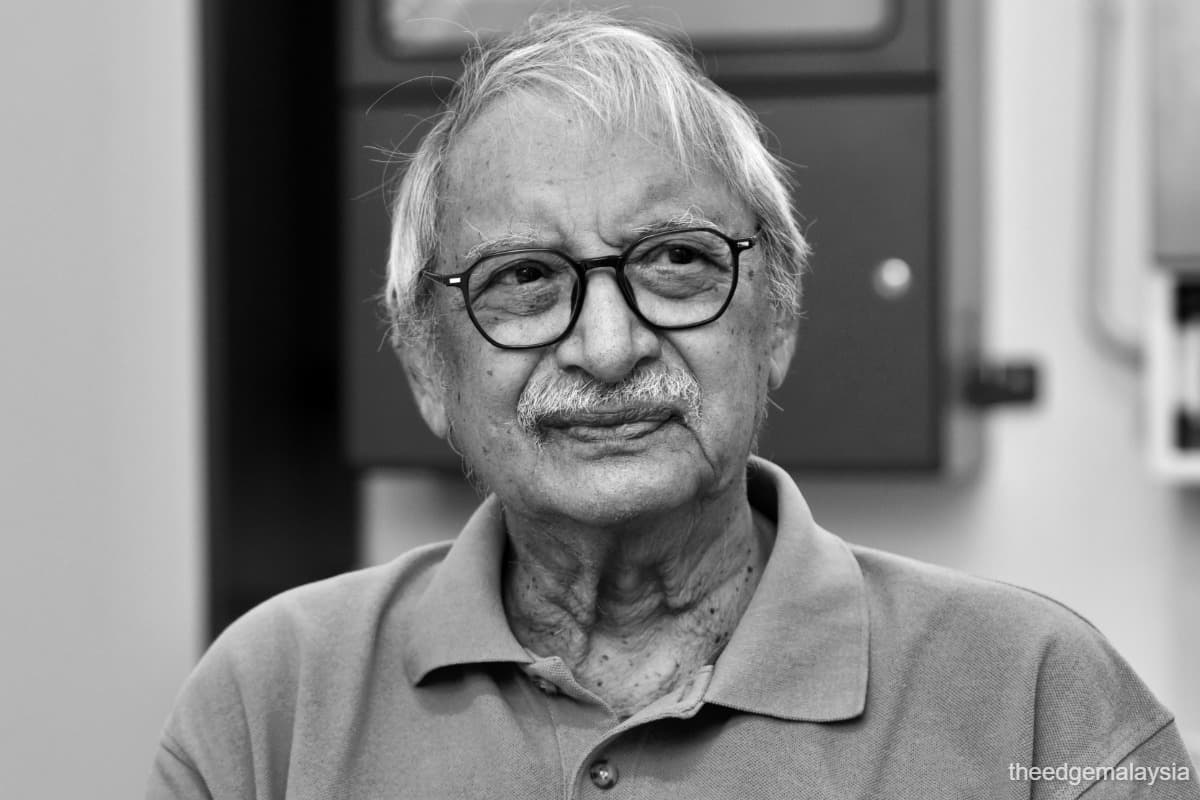
DATUK Seri Chet Singh passed away on Nov 10, and I regret that election campaigns in Melaka and parliamentary duties do not allow me to attend his funeral in Penang.
This great man was the architect of Penang’s industrialisation, turning the muddy paddy fields in Bayan Lepas into a destination for the global outsourced semiconductor industry, which until today is highly relevant, especially in the context of chip war and an artificial intelligence boom.
I remember that on the day former Penang chief minister Tun Dr Lim Chong Eu passed away in November 2010, I sat across Chet at Penang Institute’s board room, watching him pen an emotional obituary for the transformative leader. It was just the both of us in the room.
That episode is etched on my mind. I told myself that one day when Chet goes, I will find a corner to sit down to write, reminisce, and thank him for his contributions to Penang and the nation, and his kindness and inspiration to me.
After graduation, Chet, who was born in 1936, was a young and competent federal civil servant rotated to various ministries, including the Defence Ministry, as well as the Home Ministry which was then led by Tun Dr Ismail Abdul Rahman.
Shortly after turning 30, he was appointed Penang’s State Financial Officer. In 1968, Wong Pow Nee’s Alliance government proposed a piece of legislation to form the Penang Development Corporation (PDC). During the debate in the state assembly, the then opposition leader Chong Eu thrashed the idea.
Less than a year later, to Chet’s bemusement, one of Chong Eu’s first acts as the new chief minister was to make PDC a reality and the main vehicle for Penang’s development. And to his surprise, he was made the first general manager to lead the agency for two decades until Chong Eu lost in the 1990 general election. Chet was later appointed senator for one term, recommended by Barisan Nasional’s Gerakan.
Among the semiconductor folks in Penang, there’s a story that many of them remembered. When Intel founder Andy Grove got his car stuck in the mud while visiting the construction site of Intel’s first-ever overseas plant, Chet, who was by his side, quickly ensured that PDC set up an engineering arm to do public works in the industrial areas, in case the Public Works Department (JKR) failed to keep up with the pace of investors.
In 2007, my good friend and contemporary from the Australian National University, Dr Francis Hutchinson (currently coordinator of the Malaysia Studies Programme at the ISEAS-Yusof Ishak Institute) passed me his PhD thesis comparing the development of supply chains in Penang and Bangalore, India. That was the first time I learnt about PDC’s works in detail as well as Chet’s massive role in shaping industrial development in Penang. In fact, Penang pioneered the export-oriented industrialisation model adopted by the Tun Abdul Razak Hussein government at the federal level. Prior to the 1970s, the industrial model was focused on import-substitution.
When Penang lost its free port status in 1967, the unemployment rate was 17% at one point. The PDC-led industrial development effort in the early 1970s was decidedly about creating better jobs with better pay for Malaysian workers, which is something that contemporary economic leaders must remember. Chet was also passionate about skill development for Malaysian workers, leading him to help establish the Penang Skill Development Centre in 1989. He also cared very much about technology transfer from foreign firms to Malaysian companies, both during his time in office and post-retirement, another point which I always kept in mind.
What I did not anticipate was that in the 2008 general election I would contest and win a parliamentary seat in Penang in what was termed an electoral tsunami that would bring DAP, then a permanent opposition party, to power in the state.
Then newly elected chief minister Lim Guan Eng assigned me to handle the state government think tank Socioeconomic and Environment Institute (SERI, renamed as Penang Institute since 2012), of which Chet was among the founders in 1997 and continued to serve on its board until his passing. He served selflessly while living a frugal life.
During my early days as a member of Parliament, I spent many hours with Chet to learn about Penang’s industries. Guan Eng accepted my recommendation to appoint him as chief minister’s adviser on PDC, enabling him to contribute ideas to the state development from within the government for almost a decade. In 2010, recognising his contribution to Penang, Guan Eng as chief minister recommended him to be awarded the Dato’ Seri title by the Yang di-Pertua Negeri.
Even when I left Penang to contest in Johor in the 2013 general election, I still took time to visit Chet. Whenever Penang Institute’s Datuk Dr Ooi Kee Beng and I visited him, his wife Bhajan would prepare breakfast for us. During those deep conversations, he expressed his sincere and candid views about the future of Penang’s industries, and the nation’s well-being and prospects.
His vision, integrity, and life works reshaped the industrial landscape of Penang and Malaysia, provided meaningful jobs for generations, and laid the foundation for Malaysia to scale the technology ladder in the global semiconductor sector.
Thank you, Datuk Seri Chet Singh. My deepest condolences to Bhajan, Sunita, and Anil. May Waheguru ji give you strength to bear the loss, and grant peace to the departed soul.