

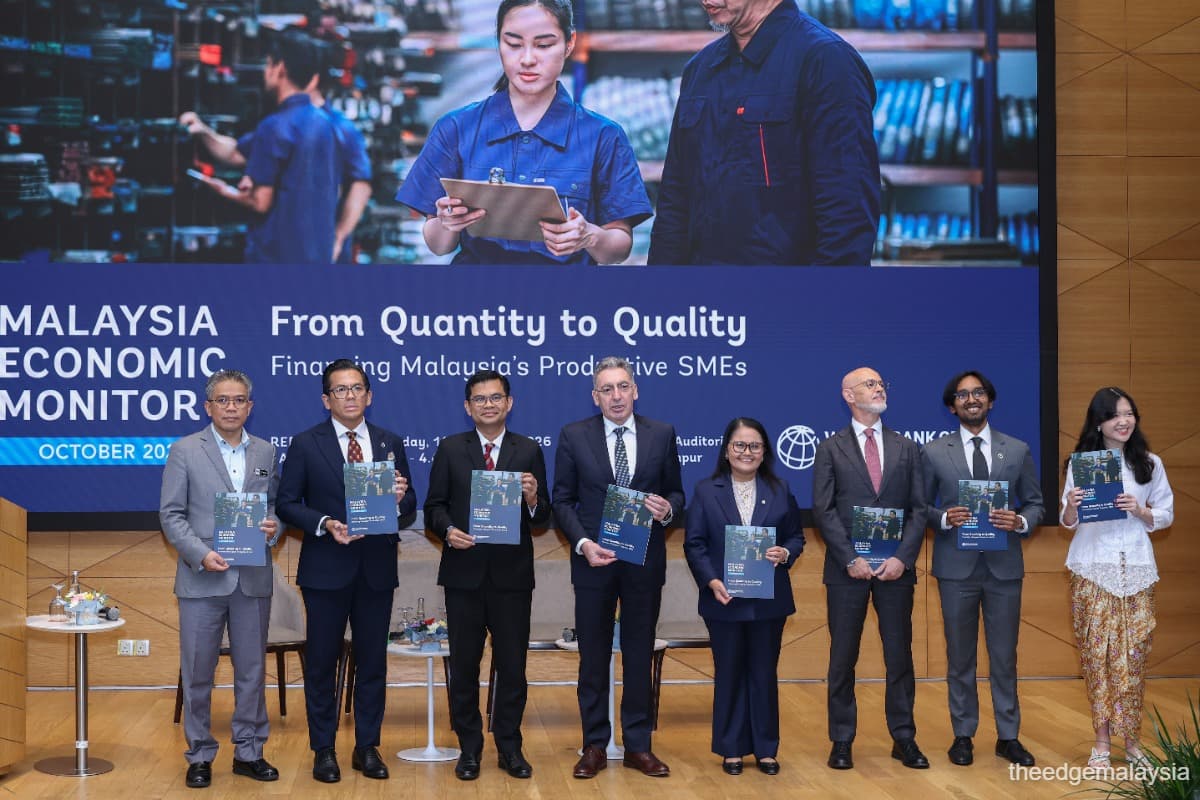
(From left) Economy Ministry deputy secretary general Che Kodir Baharum, Deputy Minister of Economy Datuk Indera Mohd Shahar Abdullah, Minister of Economy Akmal Nasrullah Mohd Nasir, World Bank Group division director Dr Zafer Mustafaoglu, acting country manager Lamtiurida Hutabarat, senior economist Dr Pietro Calise, economist Deisigan Shammugam and research analyst with the fiscal policy and growth team Fionne Lim at the launch of the World Bank's October 2026 Malaysia Economic Monitor (Photo by Low Yen Yeing/The Edge)
KUALA LUMPUR (Nov 11): The World Bank said Malaysia should allow small and medium enterprises (SMEs) to use equipment, receivables and inventory as collateral to secure financing, instead of relying mainly on land and buildings.
The bank's division director for the Philippines, Malaysia and Brunei, Zafer Mustafaoglu, recommended operationalising the movable property security interest regime and establishing a unified, notice-based movable-collateral registry.
He said the proposed framework would allow more SMEs to use equipment, receivables and inventory as loan security.
"This is not a story of firms being turned away from banks. Rather, it is a story of specific, identifiable frictions," he said at the launch of the World Bank's October 2026 Malaysia Economic Monitor on Wednesday (Nov 11).
“The question is not simply about whether SMEs can access credit but whether the finance available to them actually matches the productive and innovative investment they need to make," said Mustafaoglu.
This, he added, is vital for Malaysia's transition towards productivity-led growth, enabling technology adoption, innovation, business upgrading, and other investments that depend more on future productive capacity than on existing collateral.
The report, titled From Quantity to Quality: Financing Malaysia's Productive SMEs, identified three main constraints for SMEs obtaining financing: limited ability to pledge movable assets such as equipment and receivables as collateral, difficulties for lenders in assessing firms without conventional credit histories, and a shortage of financing suited to higher-risk, longer-term or intangible-intensive investments.
Beyond collateral reform, the World Bank recommended that Malaysia introduce standardised annual reporting on public SME financing instruments, covering their exposures, pricing, losses and outcomes.
The third recommendation was to pilot higher-risk financing instruments, including guarantees and risk-capital measures, with sound pricing and meaningful private-sector risk retention.
Mustafaoglu said strengthening measures would help channel financing towards productive SMEs without exposing the public sector to risks it was not equipped to manage.
“Well-financed, productive SMEs would create better jobs and a stronger financial ecosystem would drive the next wave of productivity-led growth,” he said.
Rebuilding fiscal buffers amid global uncertainty
Mustafaoglu urged Malaysia to continue rebuilding its fiscal buffers to strengthen the country's resilience against future economic shocks, as geopolitical conflict, trade tensions and softer global demand could weigh on trade and confidence.
“As a highly open economy, Malaysia remains exposed, especially through trade and financial channels,” he said.
Mustafaoglu said the outlook for Malaysia's economy remained positive, supported by employment gains, targeted fiscal support and continued investment activities.
The bank last month raised its 2026 economic growth projection for Malaysia to 5.1%, from 4.4% previously.
Securing financing suited to needs
Also present at the launch was Economy Minister Akmal Nasrullah Mohd Nasir, who said Malaysia risked losing opportunities for innovation, scale and stronger national productivity if productive firms could not secure financing suited to an innovative, longer-term or intangible investment.
He said Malaysia's longer-term ambition is to enable productive SMEs to scale up, adopt advanced technologies and participate in higher-value activities.
"Success must be reflected not only in financing volumes or firm-level output but also in stronger capabilities, more competitive wages and sustainable, high-income jobs for Malaysians," he added.
The report revealed a funding gap between smaller firms and larger businesses.
Bank financing accounted for around 28% of fixed investment among SMEs, compared with approximately 50% among large frontier firms.
Akmal said the comparison between SME and large frontier firms underlined the need to examine whether financing arrangements were sufficiently responsive to businesses with growth potential, rather than assuming that credit availability alone was enough.