

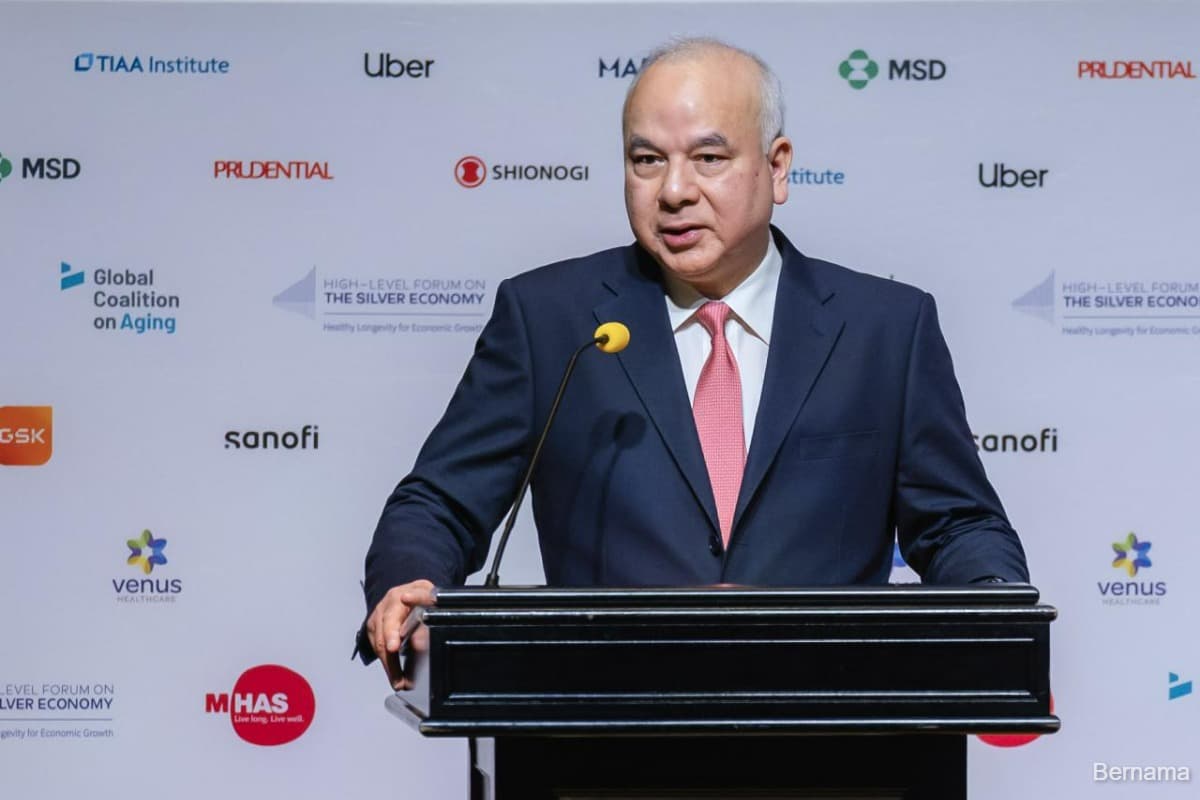
KUALA LUMPUR (Nov 11): The Sultan of Perak, Sultan Nazrin Shah, has emphasised that healthy ageing must be inclusive and cannot become a commodity available only to those who can afford it.
The Sultan said that while modern civilisation has achieved longer lifespans, the ability to age with health, dignity and purpose should not depend on personal wealth.
"Economic consumption must never be the metric that validates human life. The silver economy must be understood not merely as a marketing frontier for older consumers, but as a structural realignment of our economy towards inclusivity, innovation and social stability.
"True inclusion requires concrete, practical application. Healthy ageing cannot become a commodity available only to those who can afford it," he said in his royal address, titled The Silver Economy: A Foundation for Shared Prosperity, at the High-Level Forum on the Silver Economy 2026: Healthy Longevity for Economic Growth on Wednesday.
Sultan Nazrin said that if a longer, healthier life is among the crowning achievements of modern civilisation, the fruits of that achievement must not depend on the balance of one's bank account.
The Sultan said society is ultimately judged by whether the opportunities it creates remain within the reach of its most vulnerable citizens.
Sultan Nazrin also called for environments to be designed to actively preserve human capability rather than merely accommodating decline.
"Healthy ageing requires the right infrastructure, not simply the right services. We can no longer treat housing, healthcare, financial security, and technology as separate areas of policy. They are interconnected corridors in the same lived environment," he said.
The Sultan said public policy must not be restricted to institutional medical care, but should be geared towards cultivating integrated communities where senior citizens can remain active and independent while receiving stepped-up support as their needs change.
Sultan Nazrin cited findings from Malaysia's National Health and Morbidity Survey published earlier this year, which revealed that only 14.7% of Malaysians aged 60 and above met the criteria for ageing well.
"This figure, which represents the gap between lifespan and healthspan, should give us pause. It underscores the argument of Dr Atul Gawande, the surgeon and public health writer: 'Our ultimate goal, after all, is not a good death but a good life to the very end'. This objective forces us to look beyond mere survival statistics and confront the core architecture of longevity," he said.
Sultan Nazrin said viewing an ageing population solely through the narrow lens of expenditure overlooks the immense social and human capital that healthier ageing preserves.
Citing Malaysia's Care Strategic Framework, the Sultan said analysis shows that every ringgit invested in care can generate up to RM7 in wider economic returns through gains in growth, employment and income.
"A longer-lived population is a vast repository of accumulated wisdom, institutional memory, and mentorship. We must never treat age and dependency as synonymous. They are not," he said.
Referring to the Kuala Lumpur Declaration on Ageing: Empowering Older Persons in Asean, Sultan Nazrin said healthy ageing must be inclusive by design, ensuring equitable access to healthcare, public services and preventive measures across all stages of life.
At the event, Sultan Nazrin received the Baroness Sally Greengross Award for Healthy Longevity Innovation from Global Coalition on Aging chief executive officer Michael Hodin.
Uploaded by Chng Shear Lane