

This article first appeared in The Edge Malaysia Weekly on November 9, 2026 - November 15, 2026
AMS Advanced Material Bhd (KL:AMS) is looking to move up the value chain as the semiconductor investment boom drives demand for its aluminium products and processing services.
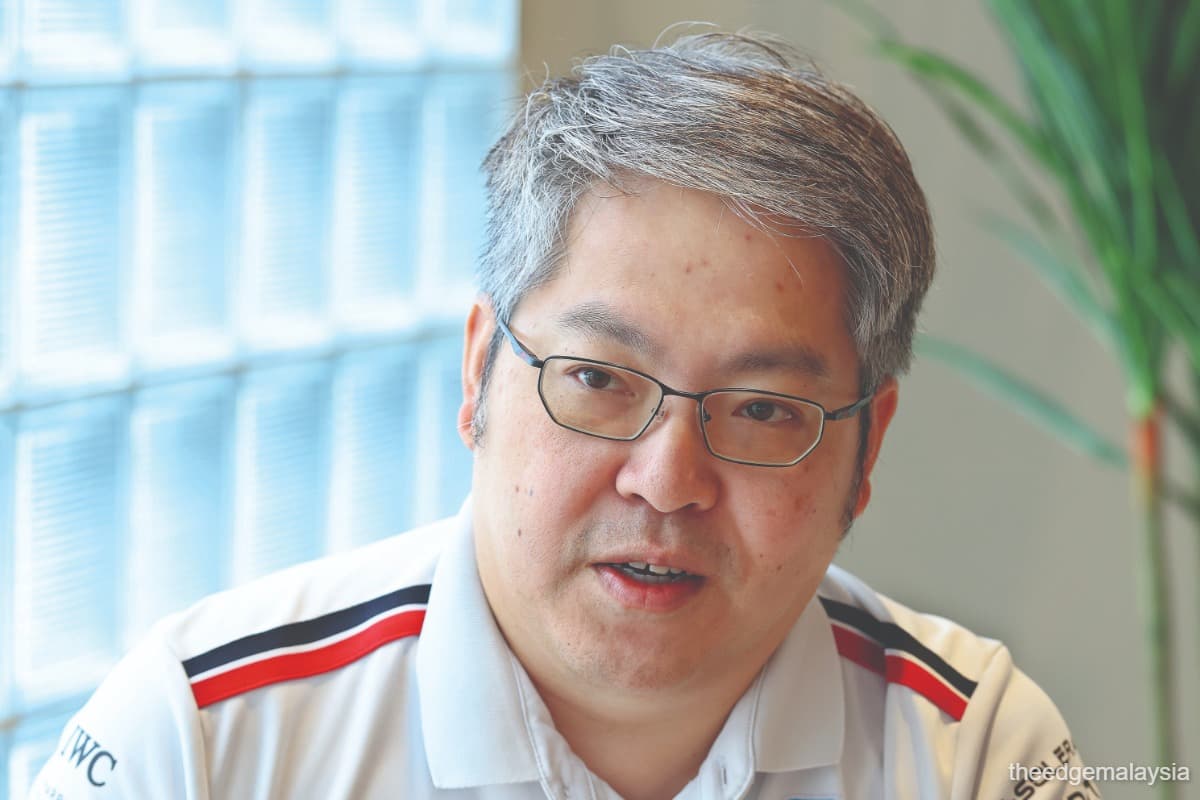
“The markets are all full, and clients were asking whether we could do more pre-machining to enhance their production efficiencies. On top of normal cutting and sizing, there is strong demand for us to do pre-machining works like roughing, side milling and vertical simple drilling,” group managing director Keith Keh Teng Yang tells The Edge in an interview.
He describes the current semiconductor cycle as the strongest he has witnessed since joining the business in 2013.
“This is the strongest boom. I definitely see 2027 bringing our strongest growth,” he says, noting that AMS has already secured purchase orders up to May next year.
This optimism is underpinned by rising semiconductor capital expenditure (capex) as global chipmakers transition from one technology generation to the next, which requires existing equipment to be upgraded or replaced. “When there is a change in technology or a revolution, the machines have to be changed. That drives the capex,” says Keh.
Expanding processing capabilities, capacity
AMS specialises in the supply and value-added processing of non-ferrous industrial metals, primarily aluminium. Its clientele spans the aerospace, marine, automotive, construction, consumer products and semiconductor industries.
For the semiconductor industry, the group supplies machining houses that serve front-end and back-end equipment manufacturers, which gives it direct exposure to global capex trends.
AMS’ semiconductor and engineering support segment contributed 59.2% to the group’s revenue in the third quarter of the financial year ended Sept 30, 2026 (3QFY2026) — a sharp rise from 36.9% in FY2025, 31% in FY2024 and 8.7% in FY2023.
The group is expanding its physical footprint to meet the rising demand. Its Penang facility is currently running at full capacity, with extended working hours and a second shift, while its smaller Johor plant has seen utilisation jump from about 75% to 100% following orders from a new semiconductor customer.
To accommodate further growth, AMS is setting up a new plant in Penang that will double the floor space of its main facility. Scheduled to begin operations in 1Q2027, the plant will house 10 new machines, including three-axis machining equipment that will enable the group to undertake preliminary metal preparation or pre-machining operations, such as roughing, drilling and side-milling.
These capabilities will allow the company to carry out more initial processing before materials are delivered to its machining-house customers for higher-end finishing work. By outsourcing preliminary work, the machining houses can improve production efficiency and reserve their more sophisticated and expensive machines for higher-value tasks.
AMS is careful not to compete directly with its own customers which undertake more sophisticated machining for semiconductor equipment manufacturers. “Our value proposition is that we are the material supplier and the processor,” says Keh.
The additional processing capabilities could also improve profitability by allowing AMS to capture more value from each order. Its gross margin rose to 16.8% in the first nine months of FY2026, from 15.6% in FY2025 and 13.2% in FY2024.
Keh hopes the expansion will push the group’s profit before tax margin from high single digits into double-digit territory.
Securing business directly from OEM and geographical expansion
Besides serving machining houses, AMS is increasingly pursuing jobs directly from original equipment manufacturers (OEMs), particularly across the US and Europe.
The group has secured a European OEM customer and is already receiving orders. It is also supplying US machining houses as multinational corporations (MNCs) diversify supply chains under the “China-plus-one” strategy.
The new Penang facility is intended to support these opportunities, broadening AMS’ customer base and bringing it closer to end customers.
Keh sees Penang becoming an increasingly important semiconductor hub in the region as MNCs continue investing in the state, creating opportunities for local suppliers to expand alongside them. He likens the development to Taiwan’s semiconductor ecosystem, where clusters of equipment manufacturers, OEMs and suppliers reinforce one another.
Notwithstanding the present opportunities, AMS is taking a measured approach to capacity expansion. Rather than investing heavily based on forecasts from a single customer, it wants to ensure new machines can serve multiple customers and applications. “We don’t simply build capex for one client,” says Keh.
The new machines are being funded by cash and the proceeds from its initial public offering (IPO), without taking on additional debt, he adds.
AMS also maintains a diversified customer base, with no single top-five customers accounting for more than 10% of its overall revenue.
Listed on the ACE Market in April this year, AMS raised RM32.77 million in gross IPO proceeds, of which RM22.99 million remains unutilised. The group is in a net cash position, with RM40.98 million in cash against total borrowings of RM31.94 million.
With material lead times stretching six to seven months, AMS must make procurement decisions well ahead of delivery. Given the semiconductor industry’s cyclical nature, the group takes a cautious approach to inventory management, replenishing stocks based on only 60% to 70% of expected demand, says Keh.
Scrap collection adds another growth avenue
AMS is entering the aluminium scrap collection and processing space as the group sees an opportunity to collect scrap generated by machining activities from its customer base — which number roughly 900 companies now — process it and sell it directly to smelters.
Its subsidiary, AMS Ecogreen Sdn Bhd, has obtained the necessary licences to commence operations. The group plans to start by processing about 17 tonnes of scrap a month and targets to scale towards 40 tonnes a month as volume grows.
By avoiding smelting itself, AMS avoids heavy energy overheads and additional compliance requirements, while opening a high-margin, sustainable revenue stream.
“We see this scrap collection is good, not just for sales revenue or profit. The venture offers both commercial and environmental benefits by recovering material that would otherwise be discarded, and supporting customers’ sustainability objectives,” says Keh.
For now, AMS intends to establish a consistent supply base before considering further expansion into the business.
Diversification provides a buffer
While semiconductor-related demand is taking centre stage, AMS continues to serve customers in the aerospace, automotive and transport, construction and consumer-related industries. This provides the group some flexibility in deploying processing capabilities if demand in one sector weakens.
These industries are not expected to contribute equally to growth.
For example, Keh sees limited upside from automotive clients, partly because Chinese automakers assembling vehicles in Malaysia tend to bring in their own components. This limits opportunities for local component suppliers despite the expansion of electric vehicle manufacturing.
AMS has also faced softer aerospace demand as geopolitical tensions and flight disruptions affect customers with exposure to the Middle East.
Marine is a more promising niche. The group supplies aluminium products to vessel builders, including those involved in crew-transfer vessels servicing offshore wind farms in Taiwan and South Korea. It has also secured new orders from Batam and sees Indonesia as a potential area of focus in 2027.
For all its optimism, Keh acknowledges that Chinese competition remains a key challenge for Malaysian manufacturers.
AMS has been approached by Chinese automotive companies for potential business but it has walked away from some opportunities because the margins were too thin to justify the working capital and capacity required. The challenge, he says, is competing with Chinese manufacturers that can operate on thinner margins and exert significant pricing pressure, making it difficult for Malaysian small and medium enterprises to compete on cost alone.
AMS prefers customers that are willing to grow alongside the group, rather than compete purely on price. This means customers that are more collaborative and willing to support suppliers’ capex as they expand their operations, says Keh.
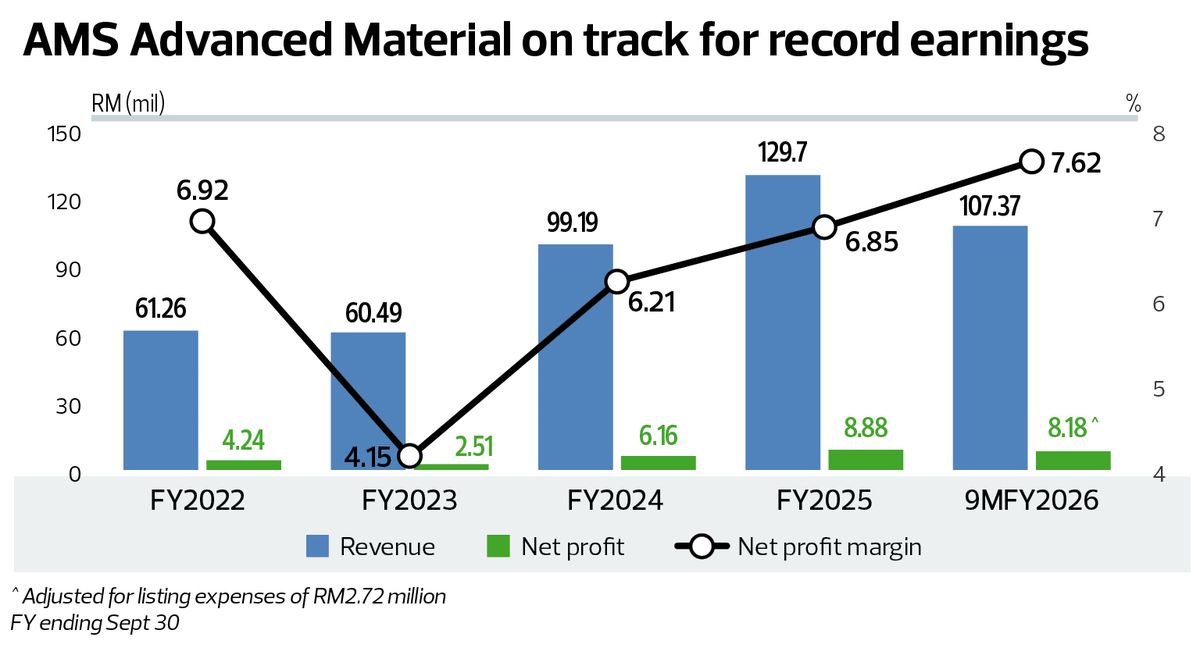
Financially, the group has achieved steady growth. Both net profit and revenue grew at a three-year compound annual growth rate of 28.4% between FY2022 and FY2025, with its bottom line rising from RM4.2 million to RM8.9 million, as the top line climbed from RM61.3 million to RM129.7 million.
For the first nine months of FY2026, the group’s net profit (adjusted for listing expenses) amounted to RM8.2 million, with revenue coming in at RM107.4 million. Annualising these figures would imply full-year revenue of about RM143.2 million, up 10.4% from FY2025, with an adjusted net profit of RM10.9 million, up 22.7%.
The group’s share price has gained 27.6% from its IPO price of 29 sen since its ACE Market listing on April 23 to close at 37 sen last Tuesday.
At a market capitalisation of RM226.4 million and based on indicative annualised net profit of RM10.9 million, the shares are trading at an indicative price-earnings ratio (PER) of 20.8 times. No analysts currently cover the stock.
Keh is the largest shareholder of AMS, with total equity interest of 74.05%, held mainly through investment vehicles AMS Metal Group Sdn Bhd, which owns 51.27% of the group, and Wisdom Partners Sdn Bhd, which holds 22.59%.
Keh owns 56% of AMS Metal Group, while Tan Chee Yuen, Lee Boon Kean and See Cherng Jye have 20.5%, 13.5% and 10% respectively. Wisdom Partners is a wholly-owned subsidiary of AMS Metal Group.
Save by subscribing to us for your print and/or digital copy.
P/S: The Edge is also available on Apple's App Store and Android's Google Play.