


This article first appeared in The Edge Malaysia Weekly on November 9, 2026 - November 15, 2026
GLOBAL port congestion is becoming an entrenched feature of the shipping industry rather than a temporary fallout from the Covid-19 pandemic as geopolitical tensions, extreme weather and shipping route disruptions continue to unsettle vessel schedules and create unpredictable arrival patterns.
“Port congestion has become more frequent in recent years. I believe this is the new normal,” Westports Holdings Bhd (KL:WPRTS) group managing director Datuk Eddie Lee Mun Tat tells The Edge.
Typhoon Saudel has severely disrupted major Chinese ports including Ningbo and Shanghai since late August, adding to congestion caused by a series of recent storms. Meanwhile, drought conditions linked to the El Niño climate phenomenon have prompted the Panama Canal to restrict daily vessel transits since early September.
The disruptions have compounded pressure on global shipping capacity, with carriers increasingly forced to reroute vessels and adjust sailing schedules.
Shipping companies such as MTT Shipping and Logistics Bhd (KL:MTTSL) expect freight rates to remain elevated into 2027, underpinned by geopolitical uncertainty, weather-related disruptions and persistent port congestion. The Drewry World Container Index showed spot freight rates rising 143% year on year (y-o-y) to US$4,429 per 40ft container as at Oct 29, 2026.
“Typhoons have become more disruptive, forcing port closures and causing vessels to bunch up as operations resume. Port congestion is absorbing an estimated 14% to 15% of global container shipping capacity,” MTT Shipping co-founder and managing director Ooi Lean Hin told The Edge recently.
Extreme weather is only part of the problem. Geopolitical tensions are also reshaping global shipping routes, with the Iran conflict disrupting trade through the Strait of Hormuz and Houthi attacks in the Red Sea forcing shipping lines to divert vessels around the Cape of Good Hope, Westports’ Lee says.
“We can expect to see more extreme weather, but it is not only extreme weather that poses significant operational challenges to port terminals. Weather is just a small part of it, with geopolitical tensions being a bigger factor,” says Lee.
The resulting disruption has made vessel arrivals increasingly difficult to predict, with major transhipment hubs such as Singapore, Port of Tanjung Pelepas (PTP) and Port Klang experiencing intermittent congestion.
“The arrival pattern of vessels these days is that you don’t have a pattern anymore,” Lee says.
For Westports, the situation remains manageable. Lee says vessels calling at the terminal are generally able to complete their turnaround within a day, which he considers a good performance, given the increasing unpredictability.
The industry’s tolerance for delays has also shifted.
“Many years ago, even a few hours’ delay, like five to 10 hours, would make shipping lines kick up a fuss. Now, even with a one-day delay, they are not complaining at all. I think this is normal already,” says Lee.
The persistent disruptions have also helped keep ocean freight rates elevated, benefiting shipping companies.
“If you take a look at the last six years, from Covid-19 to the Red Sea crisis and then the Iran war, every year you have something to keep ocean freight rates high. Shipping companies are very profitable,” Lee notes.
Strong demand offsets rising operating costs
Although congestion can strain terminal capacity and complicate operations, it also indicates strong throughput and robust demand for terminal services.
For Westports, the key is ensuring that congestion does not become severe enough to discourage shipping lines from calling at the terminal.
“Port congestion means I have so many vessels waiting outside [the port for a berth]. When a vessel leaves, there will immediately be another occupying the slot. But, of course, in the long term, it will be no good to wait for so long. The shipping line may instead opt to skip the port entirely rather than wait,” says Lee.
He notes that Westports’ container yard capacity has been expanded to accommodate higher volumes.
The group converted its former on-dock depot and container freight station into additional container yard space, increasing its annual handling capacity by about 500,000 TEUs (twenty-foot equivalent units).
“We are also much more disciplined right now compared with the past,” says Lee. This includes rejecting containers without clearly identified final destinations and maintaining yard occupancy at between 70% and 80% to minimise congestion and improve operational efficiency.
Looking ahead, Lee is optimistic about cargo demand, with global trade expected to grow 2% to 4% a year over the next two to three years. Southeast Asia is likely to be among the stronger-performing regions, he says.
Demand for components used in data centre and electric vehicle (EV) construction is expected to support growth, Lee says.
He adds that limited availability of roll-on/roll-off (RoRo) vessels, which typically take two to three years to build, has prompted some car makers to use container ships to transport EVs, providing an additional source of demand for container handling services.
Nevertheless, rising operating costs remain a concern for port operators. Higher fuel prices and inflation in material costs could weigh on the operators’ margins if they persist.
Westports has been able to mitigate some of these cost pressures through higher port tariffs and stronger revenue from value-added services (VAS), which include storage and reefer charges.
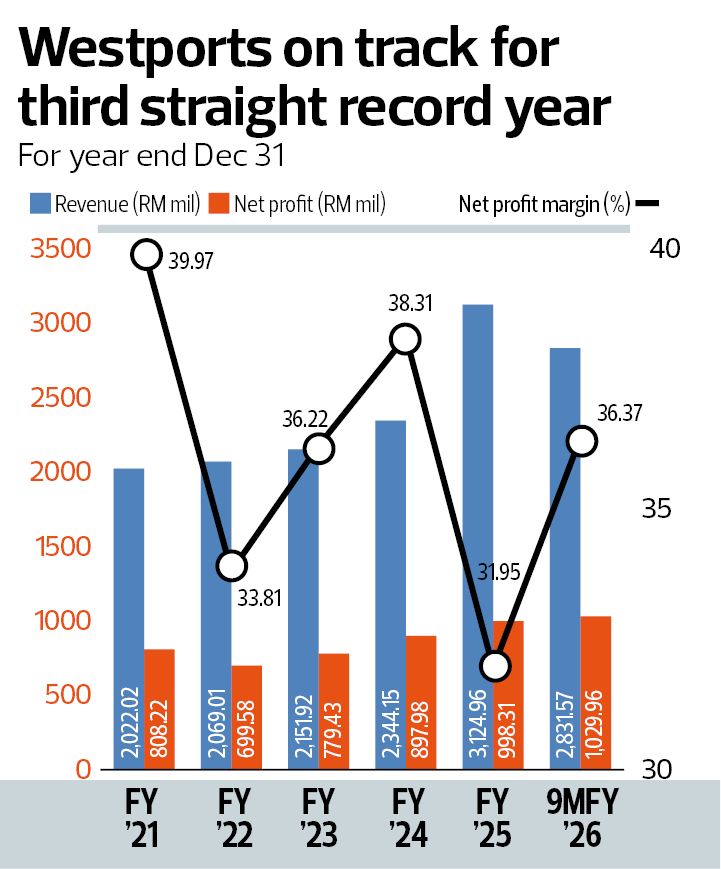
Net profit rose 42% y-o-y to RM1.03 billion in the nine months ended Sept 30, 2026 (9MFY2026), already surpassing its full-year FY2025 earnings of RM998.31 million. Revenue increased 37% to RM2.83 billion from RM2.06 billion.
The stronger performance came despite higher diesel prices, which Lee acknowledges will remain a challenge for port operators.
“High diesel prices will be a continual challenge for all port operators if fuel prices remain high,” he says. In an Oct 21 note, CIMB Securities said fuel was Westports’ second-largest operating cost component, accounting for 22.3% of total operating costs in 9MFY2026, up from 16.5% a year earlier.
Westports has received some relief from the government’s phased port tariff adjustments, the first increase in a decade. The group implemented a 15% tariff hike in July 2025, followed by a further 10% increase in January 2026.
“The final phase, a further 5% increase, will take effect in January 2027 and help cushion the impact of rising fuel prices,” says Lee.
Analysts are expecting another record year for the group. Bloomberg-compiled estimates show Westports’ net profit rising to RM1.34 billion in FY2026 and RM1.4 billion in FY2027.
Growth was not uniform, however, across all of the group’s revenue segments.
VAS revenue fell 15% quarter on quarter in 3QFY2026, owing partly to lower container storage income, following the normalisation of unusually high volumes of long-staying metal and electronic waste (e-waste) containers.
Lee says the elevated storage income in earlier quarters was unsustainable, as containers carrying suspected illegal waste had remained at ports for extended periods, generating additional storage charges.
“There were a lot of illegal e-waste and metal coming into Malaysia. All these containers were staying quite long in the port, not only at Westports but at other ports as well. They incurred quite a big portion of storage charges.
“However, these cargoes are actually illegal. That is why you see in 3QFY2026 that the storage charges from long-staying illegal waste cargoes have been tapering off,” he explains.
The decline was partly offset by higher average container yard occupancy rates of 89% in 3QFY2026 compared with 74% in the preceding quarter, following the commissioning of the new container yard.
Despite the softer VAS contribution, Westports expects overall container throughput for FY2026 to at least match the 11.3 million TEUs handled in 2025.
In an Oct 21 note, CGS International raised its FY2026 container volume forecast to 11.74 million TEUs from 11.61 million TEUs previously, citing expectations of stronger fourth-quarter volumes.
Not in a rush for M&A
Beyond its near-term earnings prospects, Westports is banking on its Westports 2 expansion to drive its next phase of growth from FY2028.
The project involves developing eight new berths, from Container Terminal 10 (CT10) to CT17, and is expected to double the group’s container handling capacity to 28 million TEUs annually.
The first 300m wharf at CT10 is scheduled for completion by the end of the second quarter of 2028, followed by a second 300m wharf by the end of the fourth quarter.
The expansion is intended to position Westports to capture rising container volumes as regional trade expands and Southeast Asia strengthens its role in global supply chains.
Apart from expanding its core port operations, Westports is also assessing potential investment opportunities in Southeast Asia that could complement its existing business.
Lee says the group has been evaluating opportunities in the region for several years, but will only pursue deals that can generate meaningful synergies and improve profitability.
“We are prepared to look into it, and it has to be in Southeast Asia. Any investment or project we would like to participate in has to add synergy, in the sense of making Westports more profitable or generating higher profits. We are not in a rush. We are very mindful about that. We are not chasing market share,” he says.
Westports introduced a dividend reinvestment programme (DRP) in 2025 to raise up to RM600 million over five years, with the proceeds intended to fund working capital, capital expenditure and other long-term growth initiatives.
About RM400 million has been earmarked to fund the equity portion of Westports 2, leaving about RM200 million for other expansion opportunities.
In an Oct 22 report, Maybank Investment Bank Research said Westports could terminate the DRP before the end of its planned five-year tenure if no suitable investment opportunities emerge.
Analysts remain broadly positive on Westports, although its valuation suggests that much of its expected earnings growth may already be priced in.
Of the 18 analysts covering Westports, 11 have a “buy” recommendation, five a “hold” rating and two a “sell” call. Their average target price of RM7.45 implies upside of 2.8% from last Wednesday’s closing price of RM7.25.
Westports shares have gained 28% year to date, valuing the group at RM25 billion at Wednesday’s close. The stock was trading at 18.59 times its forecast FY2026 earnings.
Save by subscribing to us for your print and/or digital copy.
P/S: The Edge is also available on Apple's App Store and Android's Google Play.