


This article first appeared in The Edge Malaysia Weekly on November 9, 2026 - November 15, 2026
A series of developments is lifting the prospects of solar farm developers as the government seeks to increase renewable energy (RE) adoption in the power-hungry data centre (DC) sector.
Last month, Minister of Energy Transition and Water Transformation Datuk Amar Fadillah Yusof said the government was drafting a framework for DC power consumption, which includes a minimum RE requirement of 30%.
Sources tell The Edge that the government is exploring even higher RE targets for future DC projects, particularly those powered off-grid.
It is understood that the 30% threshold has been floated since earlier this year. For DCs approved on the condition of using off-grid power, talk is that the RE requirement could go as high as 50%, although specific details are still being ironed out.
If implemented, the compulsory RE requirements could catalyse new solar farm developments under the Corporate Renewable Energy Supply Scheme (CRESS), which allows RE developers to sell electricity directly to industrial customers.
CRESS adoption has been moving slowly because its primary target market, the DCs, are weighing the programme’s total cost — how much one pays for solar energy plus fees to use Tenaga Nasional Bhd’s (KL:TENAGA) grid — against the cost of just drawing electricity directly from the grid via Tenaga.
A mandatory RE quota now leaves DCs with no choice but to comply and look for solar farms to partner with.
“Thirty per cent is a good number for the DCs. The requirement could be more after that,” says a source.
According to the latest publicly available data, CRESS has attracted the interest of 11 solar farm developers and eight end-consumers, representing more than 3gw in capacity.
One CRESS project making advanced progress is a 100mw solar farm under construction in Kedah, led by privately owned HLGY Energy Sdn Bhd and Singapore-headquartered Bridge Data Centres.
Recent CRESS awards include two projects totalling 189mw won by Northern Solar Holdings Bhd (KL:NORTHERN). Meanwhile, Tenaga is reportedly exploring a 500mw solar supply arrangement with DayOne DCs.
Nevertheless, some power generation developers remain cautious about CRESS’ prospects. “I won’t celebrate yet, not until we see [the conditions] in an official document,” says an executive, pointing to recent adjustments in grid usage fees under CRESS.
In September, the Ministry of Energy Transition and Water Transformation (Petra) announced a reduction in the System Access Charges (SAC) to 14 sen/kWh, down from 20 sen previously, for eligible participants. However, the Energy Commission then clarified in October that CRESS projects remain subject to an additional charge of 4 sen/kWh.
Moving parts
When asked whether a mandatory RE requirement will slow down DC projects, industry players suggest that approved DCs yet to begin construction will likely proceed. A more decisive factor to look at is the government’s push for DCs to source their own electricity off-grid, they say.
How much RE generation capacity needs to be planted up depends on the details in the upcoming framework.
Should the 30% RE requirement be based on gigawatt-hour (gwh) — the total energy consumed over a certain period — a solar farm’s peak generation capacity must be between 80% and 90% bigger than the DC’s capacity to meet the 30% requirement due to the intermittency of solar energy production. For example, a 100mw data centre would roughly require a 180mwp solar farm to meet its 30% RE energy consumption target.
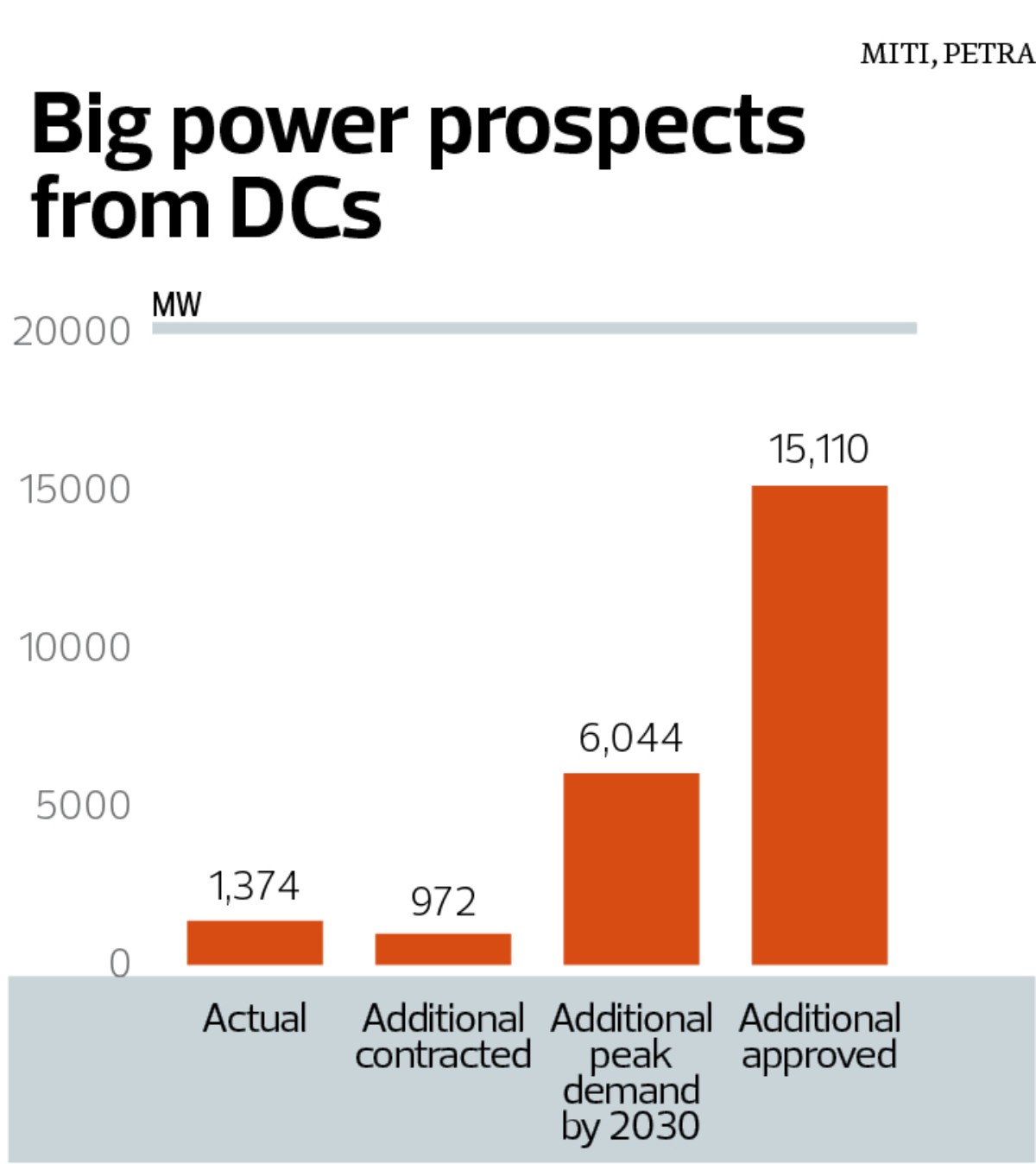
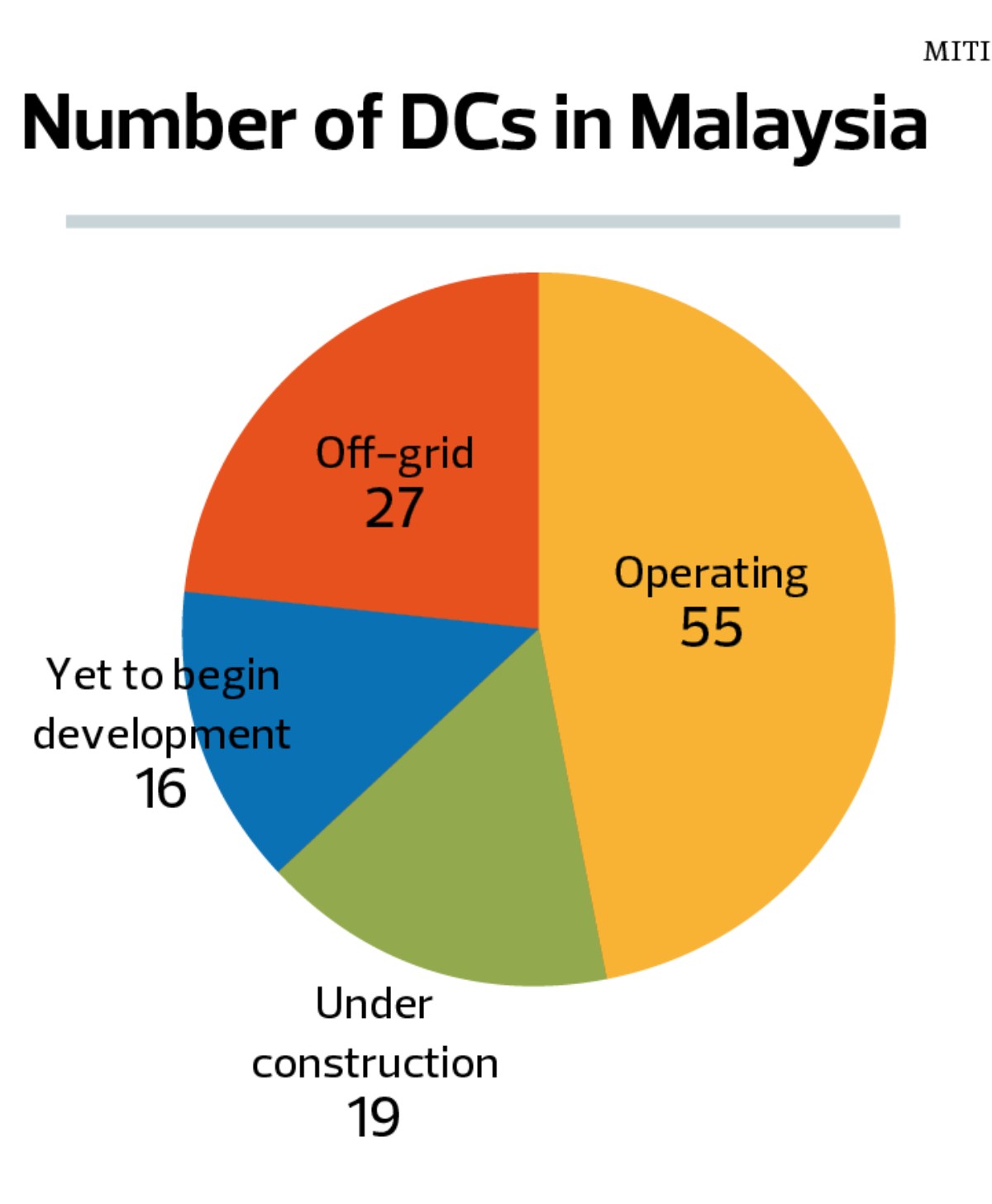
Data from the Ministry of Investment, Trade and Industry (Miti) shows that the government has approved 23gw to 23.5gw of DC capacity, based on maximum demand. This includes 27 DCs that are expected to use off-grid electricity, which reports say carry a combined capacity of about 8gw.
As at August, operational DCs had contracted 2.3gw in capacity demand. By 2030, the total maximum DC demand is expected to cross 8gw, potentially requiring 14gwp of RE capacity to meet a 30% energy supply rule.
Nevertheless, the devil is in the details. Among the questions raised by industry players are whether programmes like CRESS is eligible to be considered as off-grid supply for DCs, or only dedicated self-consumption (Selco) solar installations qualify. Selco solar projects are more challenging logistically because they must be located close to the consumption point.
Another question is whether the Green Electricity Tariff (GET) — RE sold by Tenaga through the grid at a slight premium to the normal tariff — qualifies as RE for the DCs.
GET supply totalling 6.6TWh has been fully taken up, according to data from the Malaysia Green Attribute Tracking System (mGATS). Based on existing available RE capacity of nearly 6gw on the grid, back-of-the-envelope calculations indicate that the GET quota could easily be expanded.
If that quota is increased and is allowed to qualify for DCs’ mandatory 30% RE target, the GET could end up absorbing much of the demand from existing contracted DC capacity of 2.3gw.
One industry player views this outcome as unlikely, though, saying: “The government’s ultimate objective is new generation capacity. But nothing is official yet.”
RE tailwinds
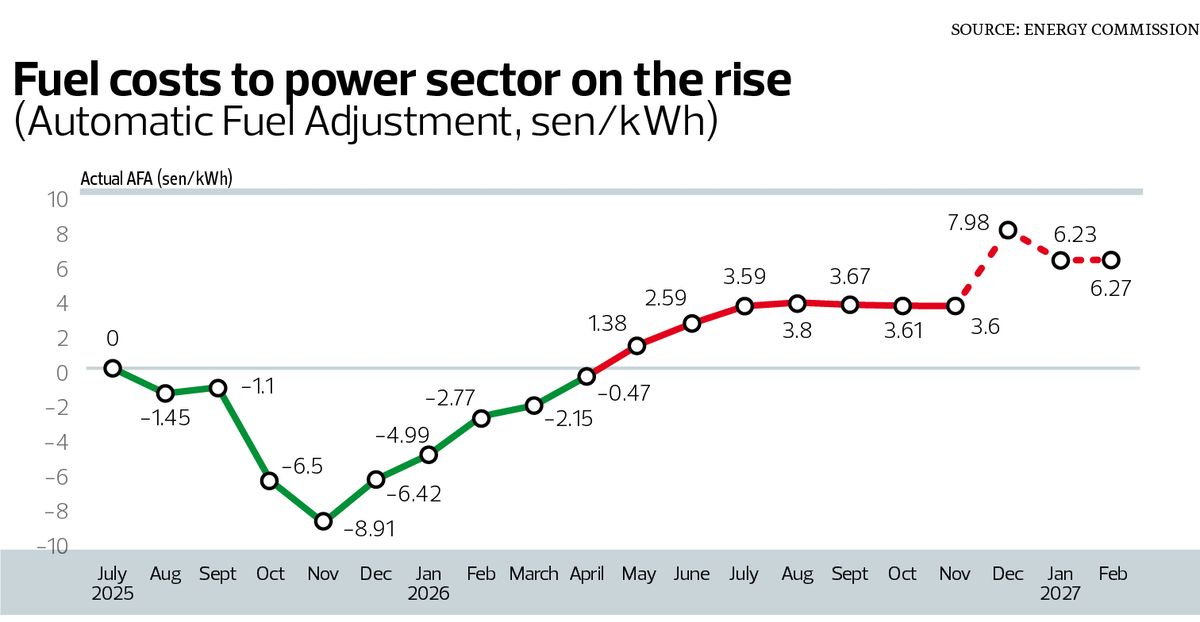
Outside the DC space, rising fossil fuel costs continue to favour RE adoption.
Malaysia’s electricity tariff has incorporated a fuel surcharge since May, which official projections indicate will stabilise at a higher level in the coming months, potentially increasing to 6 to 8 sen/kWh based on the latest official projections.
Against this backdrop, CRESS is being explored by other industrial users. Among them is a major 680mw joint development between Gamuda Bhd (KL:GAMUDA), SD Guthrie Bhd (KL:SDG) and Petroliam Nasional Bhd’s (PETRONAS) Gentari Sdn Bhd for a US-based tech firm.
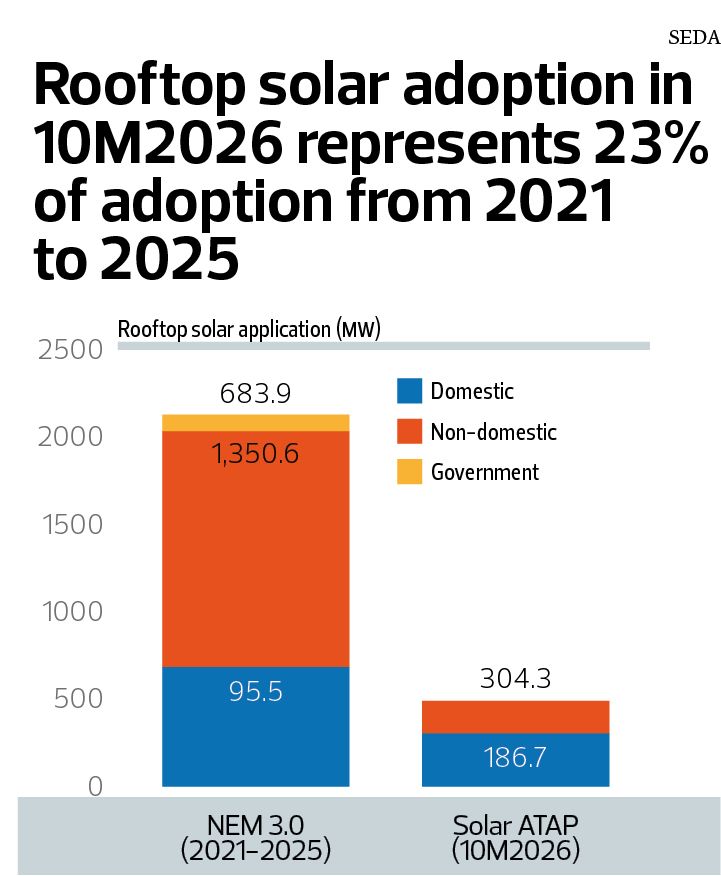
The appetite for rooftop solar has picked up again. Data from the Sustainable Energy Development Authority (Seda) shows more than 490mw in rooftop solar applications were submitted in the first 10 months of 2026, with 307mw already operational.
For solar developers, the momentum shows no sign of slowing. Malaysia’s latest Large-Scale Solar bidding round (LSS6) concluded in late October, offering a total allocation of 2,650mw, with the winning bids expected to be announced as early as January next year.
Save by subscribing to us for your print and/or digital copy.
P/S: The Edge is also available on Apple's App Store and Android's Google Play.