

This article first appeared in The Edge Malaysia Weekly on November 9, 2026 - November 15, 2026
TAN Sri Lim Kang Hoo, who has lain low for the past few years, is back in action. The 71-year-old businessman, who grew up in Gombak, has a few projects up his sleeve: he wants to build a new expressway across Kuala Lumpur, list toll concession operations owned by his flagship Ekovest Bhd (KL:EKOVEST), and revive the KL Bund project that comprises flood mitigation works and the beautification of the Gombak River.
Ekovest is expected to begin construction of Laluan Istana-Kiara Expressway (LIKE), stretching from Jalan Duta to Jalan Sungai Besi, as early as the first quarter of next year.
LIKE will be the fourth concession under Ekovest’s belt, apart from the three intra-city highways in Kuala Lumpur, namely Duta-Ulu Kelang Expressway (DUKE 1), DUKE Phase 2 (DUKE 2) and Setiawangsa-Pantai Expressway (SPE, or DUKE 3).
The construction of the 7.7km elevated toll expressway will cost roughly RM2.5 billion. The company will issue bonds to fund the project, said founder and controlling shareholder Lim in a rare media briefing last week.
According to the executive chairman, the internal rate of return (IRR) for LIKE will not be more than 10%. “But it is bankable … good enough for the banks to lend us,” he said, but acknowledged that toll concessions are not as lucrative as before.
When asked if it would be a flat toll rate throughout the 54-year concession period, Lim said there would be a mechanism for toll hikes.
“We have secured a RM1.02 billion loan from MBSB Bank … we have also got shareholder approval for the rights issue at the recent EGM (extraordinary general meeting),” Lim said, adding that the money raised is intended for the required equity of the concession.
The RM1.02 billion loan has been granted to Ekovest Holdings Sdn Bhd (EHSB), Lim’s investment vehicle that holds a 10.05% stake in the listed company. This will enable EHSB to provide an additional undertaking for the unsubscribed rights shares, in addition to its undertaking for its entitled shares.
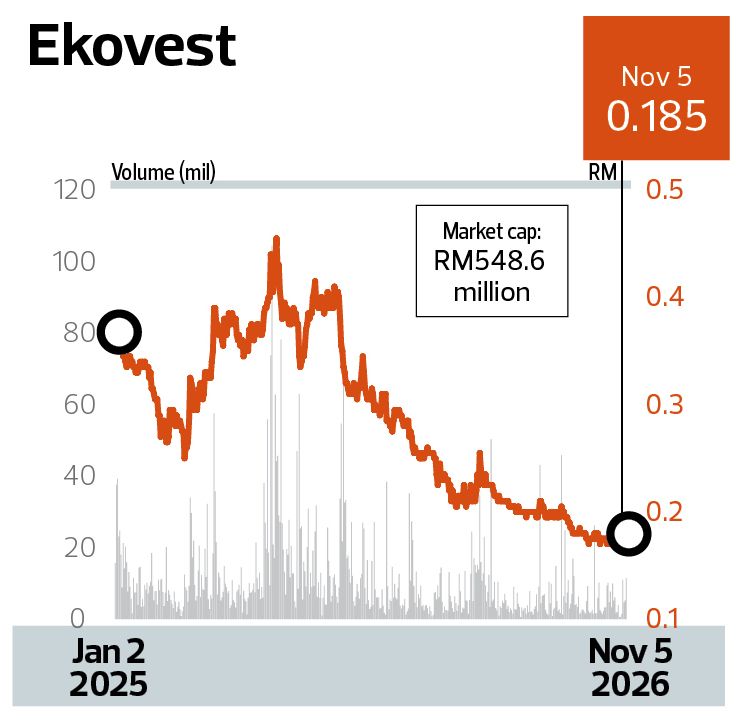
Ekovest has also made a cash call to raise RM355.84 million fresh capital from shareholders via a three-for-five rights issue priced at 20 sen a share. However, the issue price is higher than the stock’s closing price of 18.5 sen last Thursday.
Ekovest’s share price has been on a downward trend over the past two years, and is down nearly 60% in 16 months, significantly off last year’s peak of 45.5 sen in August.
It is not hard to fathom its lacklustre share price performance given that Ekovest has been loss-making over the past five years.
For the financial year ended June 30, 2026 (FY2026), Ekovest’s net loss widened to RM204.57 million from RM139.55 million the year prior. Its annual revenue hit RM1.1 billion in FY2023 and FY2024, but shrank to RM851.14 million in FY2026 from RM992 million in FY2025.
Ekovest’s concession assets were pegged at RM7.92 billion as at June 30. The company’s debts included medium-term notes of RM5.36 billion and bank borrowings of RM756.9 million, while its cash and short-term deposits amounted to RM74.3 million and it had investment funds of RM305.2 million.
Listing of highway concessions in 2027?
Lim said Ekovest will have to list DUKE 1, DUKE 2 and DUKE 3 eventually, pointing out that this was a condition for the Employees Provident Fund’s (EPF) investment in Konsortium Lebuhraya Utara-Timur (KL) Sdn Bhd (Kesturi) in 2017.
EPF had acquired a 40% stake in Kesturi, which currently owns the concessions for DUKE 1, DUKE 2 and DUKE 3, for RM1.13 billion from Ekovest. Kesturi was then valued at RM2.83 billion when the three expressways were not mature yet.
The share purchase deal came with an exit event set as a listing or trade sale within five years, extendable automatically by two years, which ended on Feb 13, 2024. This was followed by an extension of up to two years — approved by EPF — to Feb 12, 2026.
In February this year, EPF granted Ekovest a one-year extension to implement its exit plan from Kesturi.
Under the 2016 shareholders’ agreement, EPF is guaranteed a minimum IRR of 10%, with a performance target of 11.5% under the exit event.
If no exit occurs by the extended date, there is a put option for EPF to sell its shares to Ekovest at a 10% return within six months of the extended expiry date. Meanwhile, EPF could also exercise a call option to buy out Nuzen Corp Sdn Bhd’s 60% stake in Kesturi if the put option is not fulfilled.
“Our cash flow and profitability took a hit. The [Covid-19] pandemic affected all industries and we were not spared. Otherwise, the listing would have taken place earlier,” Lim said, pointing out that “there were no cars on the road during MCO (Movement Control Order)”.
He does not rule out that Ekovest might list the highway concessions through the Infrastructure Project Corporation (IPC) route on Bursa Malaysia.
To be qualified for an IPC listing, one must have the right to build and operate an infrastructure project locally or abroad with project costs of not less than RM500 million, and the concession or licence for the infrastructure project awarded by a government or state agency. The remaining concession period must be at least 15 years.
According to Lim, the traffic volume for DUKE 1 and DUKE 2 is roughly 240,000 vehicles per day while that for SPE or DUKE 3 is 85,000.
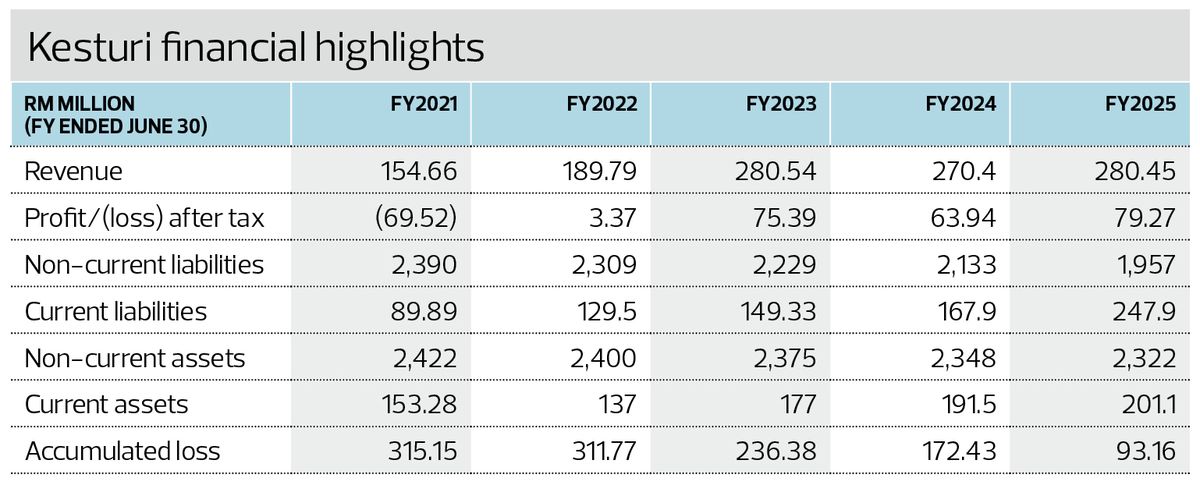
Filings with the Companies Commission of Malaysia (SSM) show that Kesturi posted a net profit of RM79.27 million on revenue of RM280.45 million for the financial year ended June 30, 2025. Its balance sheet as at June 30, 2025 indicated its accumulated loss fell to RM93.16 million from RM311.7 million while non-current liabilities amounted to RM1.95 billion while non-current assets stood at RM2.32 billion (see chart).
Reviving the KL Bund project
Ekovest focuses on intra-city expressways to ease traffic congestion in the Klang Valley, said Lim, who foresees the need for “DUKE 5, DUKE 6 and more” as the capital city expands due to population growth.
However, the businessman also intends to kick-start the KL Bund project along the Gombak River. “This is also a flood mitigation project. There will be clean water on top of the flood tunnel. Once the river has been cleaned up, developers will want to be there,” asserted Lim.
Ekovest has accumulated parcels of land along the river and will either develop them over time, form joint ventures with other developers, or sell tracts.
“The government should start with building the flood tunnel which will help to channel rainwater to prevent flash floods,” suggested Lim.
The flood tunnel and beautification works along the river are expected to cost the government about RM900 million.
Nonetheless, the businessman has yet to present his proposed plan to Putrajaya.
Will Lim be able to kick-start the project and make it another growth catalyst for Ekovest?
But besides the cash call, the more important task is the listing of its concession business to pave the way for EPF to exit, lest Ekovest is forced to make good on EPF’s put option.
Save by subscribing to us for your print and/or digital copy.
P/S: The Edge is also available on Apple's App Store and Android's Google Play.