

(Nov 11): Russia has effectively abandoned attempts to replace the dollar with China’s yuan under the pressure of US secondary sanctions, underlining the difficulties facing other nations looking for an alternative global currency.
Despite rising trade with China, the yuan’s share in payments for Russian exports has halved this year to 22% from its peak in mid-2024 when the US widened secondary sanctions, according to the latest Russian central bank data. In trade with Asia, Russia now receives rubles for 69% of its exports.
Russia’s experience represents an unprecedented experiment that ultimately showed the limitations of President Xi Jinping’s ambition to turn the yuan into a “powerful currency” for international trade, financial markets and central banks’ reserves. Chinese officials, however, have been equally clear they aren’t trying to turn the yuan into a replacement for the dollar, as Beijing keeps tight capital controls to guard currency flows.
Russia’s shift came after Chinese banks retreated in the face of threatened US secondary sanctions over the war in Ukraine. It demonstrates the US’ ability to enforce its political will, even with the world’s second-largest economy — and emphasises the dollar’s global dominance.
Still, the setback hasn’t damaged the “no limits” friendship that Xi and President Vladimir Putin declared weeks before Russia’s 2022 full-scale invasion of Ukraine. Those political ties will be on display next week when they meet at the Asia-Pacific Economic Cooperation summit in China’s Shenzhen, where they may also hold an unprecedented trilateral meeting with US President Donald Trump.
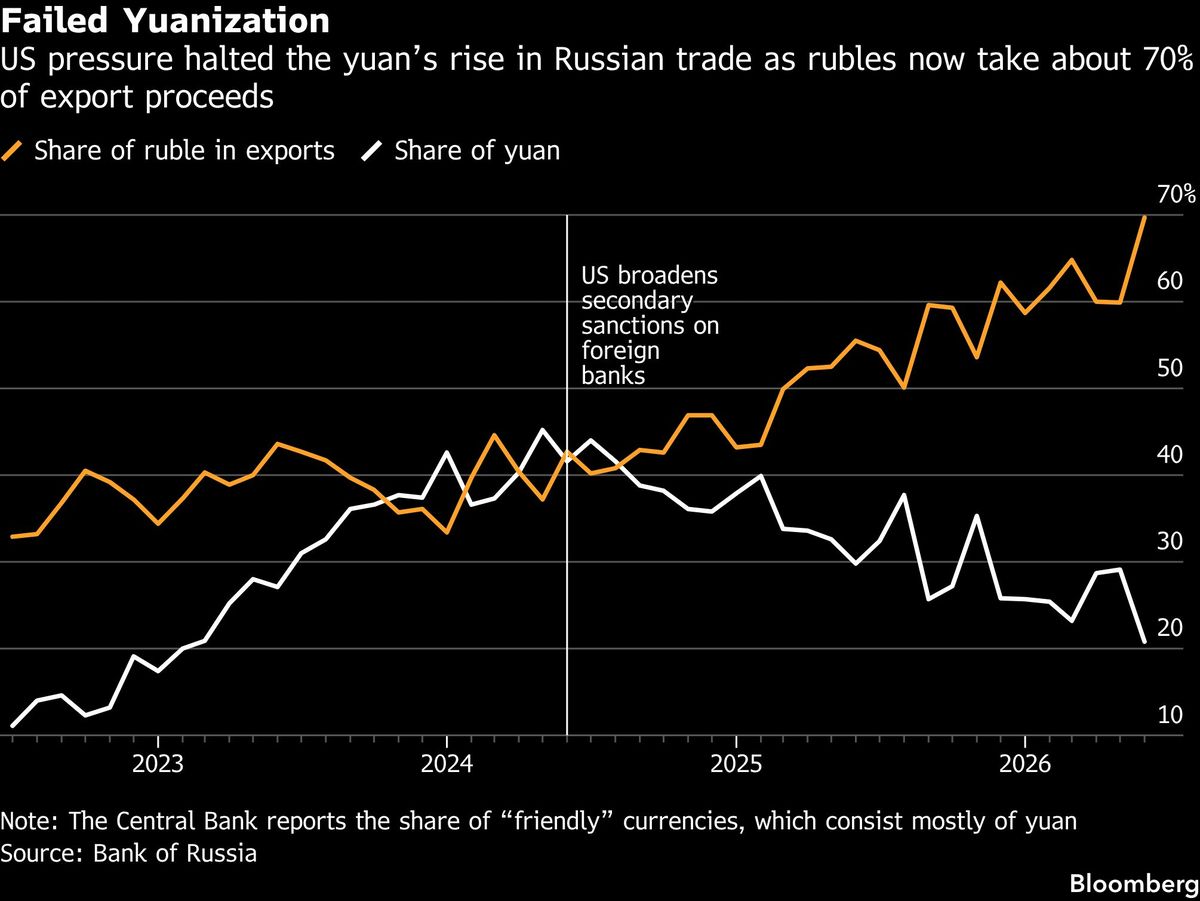
The move away from the yuan has left Russian businesses facing mounting problems with cross-border payments. Unable to settle directly in the Chinese currency, companies have to use intermediaries, third countries and more complex payment routes, making transactions slower, more expensive and less predictable.
Alexander Vedyakhin, first deputy chairman of Sberbank, Russia’s largest lender, said that even after Russia and China formally shifted toward trade in national currencies, payments are prone to constant disruptions.
“Normal banking payments have shrunk dramatically,” said Alexander Gabuev, director of the Carnegie Russia Eurasia Center.
Yuan embrace
Russia’s economy adopted the yuan at extraordinary speed when the US and its allies imposed sanctions over the war in Ukraine. The Chinese currency grew to account for nearly half of Russia’s foreign trade, became the most traded currency on Moscow’s domestic foreign-exchange market and overtook the dollar in bank deposits.
Banks switched lending from dollars and euros into yuan, while the market for yuan-denominated bonds expanded at double-digit rates and the currency became one of the principal assets in the central bank’s reserves.
That’s part of a broader trend that’s seen many countries seek to reduce their dependence on the greenback in response to Trump’s trade disruptions. While the yuan is seen as a potential alternative, China also remains heavily reliant on the dollar-based financial system.
While any changes to open up China’s markets would likely be modest, the country’s latest five-year plan stretching to 2030 vows to increase the openness of its capital account to advance the currency’s internationalisation. Russia accounted for about 30% of the increase seen since 2021 in the share of China’s trade settled in yuan, according to Bloomberg Economics’ estimates.
That’s because Russia’s business ties with China surged after it was largely shut out by European Union sanctions from a market that was previously Moscow’s largest. China is now Russia’s largest trade partner, accounting for more than a third of its foreign trade.
Until mid-2024, Russia had effectively created an additional channel for the yuan’s international use. The value of Russian exports denominated in yuan consistently exceeded the value of exports shipped directly to China, meaning buyers elsewhere were also increasingly paying Russia in yuan.
In effect, Russia was making a substantial contribution to Beijing’s effort to expand the currency’s role beyond China’s own borders. At its peak, the yuan ranked fourth in SWIFT international payments, behind the dollar, the euro and the British pound.
While the gains came quickly, the reversal has been faster.
Russian businesses were thrown into turmoil after the US significantly widened the grounds for imposing secondary sanctions on financial institutions and companies dealing with Russia in June 2024. Payments were frozen or delayed for months, transfers were sent back, and China’s largest lenders stopped dealing completely with Russian counterparties.
Russia’s economy, by then heavily reliant on the yuan, faced an acute shortage of foreign currency. The Bank of Russia eventually urged lenders to restrain yuan-denominated credit.
Several channels remain open, but none guarantees that a payment will go through, according to companies that help Russian businesses trade with China.
“In 2026, paying suppliers in China is no longer a routine transaction,” STA SiberiaTransAsia Group, which provides freight and customs-clearance services, said in materials for clients. Even with a signed contract and a vetted counterparty, Russian companies face payment delays, returned transfers and additional compliance checks, it said.
Many transactions now go through payment agents rather than banks, a route that’s considered more reliable but also more expensive. The total cost of cross-border payments with China now averages 15% to 20% of the transaction, including commissions and fees charged by intermediaries, according to data from STT Logistics, a freight transportation provider.
STA SiberiaTransAsia and STT Logistics didn’t respond to requests for comment.
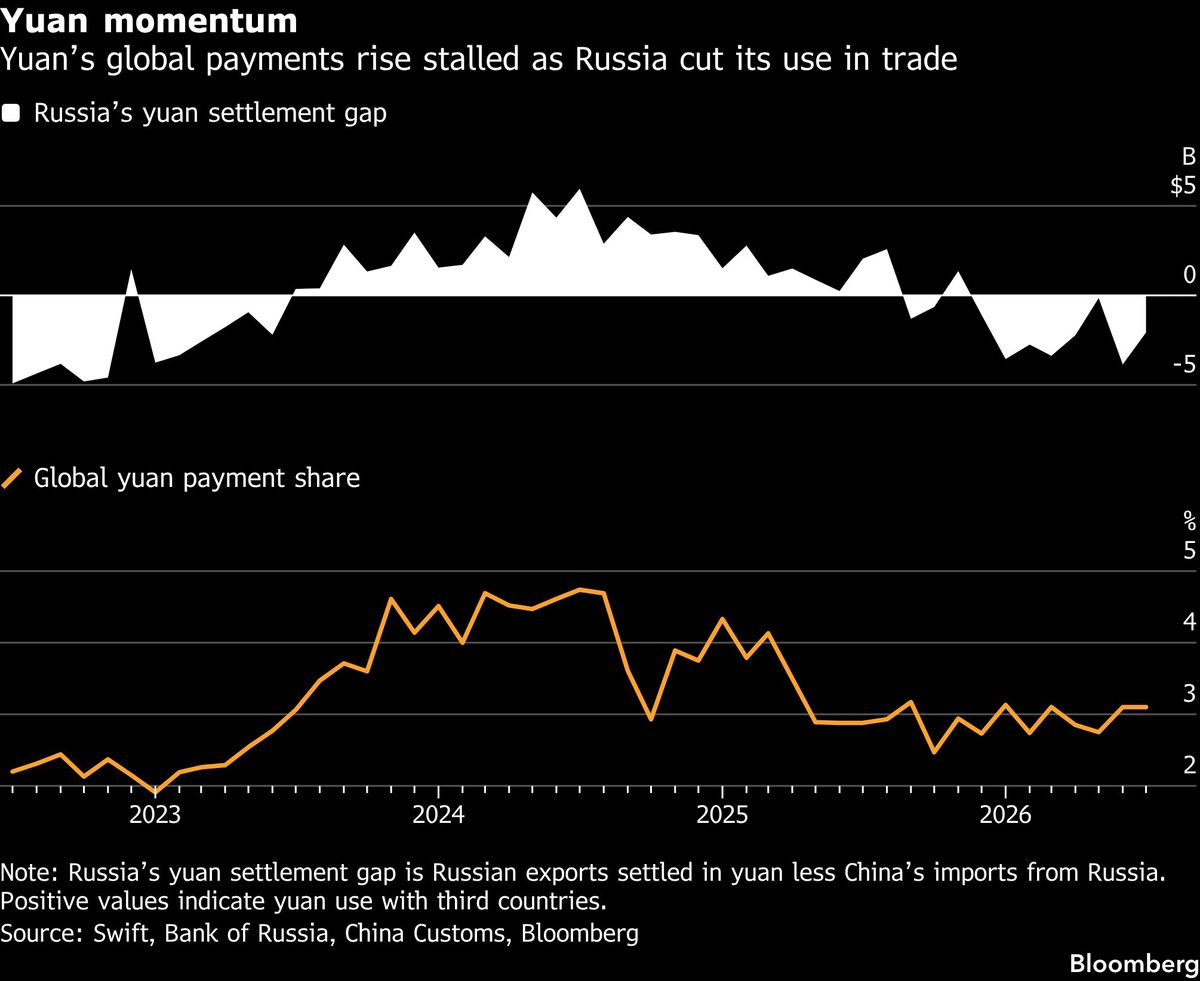
Russia’s use of the yuan in trade with third countries also turned negative late last year, according to Bloomberg calculations.
The yuan’s global share has fallen back to levels before the war in Ukraine, slipping to fifth after the Japanese yen, SWIFT data shows. Chinese officials argue that provides an incomplete picture of the yuan’s global reach, with a noticeable rise in transaction volumes through China’s CIPS network.
The currency’s share of global payments would actually rise to 6% to 7% when China’s homegrown payment system and other internal bank transactions are included, Pan Gongsheng, governor of China’s central bank, said in October.
Still, the increase in CIPS volumes isn’t enough to explain the retreat on SWIFT, says Martin Chorzempa, senior fellow at the Peterson Institute for International Economics, who analysed the dynamics of global yuan use.
“Impetus for expanding yuan internationalisation from Russia sanctions has petered out,” he said by email.
Uploaded by Chng Shear Lane