


(Nov 11): Wall Street is poised to deliver another banner year for bonuses off record profits for big banks, with questions lingering around what lies further ahead for the industry.
Year-end compensation packages are projected to rise 20% to 30% or more for traders who help investors make stock bets and bankers who help companies raise capital in the equity market, according to Johnson Associates Inc. It would be the third straight year financial firms have doled out higher payouts.
“The banks continue to do better than anticipated” in what has been “a very good year” driven by momentum in markets in recent months, Alan Johnson, managing director of Johnson Associates, said in an interview.
While the good times are still rolling, Johnson said he’s cautious about the outlook for 2027. With only a handful of stocks driving much of the trading, underwriting and advisory activity, the momentum may not stay elevated, he said.
“After three good years in a row,” he said, “I think we’re less optimistic about repeating that for the fourth time.”
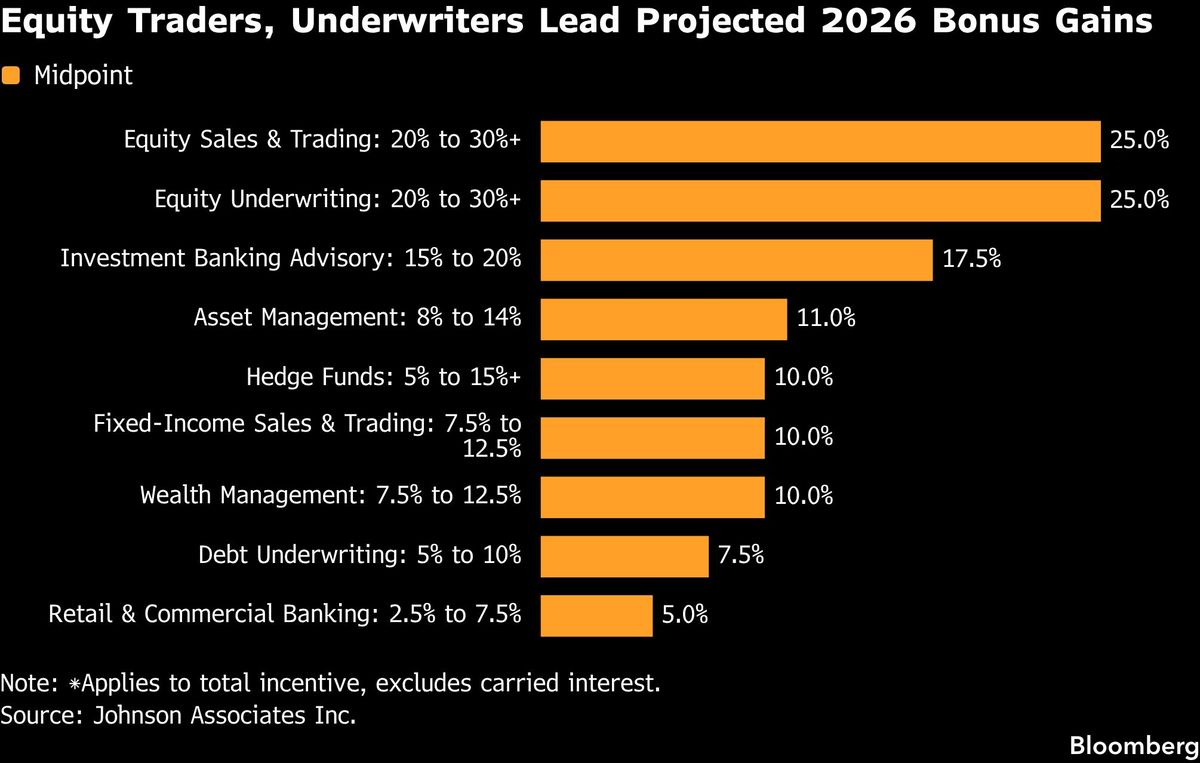
The projections for 2026 signal that incentive pay will potentially be up on Wall Street by the most ever. Last year’s payouts came on the heels of the highest annual profit the largest US banks had seen since 2021. Those firms are now on track to deliver record earnings again.
Investment bankers who arrange deals could see their pay increase as much as 20%, according to Johnson Associates. That comes as advice for arranging mergers and acquisitions has rebounded, and a backlog for future deal opportunities remains “strong,” according to the firm’s report, published on Tuesday.
The forecast follows third-quarter (3Q) results from banks in which equity desks seized on an opening to outshine their debt counterparts. Geopolitical uncertainty stemming from President Donald Trump’s shifting policies, the war in the Middle East and changing interest-rate expectations have been a boon for stock traders amid the resulting market volatility.
Fixed-income trading desks, on the other hand, face fallout from rising interest rates, which can push down the value of existing debt and crimp demand from clients to transact or borrow. Incentive pay for debt traders is projected to be between 7.5% and 12.5%, less than half of their equity peers, according to the report. Those who help underwrite debt packages could see their pay rise an even smaller amount, between 5% and 10%.
The same dynamics affecting trading and underwriting results are also giving a boost to banks’ traditional roles as lenders, with some firms setting fresh records in 3Q for how much they earned from lending, with customers continuing to borrow even as interest rates increased.
Retail and commercial banking can be particularly vulnerable to changing rates. Bankers in those fields are poised to see their incentive pay rise up to 7.5%, Johnson Associates said, with lending activity edging higher and provisions for credit losses lower as questions around the Federal Reserve’s next rate move remain.
Wealth management
Advice can be top of mind in times of uncertainty in the market. Strong demand for wealth-management services is set to boost incentive pay for professionals in that business by as much as 12.5%. Similarly, those working in asset management could see a bump of as much as 14% on the back of market appreciation and inflows to active exchange-traded funds and alternative-investment vehicles.
Johnson’s expectations also echo what other industry reports have slated for payouts this year. A forecast last month by New York State Comptroller Thomas DiNapoli predicted that the Wall Street bonus pool will break records, with profit at broker-dealer firms that belong to the New York Stock Exchange on pace to exceed US$90 billion (RM365.14 billion).
Recruitment firm Options Group said in a report that this year’s compensation would rise the most in equities, with a 15.6% gain from a year earlier. That compares to a 3% increase in investment banking and a 1.4% drop in fixed-income, credit and commodities trading.
“US banks are the outliers in the equities business. Even though European and Japanese banks did well, they didn’t capitalise like the US banks,” Michael Karp, Options Group’s chief executive officer, said in an interview. If similar market conditions persist into next year, “then 2027 could be a banner year as well.”
Full-year compensation may still change, especially with uncertainty around artificial intelligence (AI), interest rates and geopolitics. US banks will start compensation conversations in the coming weeks, with bonuses set to be paid out early in the new year.
When times are good and money is plentiful, individual windfalls can stretch into the millions of dollars, well above what bankers and traders reap from their salaries. Still, some banks may choose to exercise restraint, keeping a lid on their spending as analysts and investors raise questions around rising costs.
AI is also poised to change the way payouts are structured and companies reward their employees. The biggest Wall Street firms that have been more aggressive in managing head count and expenses may reward their employees with even more lucrative compensation, according to Chris Connors, managing director at Johnson Associates.
“The idea is it’s a bigger pie for fewer heads,” he said in a Bloomberg Television interview Tuesday. “It will probably be smaller analyst classes going forward, attrition without replacement and hopefully top-line growth.”
Uploaded by Felyx Teoh