

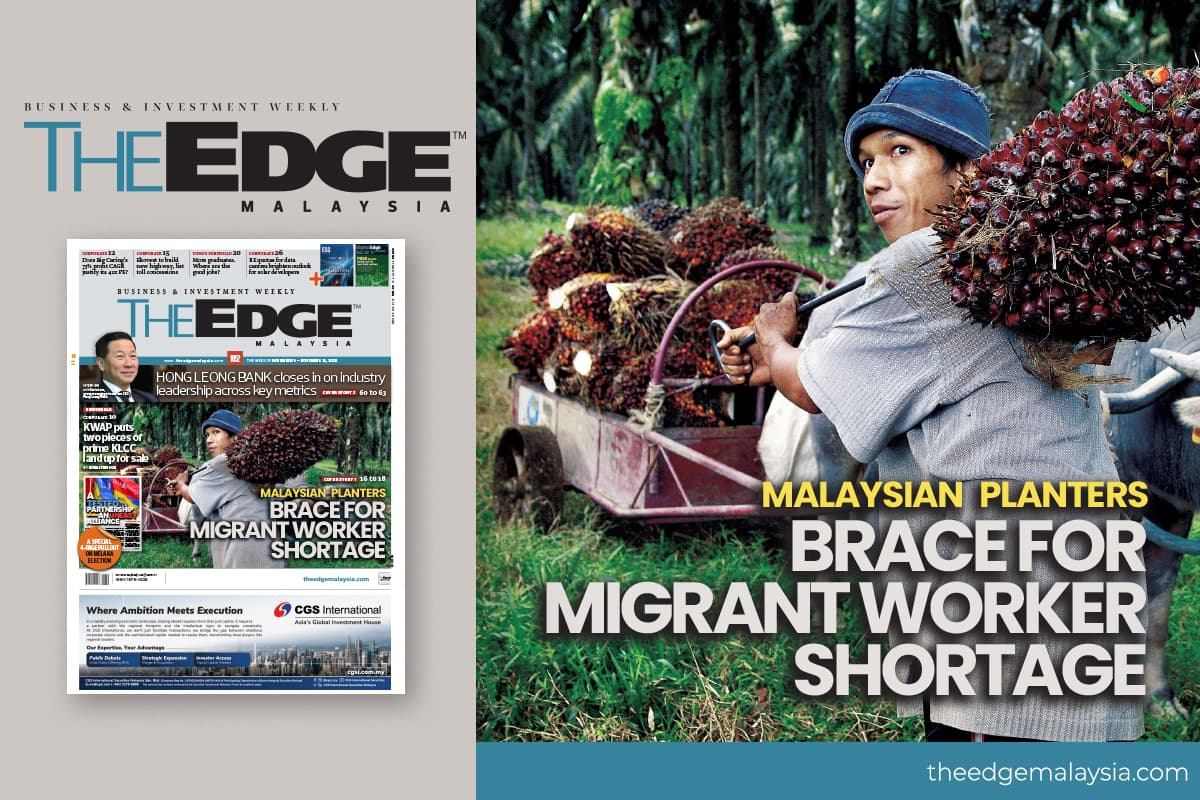
KUALA LUMPUR (Nov 7): While the public were focused on the plantation sector’s culpability in causing the haze hanging over the region in the last three months, Malaysian planters have been struggling with tight labour conditions in their estates, along with a high level of palm oil inventories.
The labour issue is a recurring problem for the country’s planters because locals shun estate work, which is considered dirty, dangerous and difficult (3D), and the migrant or foreign workers who take up these jobs return home after their contracts end. Furthermore, while certain tasks in the field are mechanised, harvesting the oil palm’s fruit, or fresh fruit bunches (FFB), still requires skilled workers.
Harvesters typically comprise Indonesians on most Malaysian plantations.
As such, oil palm plantations are heavily dependent on migrant workers who make up more than 70% of the sector’s workforce.
This high dependency on migrant workers has become a pain point for planters as they struggle to fill vacant positions in the field. On Oct 29, Minister of Plantation and Commodities Datuk Seri Dr Noraini Ahmad told Parliament that the palm oil sector is short of 30,000 workers. This works out to 11.16% of the number of migrant workers allowed to work in the plantation sector as at April 2026 this year.
Industry players that The Edge spoke with paint a mixed picture. While labour shortages may only be affecting certain pockets for now, all agree that they cannot afford a deterioration of the current situation, as they recall the disastrous effects of the severe shortage during the Covid-19 pandemic.
“The foreign labour situation in the plantation sector is becoming increasingly concerning,” says Roslin Azmy Hassan, CEO of the Malaysian Palm Oil Association (MPOA).
“While it remains manageable for some MPOA member companies, others are already experiencing shortages, particularly of oil palm harvesters. Our immediate concern is that if foreign worker recruitment is not facilitated now, the industry could face a much more serious labour shortage in the next few months.”
Read the story in Cover Story 1 in this issue of The Edge Malaysia.
Three years ago, Hong Leong Bank Bhd (KL:HLBANK) embarked on an ambitious transformation journey, with the aim of becoming Malaysia’s best-run bank across five key financial metrics.
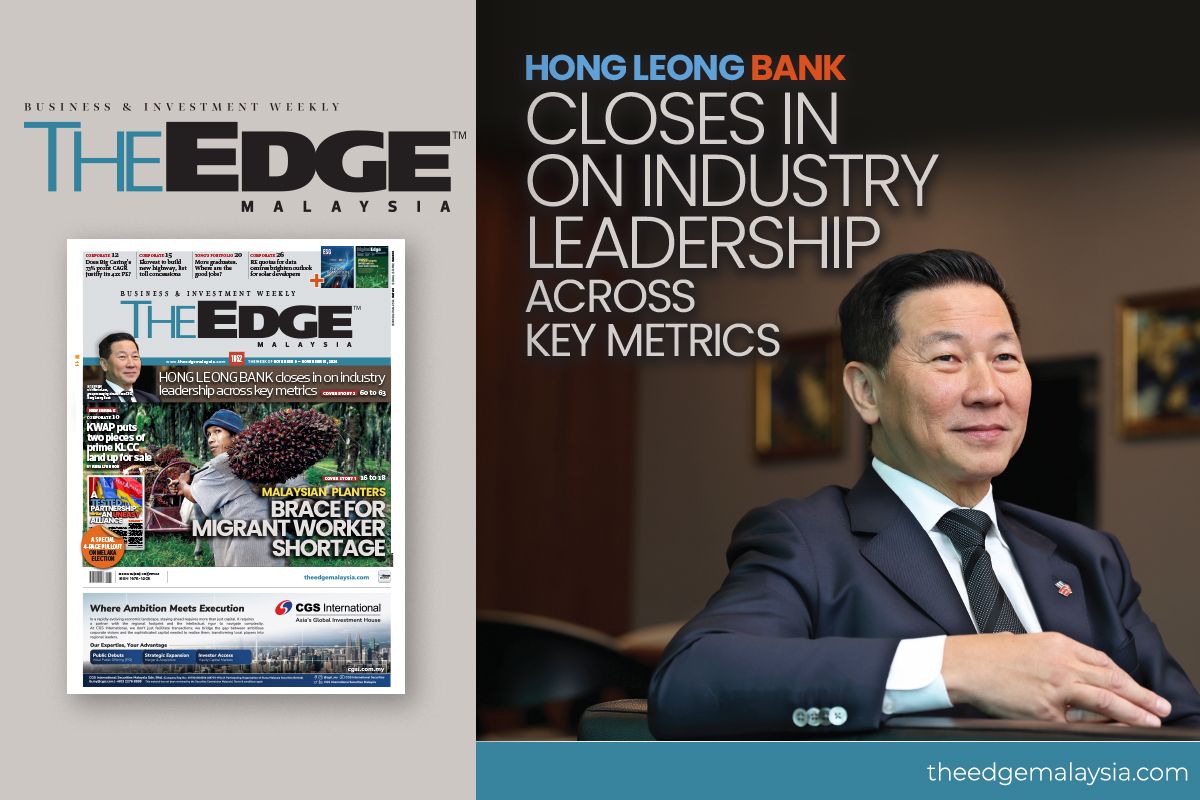
The country’s fifth-largest banking group announced targets — including a return on equity (ROE) of more than 12.5% — to be achieved within the three- to five-year span of its so-called “transformative” plan. However, its internal goal was to hit those milestones by the third year.
Having recently crossed that three-year mark, the group has made significant headway, with four of the five metrics — namely the cost-to-income ratio, current account and savings account (CASA) ratio, non-interest income (NOII) ratio and credit charge — either meeting or nearing the targets. The ROE target, however, remains elusive.
The challenge for Hong Leong Bank is that meeting its NOII and CASA targets may not be enough to lift ROE to the desired level if its net interest margin — the difference between what it earns on loans and pays on deposits — continues to narrow, analysts note.
In an interview with The Edge, group managing director and CEO Kevin Lam discusses the progress and the challenges ahead. He also reveals that the group has identified a new growth opportunity: deepening its reach into the Malay market.
Hong Leong Bank expects to sell a smaller stake in China-based Bank of Chengdu Co Ltd (BoCD) than previously indicated, as slower growth at the associate and stronger expansion in its own core business ease concerns about the BoCD’s outsized contribution to group earnings. It currently holds a 17.8% stake in the BoCD.
Read the story in Cover Story 2 of the weekly.
Save by subscribing to us for your print and/or digital copy.
P/S: The Edge is also available on Apple's App Store and Android's Google Play.