

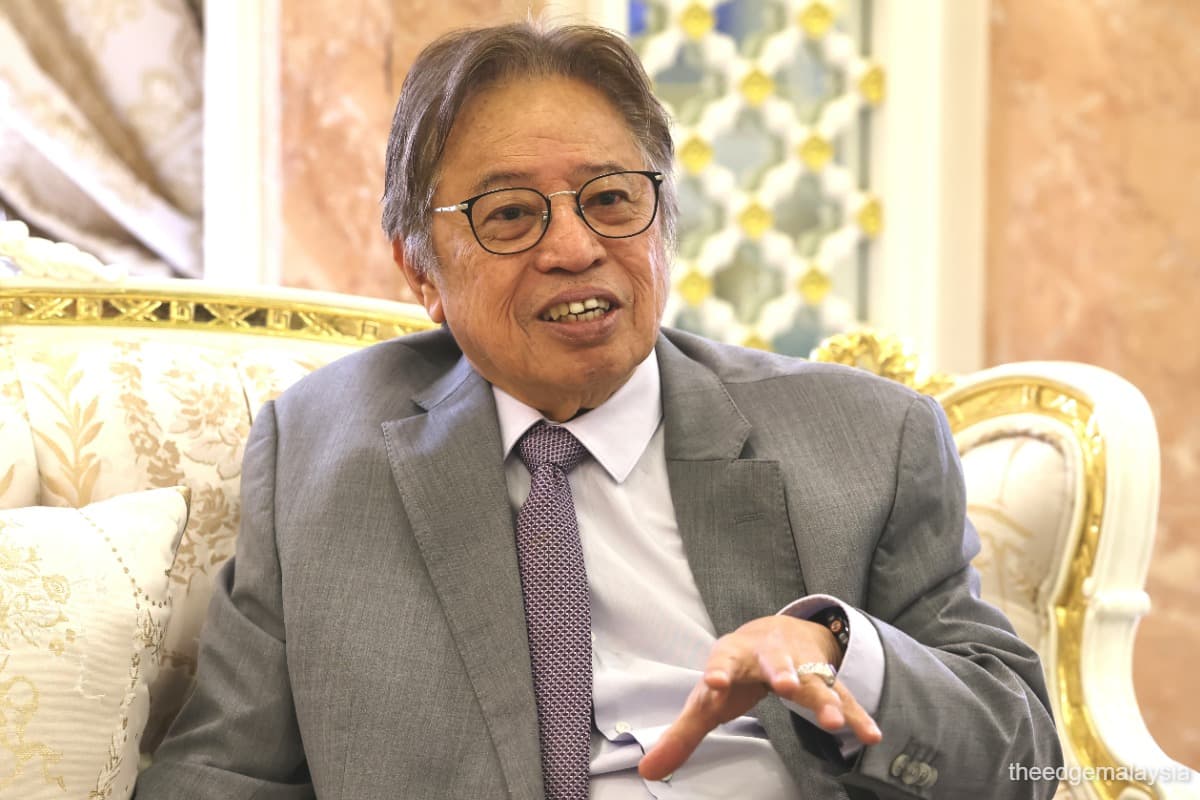
This article first appeared in The Edge Malaysia Weekly on November 2, 2026 - November 8, 2026
During The Edge’s first interview with Tan Sri Abang Johari Tun Openg at Wisma Bapa in March 2023, he explained why Sarawak’s state leader is called premier and not chief minister or menteri besar as in the peninsula.
The conversation then mostly revolved around the MA63 (the Malaysia Agreement 1963), the debate on rights to Sarawak’s rich hydrocarbon reserves and the state’s healthcare and education autonomy.
He told us that Sarawak recognises the Unified Examination Certificate (UEC), wanting graduates from Chinese schools to join the civil service in order to stop the brain drain. And he made it known that the state wanted to have a seaport, an international airport in Kuching (for connectivity) and an equity stake in a commercial bank (for investment capital), among others.
Three years on, Sarawak is the single largest shareholder of Affin Bank Bhd (KL:AFFIN), holding a 32% stake. It also has a 26.67% stake in Bintulu Port Holdings Bhd (KL:BIPORT), whose wholly owned subsidiary Bintulu Port Sdn Bhd was appointed the operator of the port by the Bintulu Port Authority Sarawak with all requisite approvals from the Sarawak cabinet. Hence, authority was transferred back to the state from the federal government. The state also took over MASwings and turned it into AirBorneo.
Sarawak’s gross domestic product rose to RM153.5 billion in 2025 — the fourth largest after Selangor (RM460.1 billion), Kuala Lumpur (RM265.1 billion) and Johor (RM170.9 billion), according to the Department of Statistics.
The state’s revenue grew from RM11.9 billion in 2022 to RM13.5 billion in 2025. Revenue is expected to reach RM13.6 billion this year and RM15.1 billion in 2027.
Now, the premier is looking beyond Malaysian shores and politics. He is mapping out strategies to make Sarawak an investment destination for technology-intensive industries.
The Petronas-Petros dispute is regarded as merely a technical puzzle now. “It is a question of understanding the law”, which an independent committee has been tasked to address, Abang Johari says. He is confident the issue will be resolved by year-end based on the joint declaration that he signed with Prime Minister Datuk Seri Anwar Ibrahim last year.
No longer dwelling on grievances, Abang Johari now talks about GPU (graphics processing units), gallium nitride chips and nano-satellites. He also mentions rare earth mining, insisting that Sarawak will not export the raw mineral.
“We want to export intelligence, rather than just energy,” he tells The Edge in an interview conducted a week after he tabled the 2027 budget at the state assembly.
Sarawak offers affordable green power and global players bring the latest technologies with them, he says. However, he acknowledges the need for the state to cultivate talents. “So I am giving free tertiary education to all Sarawakians. We are emphasising STEM subjects. The next one will be nano-satellite.”
He has stretched the horizon from 10 years to 25 years. The Post Covid-19 Development Strategy (PCDS 2030) is only the first leg, and his plan is “at least 25 years”.
His brainchild is a 2,000ha site at Tanjung Embang that will have a low-carbon gas hub, a seaport about 8km off shore, a Doha-style transit airport built on Sarawak’s own account and an artificial intelligence (AI) grid campus.
This isn’t just a grand plan on paper. Last month, Soft Bank Group Corp, Grab Holdings Ltd and Petroleum Sarawak Bhd (Petros) entered into a framework agreement to explore developing an AI and digital infrastructure platform in Sarawak. The three parties will develop a road map for the phased development of the platform.
In September, the 76-year-old leader dropped a bomb shell, saying that this could be his “final year”. When asked about the continuity of the state’s long-term grand plans, Abang Johari replies that no one can go against nature, so he needs to groom leaders.
The Sarawak state assembly was dissolved last Monday (Oct 26). Some say that may set the stage for his successor to step up.
The following are excerpts from the interview conducted by Isabelle Francis, Jose Barrock and Kathy Fong.
The Edge: Premier, under your leadership, Sarawak has achieved quite a lot. For instance, greater autonomy in education and healthcare, owning a substantial stake in Affin Bank, and you have an airline now. Are you happy with what you have gotten so far, and what’s the next plan under Post Covid-19 Development Strategy 2030 (PCDS 2030)?
Abang Johari: The basics are still based on what we have agreed under our PCDS policy, meaning we have to give emphasis to the future for Sarawak based on her strength. Sarawak’s strength is basically in energy. Energy is the key transformation agent, from the first revolution until today, which is the fifth revolution.
And from energy, then you have to formulate policies on how to get investments in. But it must be a high-end investment strategy. When you talk about, for instance, microelectronics, we cannot be just an assembler, we must be involved at the front end, in terms of producing the tool itself.
First, I introduced what I call the digital economy [as a means] to leapfrog. And after that, we talk about the hydrogen economy because hydrogen is clean energy. Hydrogen, you can extract it from water and natural gas. We have abundant water resources, hydropower dams, as well as natural gas.
And from then on, you have to assemble the strategic enablers to achieve the objective.
The acquisition of a bank is a commercial transaction. At the same time, we are on the island of Borneo. We must have connectivity. So I discussed with the federal government that perhaps we take over MasWing. So it has become Air Borneo now.
And developing ports is also important. I am very pleased that the government has agreed to give us back Bintulu Port.
Premier, you’re also going to build another seaport and a new airport?
Yes, yes. I have identified Tanjong Embang as another industrial hub. I call it both an aeropolis as well as a new gas hub — a low-carbon gas hub. And this area is more than 2,000ha.
Another one is our international airport. And then surrounding it, we will build what we call an AI grid campus. You see, AI now is basically connected to data centres. It requires a lot of energy and water, so we have to prepare for that.
In five to seven years, there will be the AI grid. We have to prepare for that because technology advances so fast. Now you have what we call a supercomputer. The computing will enable data to flow in real time. You don’t have to store data. The data will flow as long as you have very strong connectivity.
Is it fibre optic (connectivity)?
Not necessarily fibre (optic).
Cloud computing will be the key. When you have the flow of data at the speed of light, what you need is just the GPU (graphics processing unit). I went to Bristol in the UK. I saw a lab researching this. That’s why in IT, the next phase will be supercomputers. And then the result of that [is] what I call, AI grid. Actually, Europe has already started [on this].
When do you plan to start work on the AI grid campus?
Next year, January … the moment [the Sarawak state] budget is passed. Completion should be soon. It will fast track development by our state agencies. Of course, it is public-private partnership.
The Asian Development Bank in Manila asked us about this development because they are very interested.
So for the AI hubs, when will we see it happen?
I have a meeting on it after this. The developer [of the AI Grid campus] is Petros (Petroleum Sarawak Bhd). The whole area includes a deep seaport. The seaport will be about 8km [from shore]. It’ll be built with the carbon capture [facilities]. And it will be linked to our Bintulu Port.
When you say link with Bintulu Port, what does that mean?
The shipping industry is now shifting from hydrocarbon-based fossil fuels to low-carbon fuels.
And low-carbon fuel will be methanol or ammonia. Bintulu Port will be equipped with the production of [low-carbon fuel] because we already have our methanol there. Then you can provide bunkering facilities to the international shipping companies that come from the West, India, [through] Strait of Malacca, Japan, China …
And, of course, our advantage is that we still have the space. Singapore has also approached us. It’s Bintulu Port that will manage it.
What role will Singapore play?
They are just talking to us on how to collaborate with them. It’s very preliminary. What we are looking into is more on the services that they can provide to the shipping industry on that route to East Asia.
But one thing, we have our own strength, we have the gas. We are producing methanol after the [Strait of] Hormuz problem because some industries are depending on the Middle East supply. There are inquiries from the buyers whether we can increase the production of methanol because we’ve got one [production plant] in Bintulu and the other one in Labuan. What we’re going to do is we have to expand, include green methanol.
Is this low carbon hub a 10-year plan?
Oh no, no … it has to be a longer-term plan because we are now recognised by the World Economic Forum as a new emerging industrial cluster. You know, the only one in Malaysia, because of our low-carbon [fuel supply]. Out of 1,339 recognised in the world, [among] the new ones, one is in Malaysia — Samalaju.
So, for [the supply of] green energy, what are you looking at?
Gas is still green, [although] they call it blue; it’s still low carbon. And then we have hydro [power]. And hydro is being expanded into what we call [pumped] storage hydropower. And also cascading dams. And we have solar power. Floating solar panels as well as solar panels on the land. And then we got biomass. We got four [types of green energy]. So, we have a mixture of renewable energy, and that’s why we are able to participate in what we call Asean Power Grid. We are now supplying to Kalimantan, Indonesia. And we are supplying power to Sabah. Next will be Brunei. And then after that, Singapore, Peninsular Malaysia.
So the submarine cable is happening? And how about the funding?
Yes, it is. The only thing is that Singapore and us (Sarawak) have to work together with Indonesia because of the [sea] corridor for us to lay it. There is a corridor under Asean. I leave it to the federal government. It’s a government to government [matter].
I think the funding will be a collaboration between Malaysia and Singapore. In Malaysia, they’re talking about TNB (Tenaga Nasional Bhd) and PETRONAS. And Sembcorp is for Singapore. For us, Sarawak, it is just producing power.
Are you building the airport with Malaysia Airports Holdings Bhd (MAHB) or is it a state project?
It’s on our own. But now there has been discussion. Apparently, MAHB is interested in taking equity. We need a state-of-the-art airport.
I have seen how Doha Airport was built. The traffic to Africa, to Europe, as well to Asia … the design is such that passengers in transit won’t lose their direction. I don’t take 100% [of the design], but use that as a model.
Is there still a lot more gas to be discovered and developed in Sarawak?
Yes. There’s one gas field outside of Kuching, the western field, except that the gas is sour gas with high sulphur and carbon dioxide. But there is technology now to separate them, and then the sour gas will become sweet gas.
And based on the preliminary study, the gas reserve is quite substantial there. You must remember the [gas reserve] belt. The gas reserves and oil are from the northern part of Borneo; Kimanis, then it goes down to Brunei, to Baram, goes down to Mukah, and now it’s Balingian. It’s halfway [through Borneo]. And then after that, they go to Natuna. So the geology is there. Now is only the question of technology.
Premier, what we’re talking about now is old gas. But there’s a lot of new gas that has not contracted …
Yes, we have the Adong Kecil onshore, done by Petros. And that’s only one well, 800 barrels per day. It’s supposed to be about eight wells there, onshore. And now you’ve got a new technology on exploration of gas [onshore].
Balangian is onshore. Let’s see how it goes.
Premier, you shared with us in a previous interview the plan to install 10 gigawatts (GW) by 2020 and 15GW in 2035. Is that on track?
Yes, 2030 is on track [with] 10GW. Then 2035, we expect we can generate 15GW based on our development in solar, and you must also take into consideration the development of batteries [technology], because solar [power] depends on batteries. And then the new technology replaces lithium with sodium now.
Now they are saying, instead of four hours, the battery can supply 12 hours. At the moment, we are producing 50MW from Batang Ai (hydroelectric plant).
We are working with China. Number two is Masdar Abu Dhabi (Future Energy Company). And then there is one more [party] doing a study on our Murum Dam, Baleh Dam and Bakun Dam.
Premier, all these plans, but then you say you might step down.
Oh (laughs). Basically, I’m talking about age. You cannot go against nature. But we have the basics now, then we have to groom [the next] leadership to continue [with developments]. Because this one (AI grid campus) is not a 10-year plan. It could be 20 years. The direction is already there. What is also important is inclusivity and political stability. Now we are talking about the export of intelligence with energy [that we have].
Petros is now talking to SoftBank (Group Corp) and Grab Holdings Ltd.
That’s why I am preparing our human resources by giving free education. I am giving free tertiary education to all Sarawakians. So we are emphasising on STEM subjects.
The next one will be nano-satellite. I’m going into satellite also because the next trend is data intelligence — data and semiconductors going together. And Malaysia must be able to design semiconductors, design chips. And we are doing it now because we are supplying chips, even to China.
If you look at the semiconductor industry, Nvidia Corp is very strong in design. And then Taiwan’s TSMC is producing it. For us, we have our own foundry now, X-Fab; it’s been there more than 10 years. What we need now is a new semiconductor chip that can keep the volume of data. It has to be a new chip, a gallium nitride chip. At the moment, it’s silicon. But silicon chips cannot store a volume of data because when you store [a large volume of] data, it produces heat. If you are using silicon chips that cannot contain the heat, then habis lah.
I think Malaysia can do it. Sarawak can do it. We have tried. Our work is at a lab in Cardiff, the UK. Now we have produced it. They call it K-E-T-E-Q AI. Our chip is used by China for their electric meters. The chip is designed by Sarawakians.
Does that mean Sarawak already has a supply chain for the semiconductor industry?
More or less. That’s why we have to produce a new generation of chips, which will link to our nano-satellite. For a space economy, you must have your own satellite to keep your data, and at the same time, to detect new data.
And you must have a constellation of satellites. That’s why you go for a nano-satellite in low orbit. If you go for a higher one, it’s very costly. But what is important is that you can extract data from Earth.
Our university has a faculty now in space [science]. The Sarawak Space Agency now is chaired by former Chief of Defence Forces Tan Sri Affendi Buang. I studied the case of Measat. The ground station was not that well prepared. We have even studied RazakSat. What is important now is having a strong ground station capable of communicating with low-Earth-orbit satellites. If you want to go towards exporting intelligence, you must have all these ecosystems.
You’re looking at the satellite business as well?
Yes. [At the moment] I’m just studying what happened to Measat. And then we will analyse where the weaknesses are. Because our advantage is our location right on the equator.
So, you have an advantage with your satellites out there, low orbit. Then you must have a group of satellites. The communication must be consistent. For this, I have to work with the federal government. I told them, because your data is important, it’s sovereign data.
You mentioned political stability just now. How do you find the current situation in Malaysia?
I can’t talk about Peninsular. As far as Sarawak is concerned, we manage to have stability.
How’s your relationship with the federal government?
Cordial. We have worked with every prime minister. After (Datuk Seri) Najib Razak, then (Tun) Dr Mahathir Mohamad. After that (Tan Sri) Muhiyiddin Yassin and (Datuk Seri) Ismail Sabri Yaakob.
Has Umno approached you about the passing of the national budget?
Some people did ask for my view, but I said I’m concentrating on our state budget.
Under the Pakatan Harapan leadership, has it been better for Sarawak? If Umno comes back, do you think it would be different?
No, no, it’s up to them. But the ultimate is for Malaysia’s stability. You know, when I was called by the [previous] Agong (Sultan of Pahang, Al-Sultan Abdullah Ri’ayatuddin Al-Mustafa Billah Shah), the last time, His Majesty asked ‘Are you willing to join the unity government?’ Then I replied to the Agong, menjunjung titah demi untuk Malaysia (accepting the King’s order for the country).
Stability is very important. You know, we (Malaysia) were quite far ahead of Vietnam at one time. We were ahead of even South Korea. But now we are behind them. And all our neighbours are prospering. Malaysia has the strength. It is a question of how you manage it.
Sarawak’s potential to create plenty of energy, green power. Instead of exporting energy, the state wants to export intelligence. How is this concept different from the past?
This is the reason why I want to establish the AI grid campus, so all activities will be there, because all these — like storage of data, dissemination of data and transport of data intelligence — all require power. So, we establish the AI grid campus because we have energy to offer and then let the global players come here and that will create jobs for our people.
But we must have talents [to attract investments]. That’s why we have talent development through our universities. So that there will be high-pay jobs [available]. Our strength is having power, [while] investors’ strengths are knowledge and technologies. They come in with the ‘brains’; and then (we) export intelligence, backed by our graduates who will be under the top management. For all you know, our people can create something new.
Costs will be a main concern for investors. If your [price of] power is reasonable, why won’t they come here? Whoever can provide me better terms, I will go there. But what the locals should do is ramp up their intelligence and also build the ecosystem.
That’s why I give free education. It cost me RM200 million for the first cohort. The second cohort will be another RM200 million. The third year, another RM200 million. At least, I have to allocate RM1 billion.
We then produce 10,000 [graduates] a year, graduates of high calibre in 64 disciplines, all science-based. Only a few in finance, banking, psychology and cybersecurity. Swinburne, Curtin, University of Technology Sarawak and also iCATS University College — they are the ones supplying [human capital]. Then, we sponsor them [the graduates] to do master’s programmes overseas.
The new area [of study] is the seven elements of rare earth.
I don’t want to export it. For instance, the chip gallium nitride is from rare earth. And your super magnet for your market chip is rare earth. We have deposits of rare earth that will produce gallium.
Have you discussed with the federal government regarding rare earth? Does Sarawak have autonomy over these rare earth resources?
You know very well the eastern states, Kedah, Terengganu, Kelantan have it. In Borneo, we have.
(For Sarawak, the autonomy) is similar to this CCUS (Carbon Capture, Utilisation and Storage) and carbon trading. I know the federal government is going to enforce a tax on carbon. But we have our own law (Land Code) on CCUS because the land is ours. So I told them (the federal government), separate law. They have agreed to it. In this [Sarawak] budget, I did mention the levy and it cannot be double taxation for the buyers.
Rare earth is our mineral, and when you add value to that mineral, it’s commercial value for the investor. But the federal government will gain because all the taxes go to them. Corporate tax goes to them, income tax goes to them, everything goes to them. Except what we (Sarawak) have is sales tax.
Is there any amount you’re investing in rare earth mining?
This sort of thing, you cannot rely on foreigners. So you must have the technology on your own. So what you do is you study, you send your student to do it and learn the technology. If you depend on other people, then teruk (bad) lah.
That’s why we are in the middle-income trap. Because you never go to the front end. But the value is up the chain; you must create [value]. That’s what Malaysia should do.
You know, what transformed South Korea are Samsung and these big, big companies; they create new things.
I’m not criticising, I’m thinking because we are just following people all the time. Penang, macro-electronics, these are assembly plants. The front end is still in the Silicon Valley [in the US]. That’s the front end; you must have the brains. That’s why I was talking the other day with Masayoshi Son (of Softbank Group) during his visit here. I said, it’s the artificial brain and the natural brain. It’s all basically neurons.
Artificial intelligence is actually algorithm plus neuron, kan? And I did mention, reverse ANN (artificial neural network) to detect fake data.
Where do you see Sarawak in 10 years’ time?
I think it has to be at least about 25 years. Now, this is my 10th year. Very short. My PCDS has not been completed. Succession is important. I’m grooming my colleagues. And then, you know, they must have that determination. And also to take risks. I mean, the leadership must take risks, calculated risks.
When I introduced hydrogen, [there were] a lot of sceptics. But now, because of the improvement in membrane technology, the cost of producing hydrogen is coming down now. And Germany is coming back to hydrogen. China is also coming back to hydrogen. And we got hydrogen. I mean, your gas is what? H is hydrogen, water is H2O. So what do you do? You retrieve that. And then in hydrogen also, there’s a molecule within hydrogen called deuterium. And deuterium is the basis for fusion energy, reaction of gas. And fusion energy is safer than nuclear [energy]. Malaysia should be going towards that. Then you have the transition from fossil fuels and hydrocarbons to fusion energy.
Save by subscribing to us for your print and/or digital copy.
P/S: The Edge is also available on Apple's App Store and Android's Google Play.