

(Nov 6): Hedge fund managers, brokers and wealthy investors in Asia had a hectic Friday as the sharp selloff in equities reignited fears that the unwinding of artificial intelligence (AI) bets is far from over.
Money managers fielded worried phone calls as losses rippled through some of the market’s most crowded trades. Wealthy clients from Taiwan to Hong Kong faced margin calls on leveraged bets, according to people familiar with the matter. In Hong Kong, some investors braced for steep losses from structured notes as they were forced to take delivery of shares at a loss, they said.
“This is as extreme as almost any I have seen since the dot-com bubble,” said Chris McGuire, who began trading options at the CBOT in 1991. He now manages a Japanese convertible-bond arbitrage fund at Eagle’s View Capital Management. “The unwind by equity holders who all appear concentrated in the same stocks or sectors has created more one-way momentum than we have seen for a long time.”
The wild swings inflicted widespread losses in the hedge fund industry, including for giants such as ExodusPoint Capital Management and Millennium Management, though some benefitted from the volatility. McGuire said his fund gained an estimated 2.5% or more this month.
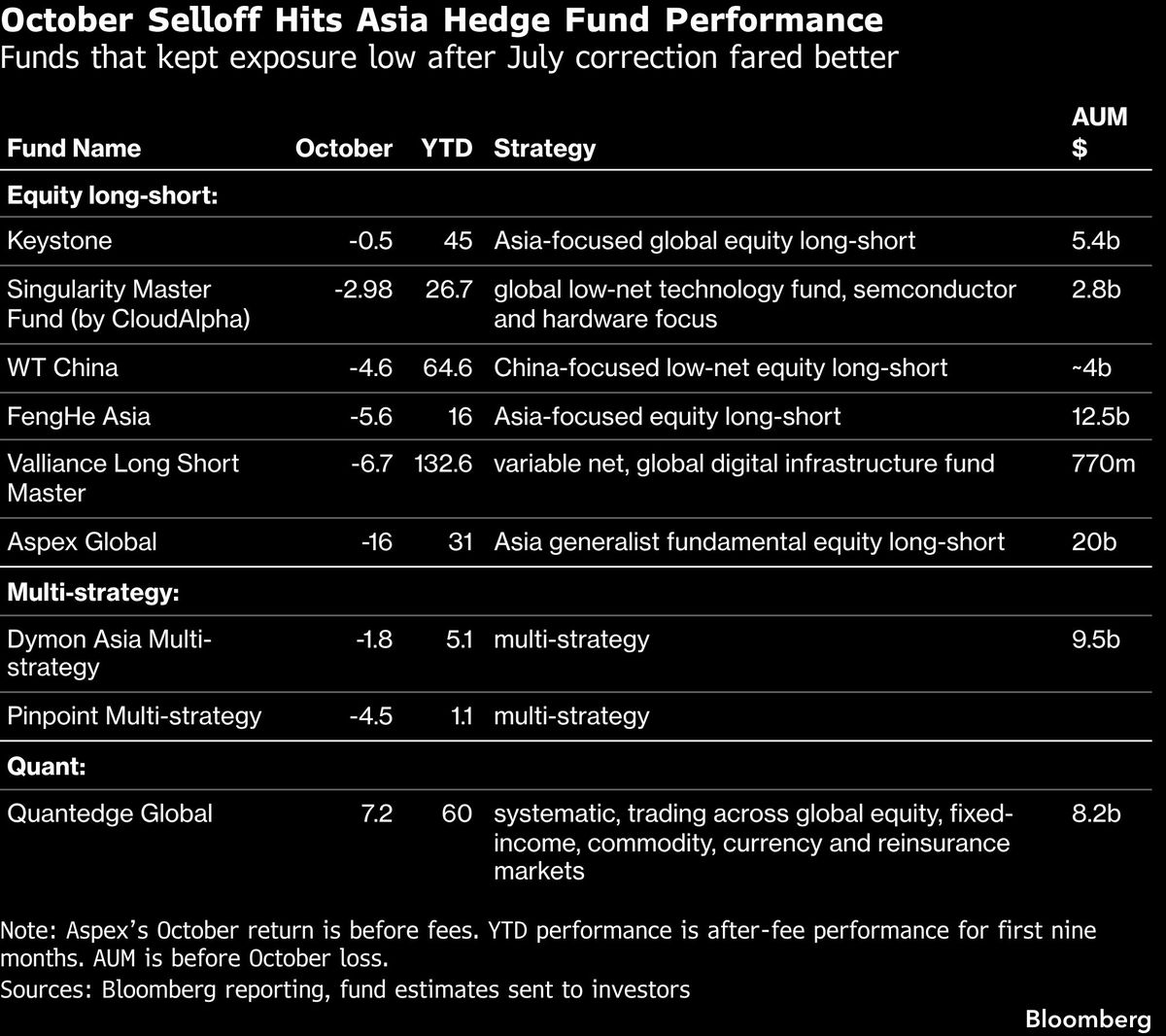
The larger picture across Asia, however, was downbeat. Hong-Kong based hedge fund Aspex suffered a 16% loss in last month’s technology shares rout, according to people familiar with the matter. In China, long-only quantitative strategies lost more than 10% in October, wiping out their gains for the year, according to a report from China Merchants Futures.
Goldman Sachs Group Inc prime brokers estimated Asia stock pickers lost 9.4% last month, eroding this year’s gain to 14%. Those focused on China tumbled 11% in October, reducing this year’s return to 16%.
Some other funds saw smaller losses. Valliance Asset Management said in an investor update that its Long-Short Master Fund fell 6.7% in October. CloudAlpha Capital Management’s US$2.8 billion (RM11.33 billion) Singularity Master Fund slipped nearly 3%, avoiding larger declines by keeping its exposures low, according to people with knowledge of the matter. The two funds didn’t respond to emailed requests for comment.
The technology selloff is being driven by expectations that Democrats, who have gained power in both houses of Congress, will push for stronger regulation of AI and slow the build out of data centres. In the US, Rob Pohly’s Samlyn Capital is dismissing senior analysts after cutting exposure to nearly every sector except global financials and Value Aligned Research Advisors, an AI-focused hedge fund, plunged 33% last month.
The MSCI Asia Pacific Index tumbled as much as 5.3% on Friday, following a rout in the Nasdaq 100 on Thursday that wiped out a record US$2.3 trillion in market value. South Korea’s Kospi Index plunged as much as 8.8%, triggering a circuit breaker.
In Hong Kong, one broker said retail investors began flooding the firm with inquiries overnight, forcing staff to work overtime to calm nerves and discuss risk management strategies. He said the only advice for clients was to “run for the exit” as quickly as they can, and for margin traders to focus on lowering their leveraged bets.
Even so, the broker said the risk of widespread forced liquidations was somewhat reduced because his firm had begun urging clients weeks earlier to increase collateral on leveraged technology positions.
“We’re fielding queries about the AI selloff left and right,” said Hiroyuki Ueno, chief strategist at Sumitomo Mitsui Trust Asset Management in Tokyo. “Sell-side clients are struggling to explain what’s going on to their customers.”
While short-term investors can react quickly, larger institutional funds face more difficult choices, Ueno said.
For many investors across Asia, the key question is no longer whether AI valuations needed a reset, but how much further the selloff will go. Confidence has evaporated faster than liquidity, leaving traders searching for a floor in a market where few are willing to call a bottom.
“The impression I got from our team’s morning meeting is that the market is behaving irrationally,” said Hiroshi Namioka, chief strategist and fund manager at T&D Asset Management Co. “I wouldn’t go so far as to say it’s outright panic, but investors are finding it difficult to see upside.”
Market participants also pointed to options-related flows amplifying volatility as key technical levels gave way.
“It looks more like a position blowout than a fundamental rethinking of the future,” said Travis Lundy, a Hong Kong-based independent analyst who consults for hedge funds. “A bad October for some appears to have triggered early November unwinds which have cascaded.”
Uploaded by Felyx Teoh