


This article first appeared in City & Country, The Edge Malaysia Weekly on November 2, 2026 - November 8, 2026
The Johor property market is witnessing a “sharp bifurcation”, with fewer transactions, and deals closing at higher prices as buyers and banks grow more selective and demand shifts towards transit-linked, well-located homes, according to Olive Tree Property Consultants Sdn Bhd CEO Samuel Tan in presenting The Edge Malaysia | Olive Tree Property Consultants Johor Bahru Housing Property Monitor 2Q2026.
“Total deal volumes may be moderating, but closures are happening at significantly higher average price points. This divergence is driven largely by highly concentrated demand,” Tan says. “Properties within walking distance of the Rapid Transit System (RTS) Link are experiencing intense demand and rapid capital appreciation, absorbing high-value inventory and propping up total transaction values. Similarly, landed residential properties are transacting at a premium, a consequence of both elevated construction costs and sustained demand for space.”
Tan says the momentum from the first quarter has continued into the second. According to the National Property Information Centre (Napic), Johor recorded robust activity in the first quarter, with 13,598 transactions worth nearly RM11.3 billion, while nationwide volumes slipped 8% year on year (y-o-y) even as values held firm. He says the contrast shows buyers are taking a measured approach.
The bulk of the unsold completed units is concentrated in non-differentiated, legacy high-rise units priced between RM500,000 and RM1 million in less strategic locations to which Tan says banks remain selective in approving loans, having moved away from the “wait-and-see” frenzy of the past towards targeted capital deployment.
“Today’s serious buyers are successfully passing rigorous loan appraisals to secure investment-grade assets [while] weaker, poorly positioned projects struggle to attract qualified purchasers,” he adds.

Growing GDP
Malaysia’s economy continues to defy external pressures. National gross domestic product (GDP) grew 6% y-o-y in 2Q2026, beating market expectations and helping cushion the economy against higher energy costs and ongoing geopolitical tensions.
Johor remains the standout, Tan says. “Having recorded an exceptional 8% GDP growth in 2025, Johor’s economic trajectory has consistently maintained a premium over the national average. With a positive net business confidence indicator of 1.2% in 2Q2026, the state is riding a wave of materialising investment tied to the Johor-Singapore Special Economic Zone (JS-SEZ) and tangible progress on monumental cross-border infrastructure.”
These investments are transformative and poised to “generate economic spillovers, cultivate local vendors and create more than 200,000 new jobs by 2030”.
Infrastructure update
As the RTS Link nears completion, developing a robust local transit network around the station is increasingly crucial.
Tan notes that the Ministry of Transport’s announcement of a 450m elevated walkway connecting the RTS Link to JB Sentral and the addition of two elevated bridges linking to Coronation Square are “vital steps for pedestrian integration”.
Another key development is Johor’s growing integration into the region’s digital infrastructure. A Moody’s Ratings report published in May underscores the state’s rising appeal to hyperscale tech companies because of its geographical proximity and connectivity to Singapore.
Tan says: “With an existing 897mw of installed capacity and a staggering pipeline that could exceed 7gw, or roughly 25% of Peninsular Malaysia’s current generation capacity, the data-centre boom is not just driving industrial land prices northwards. It is laying the groundwork for a massive spillover in housing demand for a highly skilled workforce.”
More companies are relocating to Johor, including Gardenia, which has moved its bakery production from Singapore, as well as F&B giants Asia Pacific Breweries and Yeo Hiap Seng.
“This structural shift — positioning Singapore as a headquarters hub and Johor as the manufacturing engine — is a direct testament to the momentum generated by the JS-SEZ,” Tan says.
Headwinds for developers
Despite the strong indicators, developers face significant headwinds, as geopolitical tensions in the Middle East have pushed up the cost of building materials by an estimated 30% to 40%. This raises concerns over future housing affordability and forces developers to launch their projects selectively.
Still, demand is holding up in the more affordable segments. “While the luxury segment experiences a cooling period, the mid-range market (RM300,000 to RM600,000) remains incredibly robust, anchored by genuine first-time homebuyers leveraging stable interest rates. Bank Negara Malaysia’s prudent decision to maintain the overnight policy rate at 2.75% has been instrumental in preserving this monetary stability,” Tan says.
Locally, the Johor State Economic Transformation Plan (JETP), launched in June, aims to ensure growth is not siloed in Johor Bahru, with initiatives such as positioning Batu Pahat as a pilot city for national Sustainable Development Goals (SDG) programmes. The state also remains committed to affordable housing under the Johor Affordable Housing Scheme (RMMJ), which is on track to delivering 100,000 units by 2030.
“Johor’s real estate market is no longer a canvas for unchecked speculation. It has matured into a sophisticated, fundamentals-driven ecosystem. With the impending official launch of the JS-SEZ master plan expected this December, the region is poised for an era of unprecedented, structured growth,” Tan says.
New launches
The resilience of the Johor market is most visible in the second quarter, says Tan, who observes an “aggressive rollout of new projects” that points to stronger developer confidence in the second half of the year.
Malton Bhd (KL:MALTON) has achieved a 70% take-up rate for Mutiara Kempas since its launch in May. The freehold serviced apartment project sits on 2.8 acres and has an estimated gross development value (GDV) of RM300 million. It comprises 562 units in a 39-storey tower, with sizes ranging from 801 to 1,277 sq ft and prices starting at RM336,000. It is expected to be completed in 2030.
In Tebrau, TH Tebrau Land Sdn Bhd has launched Monterra, a RM941 million mixed-use development that has achieved an 80% take-up rate since its launch in May. It comprises 1,565 serviced apartments, a shopping mall, 60 retail lots and a three-storey commercial hub with retail outlets and a medical centre. It is expected to be completed in 2030. Nearby, in Taman Desa Tebrau, Plenitude Bhd (KL:PLENITU) has launched Mandolin Residences, a freehold serviced apartment project of 712 units. Units, which measure 528 to 1,017 sq ft, comprise studio, two-bedroom, three-bedroom and selected dual-key layouts, with prices from RM326,400.
R&F Group has launched the third phase of R&F Princess Cove, Casa Suites@Mercu 3, which is a serviced apartment project offering studios to four-bedroom units. The built-up area ranges from 313 to 1,555 sq ft, with prices ranging from RM430,000 for a studio to RM2.54 million for a four-bedroom unit.
In Pulai, UDA Holdings Bhd has launched Mutiara Residence, with unit sizes ranging from 1,259 to 3,627 sq ft. It is expected to be completed in 2029.
Sutera Utama Development Sdn Bhd has launched the last phase of its 3-storey stratified apartments, totalling 228 units. The Type A Garden Villas have a floor area of 1,324 sq ft, with another 290 sq ft of private enclosed space; while the Type B Duplex Suites measure 1,211 sq ft. Prices start from RM748,000. The reported sales rate is 71% for the non-bumiputera portion.
In June, Faire Development Sdn Bhd launched Taman Nusa Permata in Iskandar Puteri, comprising terraced, cluster and semi-detached houses. The 3-storey semi-detached homes measure 35ft by 80ft and the 3-storey cluster homes 32ft by 75ft. The 2-storey terraced homes come in three versions of 22ft by 70ft, 20ft by 70ft and 20ft by 65ft.
TiLand Development Sdn Bhd is offering Meadow Heights@Bandar Tiram, freehold 2-storey terraced houses measuring 24ft by 60ft and 24ft by 65ft. The first phase comprises 97 units with a built-up area of 2,024 sq ft.
Price movements
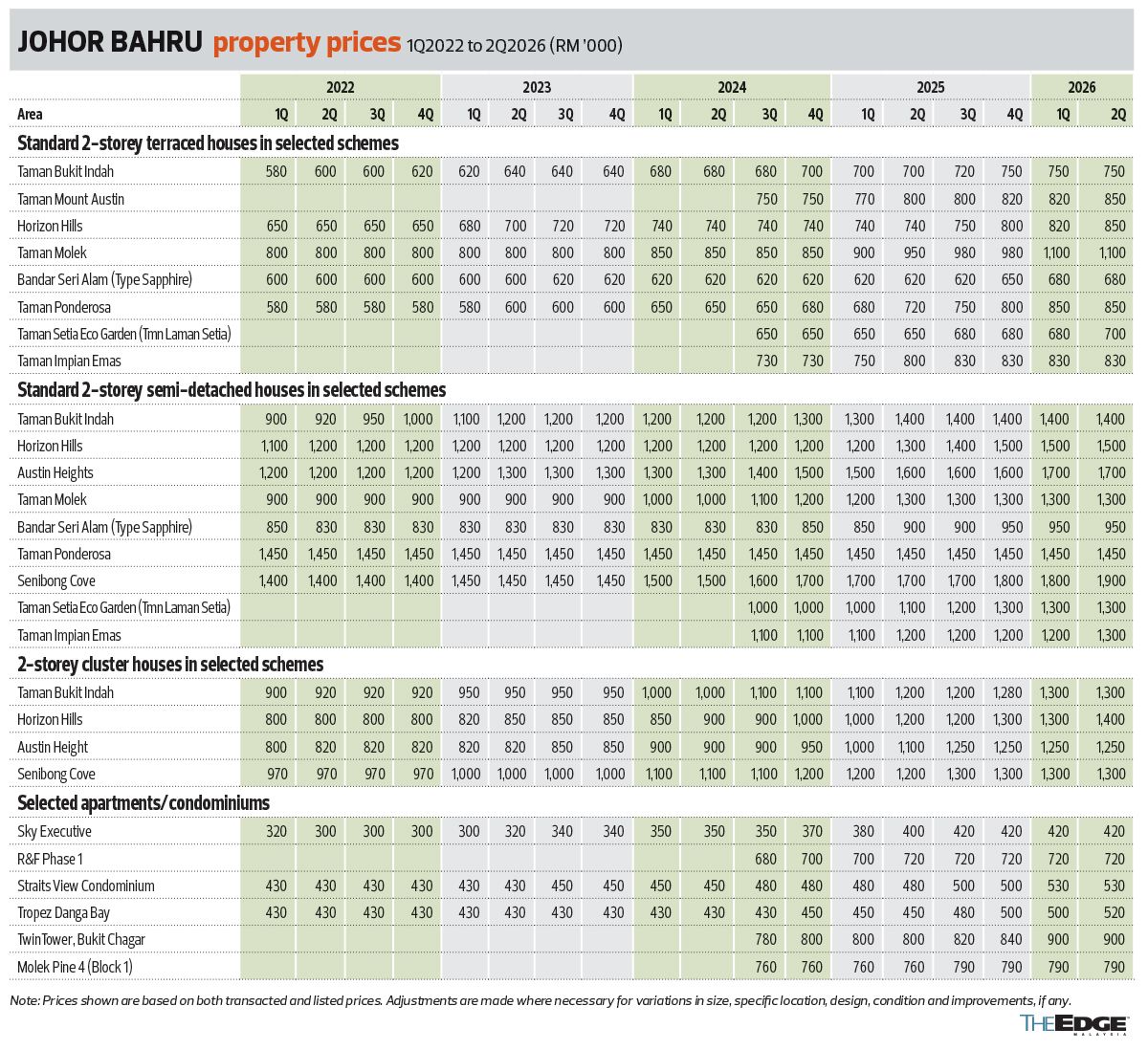
Selected landed homes and a serviced apartment scheme saw prices inch up during the quarter, while others remained largely unchanged, according to data from Olive Tree. Two-storey terraced houses at Horizon Hills and Taman Mount Austin rose to RM850,000 from RM820,000; and 2-storey semi-detached houses in Senibong Cove rose to RM1.9 million from RM1.8 million. Two-storey cluster houses in Horizon Hills climbed to RM1.4 million from RM1.3 million; and serviced apartments at Tropez Danga Bay rose to RM520,000 from RM500,000.
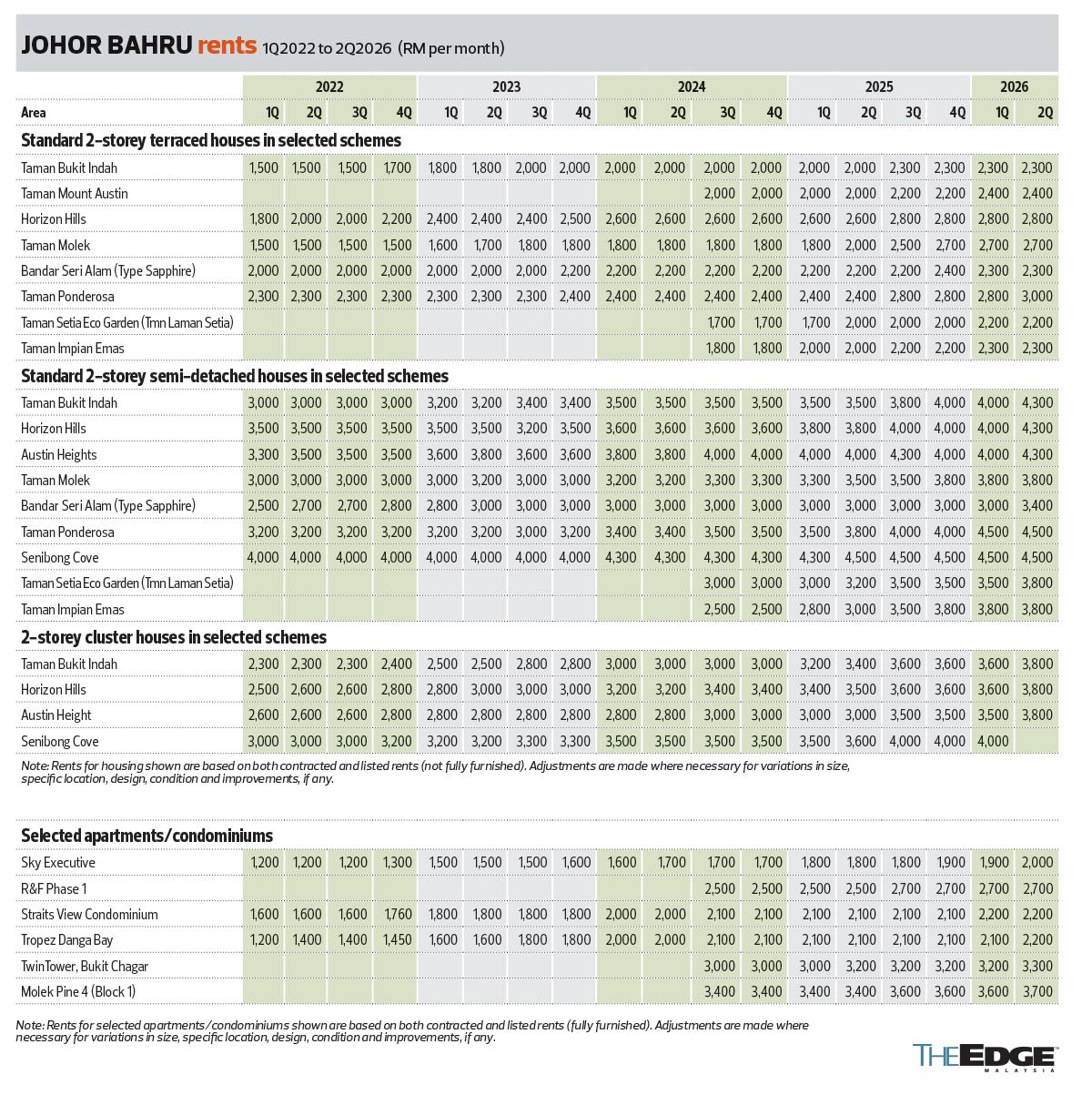
The rental market is stable as well, with only a few selected schemes seeing marginal movement, according to Olive Tree data. Among terraced houses, rent at a 2-storey unit in Taman Ponderosa rose to RM3,000 per month from RM2,800 per month.
Semi-detached houses saw the widest gains. Two-storey units in Taman Bukit Indah, Austin Heights and Horizon Hills went from RM4,000 per month to RM4,300, those at Bandar Seri Alam from RM3,000 per month to RM3,400 and those at Taman Setia Eco Garden from RM3,500 per month to RM3,800.
Two-storey cluster houses at Taman Bukit Indah and Horizon Hills rose from RM3,600 per month to RM3,800; and those at Austin Heights moved from RM3,500 per month to RM3,800. Serviced apartments recorded smaller increases, with Sky Executive going from RM1,900 per month to RM2,000, Tropez Danga Bay from RM2,100 per month to RM2,200 and Molek Pine 4 from RM3,600 per month to RM3,700.
Save by subscribing to us for your print and/or digital copy.
P/S: The Edge is also available on Apple's App Store and Android's Google Play.