


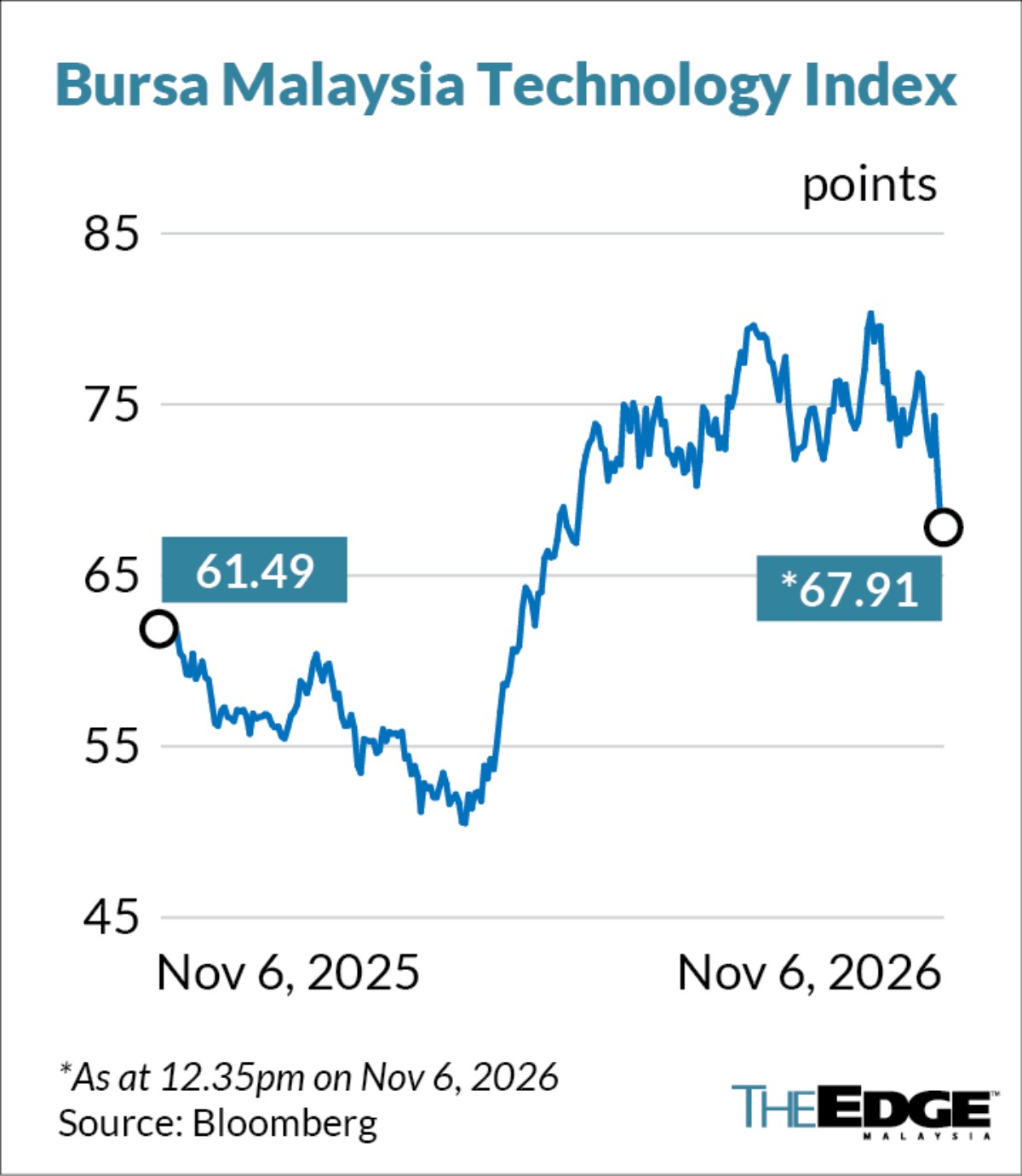
KUALA LUMPUR (Nov 6): Technology stocks remained under selling pressure on Friday, as investors weighed the implications of the Democrats' strong showing in the US midterm elections for the artificial intelligence (AI) trade.
The Bursa Malaysia Technology Index fell more than 6% shortly after the opening bell, making it the worst-performing sectoral index. It subsequently pared some losses but remained down 67.88 points, its lowest level since May 20.
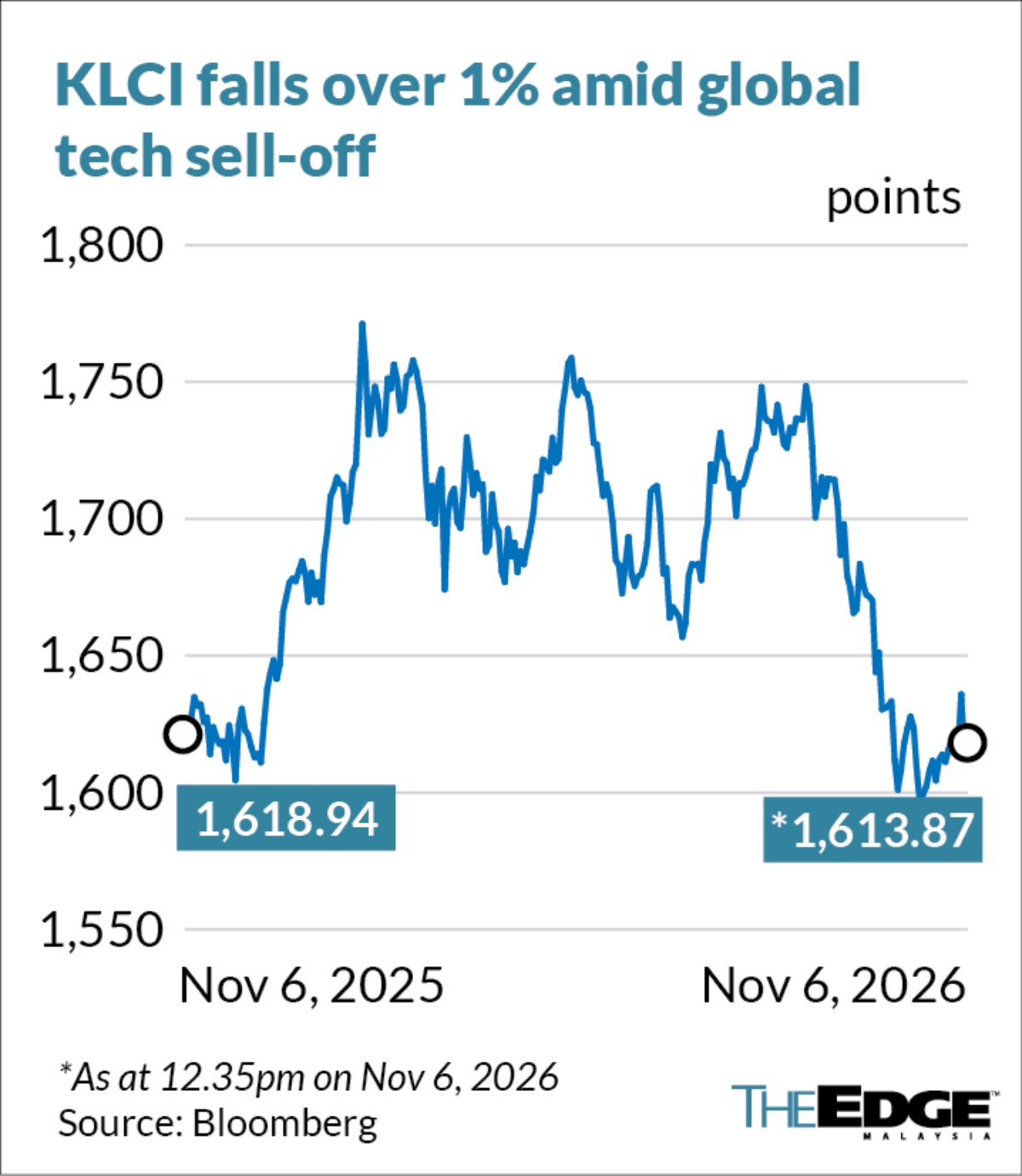
The broader market declined sharply, with the benchmark FBM KLCI down more than 1.25%.
Outsourced semiconductor assembly and test (OSAT) player Malaysian Pacific Industries Bhd (KL:MPI) was among the hardest hit, falling as much as 8% to RM35.80, its lowest since April 22, before paring losses to trade at RM36.40, valuing the company at RM7.69 billion.
ViTrox Corp Bhd (KL:VITROX) also fell as much as 72 sen, or nearly 7%, to RM9.88 before rebounding to RM10.30, despite the Penang-based company's better-than-expected quarterly results.
Frontken Corp Bhd (KL:FRONTKN) plunged as much as 37 sen, or more than 7%, to RM4.49 before paring losses to RM4.56.
Berjaya Research Sdn Bhd head of research Kenneth Leong said the sell-off over the past two trading days was largely sentiment-driven, reflecting a sharp reassessment of stretched valuations and growth expectations surrounding AI.
Nevertheless, he said the longer-term structural growth drivers remained intact, underpinned by continued AI adoption and semiconductor demand.
"We would view the current weakness as a potential valuation reset rather than a broad-based deterioration in industry fundamentals," he told The Edge.
Leong said stock selection would become increasingly important, favouring companies with strong order-book visibility, including UWC Bhd (KL:UWC), Kelington Group Bhd (KL:KGB) and Pentamaster Corp Bhd (KL:PENTA).


He also favoured companies with established customer relationships, citing Frontken's direct exposure to Taiwan Semiconductor Manufacturing Co's (TSMC) supply chain, as well as those with sustainable earnings growth prospects.
Pheim Asset Management fund manager Khoo Zing Sheng said it was too early to determine whether the AI narrative had fundamentally weakened or was merely facing a temporary setback, with much depending on US policy direction.
He cautioned that regulatory and infrastructure delays affecting data centre power and land availability by 2028 could trigger a sharp valuation reset for technology stocks priced for years of uninterrupted growth, particularly chip and memory stocks.