

(Nov 5): Emerging economies’ external debt climbed to a record US$9.4 trillion (RM38 trillion) in 2025, according to the World Bank, boosted in part by the poorest nations facing borrowing cost levels unseen since the 1980s.
Lower-income countries paid an average of 8.2% when taking fresh private loans and 9.4% in new bond issuance last year, the bank said, referring to the countries that can get grants and concessional financing from the lender. For developing nations with stronger economies, the interest rate on new bonds averaged 5.5%.
For many frontier-market issuers the challenge nowadays isn’t so much obtaining financing but the affordability of the credit they can get, the Washington-based bank said.
Private financing drove much of the increase in external debt among low- and middle-income nations — excluding China — in 2025, with net debt inflows climbing to almost US$360 billion, the World Bank said.
The Democratic Republic of Congo raised US$1.25 billion in April in its dollar-bond debut, across two securities yielding 8.75% and 9.5%, sitting “among the highest sovereign coupon rates recorded in 2026 so far”, the bank said. Angola issued by mid-August more than double the US$2 billion it sold last year, while Indonesia and the Philippines also surpassed their 2025 issuance.
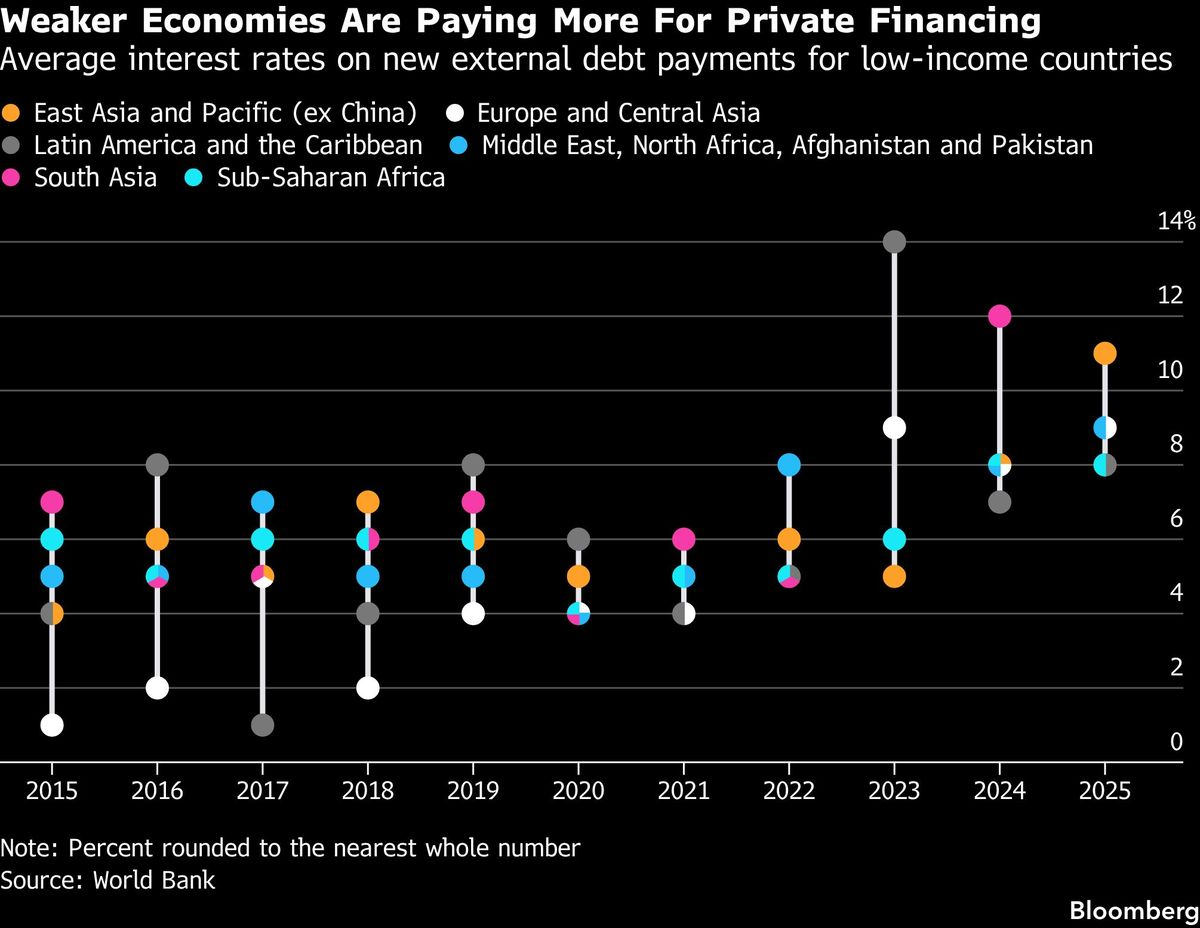
“The return of private lending to low- and middle-income countries is welcome, but these countries are borrowing more, paying more and in many cases leaving less for long-term development,” Haishan Fu, the World Bank’s chief statistician and director of development data, said in a statement.
The bank added that many governments issue new bonds to either buy back debt or smooth repayment over time — without reducing debt stocks significantly. “External shocks can be more difficult to absorb when governments already face substantial financing needs and limited room to respond,” the report said.
Governments are turning to complex liability-management operations and alternative financing structures to manage their obligations. The bank identified growing use of so-called total return swaps since 2024 in countries like Argentina, Colombia, Angola, Nigeria and Senegal, with such financing amounts ranging from about US$1 billion to US$9.3 billion.
These arrangements can provide quick access to foreign currency but carry collateral, refinancing and transparency risks, the bank added.
Uploaded by Chng Shear Lane