

(Nov 5): Goldman Sachs Group Inc and Apollo Global Management Inc are in talks with Wall Street investors to start selling portions of a roughly US$40 billion (RM162.55 billion) chip financing deal for SpaceX, just as the artificial intelligence (AI) boom braces for upheaval following a sweeping Democratic victory.
The two firms have begun approaching potential buyers for the multi-tranche financing, according to people familiar with the matter. The deal, structured to keep the debt off SpaceX’s balance sheet, is the largest arrangement of its kind for graphics processing units (GPUs) on record, SpaceX has said.
In some cases, investors are being asked to purchase slices of as much as US$500 million before the official syndication process starts, in an effort to swiftly close the transaction, the people said, asking not to be identified discussing private information. Syndication is slated to start soon, according to the people.
Representatives for Apollo and Goldman declined to comment. A representative for SpaceX didn’t respond to a request for comment.
Elon Musk’s rocket, satellite and AI venture announced the financing in October, with investors agreeing to the package before it priced.
That exposed lenders to market risk during a volatile period. Investors have retreated from the AI trade, questioning whether revenues can ever justify the breathtaking spend — a sentiment that turned lenders against some of SpaceX’s neocloud competitors, including CoreWeave Inc.
Those pressures intensified after the Democrats swept into power in Congress following midterm elections, riding a wave of voter concerns over higher living costs and the war in Iran. Data centres too became a fierce electoral flashpoint, particularly in Texas, which flipped blue just months after freezing new project approvals.
As the political landscape shifted overnight, the market reacted sharply, sending shares of both SpaceX and Tesla Inc lower. SpaceX’s data centres are based in Memphis, Tennessee, and it’s developing other sites in Mississippi.
Under the US$40 billion deal — a win for Musk — a special purpose vehicle managed by Apollo-backed Atlas SP will buy Nvidia Corp chips and issue the debt held by lenders, Bloomberg previously reported. By using this structure, SpaceX protects its corporate credit ratings.
SpaceX will rent the chips through a five-year agreement, according to a presentation seen by Bloomberg News, but is not providing a residual value guarantee or other commitments that have become common for tech firms to secure financing. “SpaceX’s obligation to pay rent is absolute,” according to the presentation.
Crucially, the documents show SpaceX cannot use force majeure clauses to pause its payments — a contrast to firms like Oracle Corp, which Bloomberg previously reported has cited force majeure in an attempt to put off its data centre obligations.
“Rent is owed regardless of equipment condition, casualty or force majeure, providing investors with a clean look-through to SpaceX credit,” the document said.
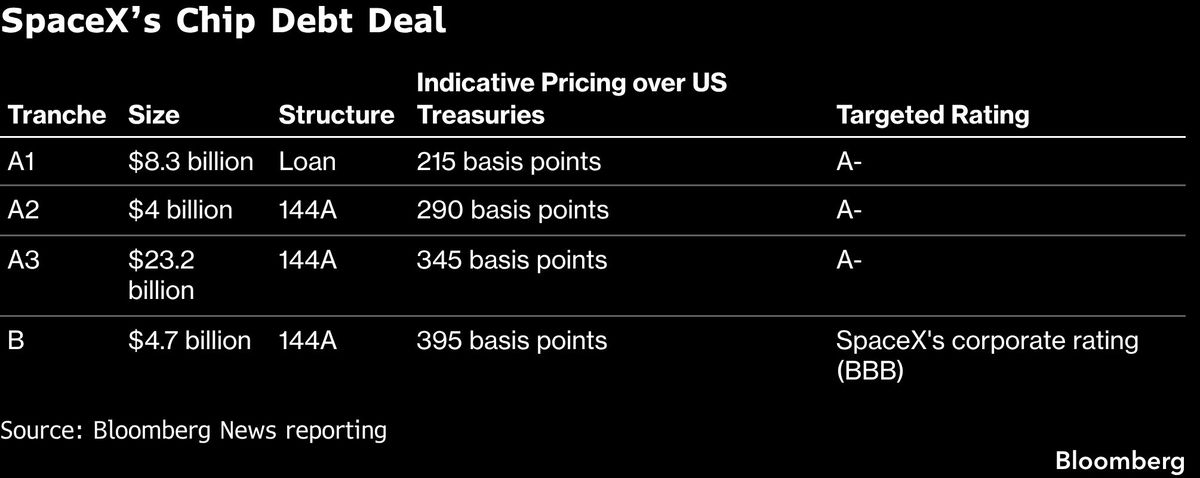
The debt is structured in several tranches, including an US$8.3 billion senior-secured loan that will be syndicated to the banks, and several tranches of bonds that will be sold to asset managers, according to the people. Goldman led the loan portion, while Apollo was the key investor in the bonds, the people said. Pacific Investment Management Co also participated in the deal.
The debt package, along with a lease prepayment of US$7 billion, will be used to pay for about US$47.3 billion of GPU equipment, namely Nvidia’s latest Rubin chips, the documents showed. The chips will be delivered in the first half of 2027.
A gauge of SpaceX credit risk jumped in early trading on Thursday. Credit-default swaps used to protect against losses on the company’s debt increased about 12 basis points (bps) to 282bps, according to ICE Data Services, near a record 284bps reached on Friday. The price of those contracts has surged from 150bps during the past two months as investors grew increasingly concerned about the level of debt being taken on to fund the AI buildout.
Uploaded by Felyx Teoh