

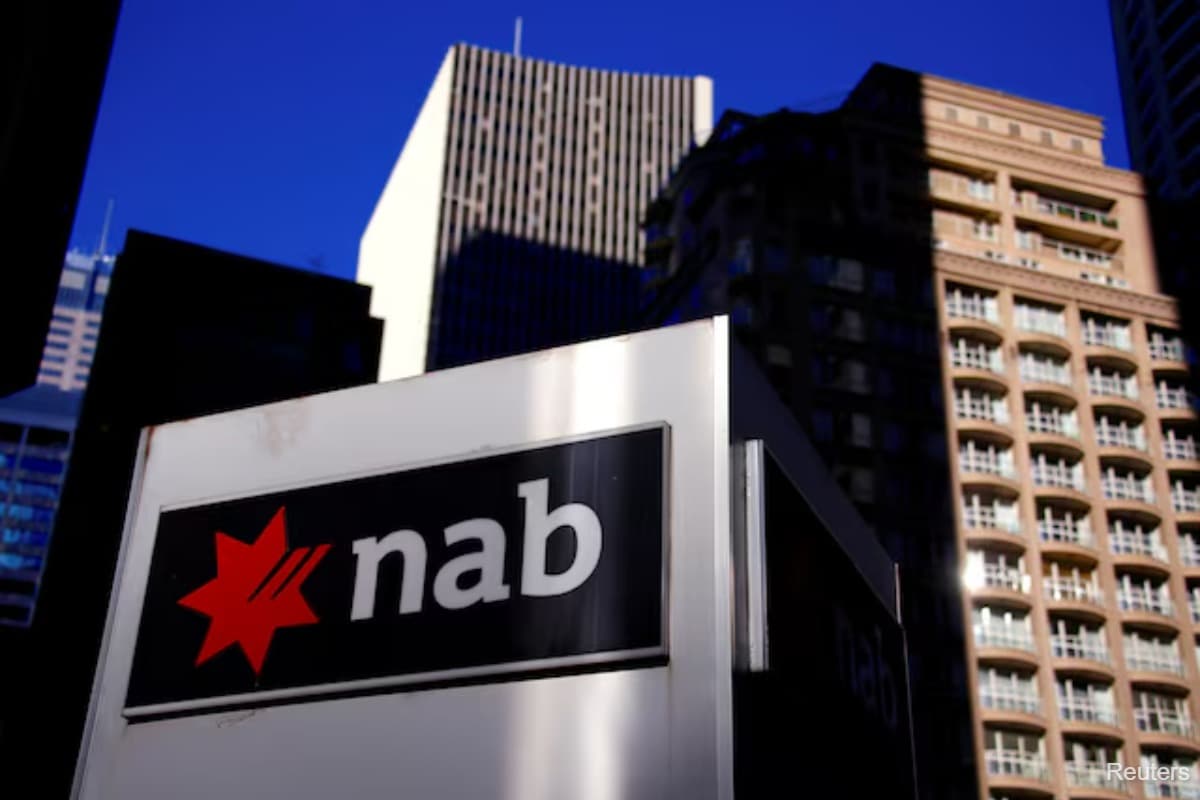
SYDNEY (Nov 5): National Australia Bank chief executive Andrew Irvine said on Thursday that Australia faced a growing risk of recession with flatlining economic growth as consumers absorbed five interest rate rises in 2026, after the lender reported a steep drop in annual profit.
NAB, Australia's top business lender, reported a cash profit of A$6.14 billion (US$4.30 billion) for the year that ended on Septr 30, below the Visible Alpha consensus estimate of A$6.33 billion and A$7.09 billion a year earlier.
The larger-than-expected drop in annual cash profit came as the bank was hit by an 86% increase in credit impairment charges. It also reported higher-than-expected costs, which sent its shares down nearly 8% in their worst session in more than 20 months. NAB shares closed down 5.37%, while the S&P/ASX 200 was up 2.6%.
NAB said its impairments were A$1.55 billion, equal to around 0.2% of gross loans and advances, the highest level since September 2020. It said the higher provisioning was the result of slowing growth, declining house prices, higher interest rates and inflationary pressures.
"Our central case is that we will see (economic) growth of around 1%," Irvine said.
"We don't think a recession is the most likely scenario, but it's probably increased in terms of its probability of an occurrence."
Irvine said NAB's customers had been able to absorb the string of interest rate rises ordered by the Reserve Bank of Australia so far this year.
The RBA raised the official cash rate by 25 basis points to 4.85% on Tuesday, the highest level in 18 years.
Markets are wagering that interest rates have likely peaked in Australia, with just six basis points of additional tightening expected by early next year. Rate cuts are coming into view, with a quarter-point move fully priced by the end of next year.
Inflation has remained stubbornly high, which economists said has prompted the central bank to move rates aggressively.
Underlying inflation accelerated to a two-year high of 3.7% in the third quarter, after spending more than five years above the central bank's 2% to 3% target band.
"It's our view that we're going to see a bit of an uptick, particularly in unemployment," Irvine said.
"And I'm hopeful that this will be the end of the cash rate rises and that we'll start to see them fall maybe in winter of 2027."
NAB's full-year results showed the bank's operating expenses excluding large notable items increased by 4.5% to A$10.29 billion in 2026. The lender forecast underlying expense growth below 3% in 2027.
In October, the bank said it would shed up to 2,500 jobs, or about 6% of its workforce, in the next year to simplify its operations and cut costs while the nation's credit growth remains under pressure.
NAB declared a final dividend of 85 Australian cents a share, unchanged from a year earlier.
Uploaded by Liza Shireen Koshy