

This article first appeared in The Edge Malaysia Weekly on November 2, 2026 - November 8, 2026
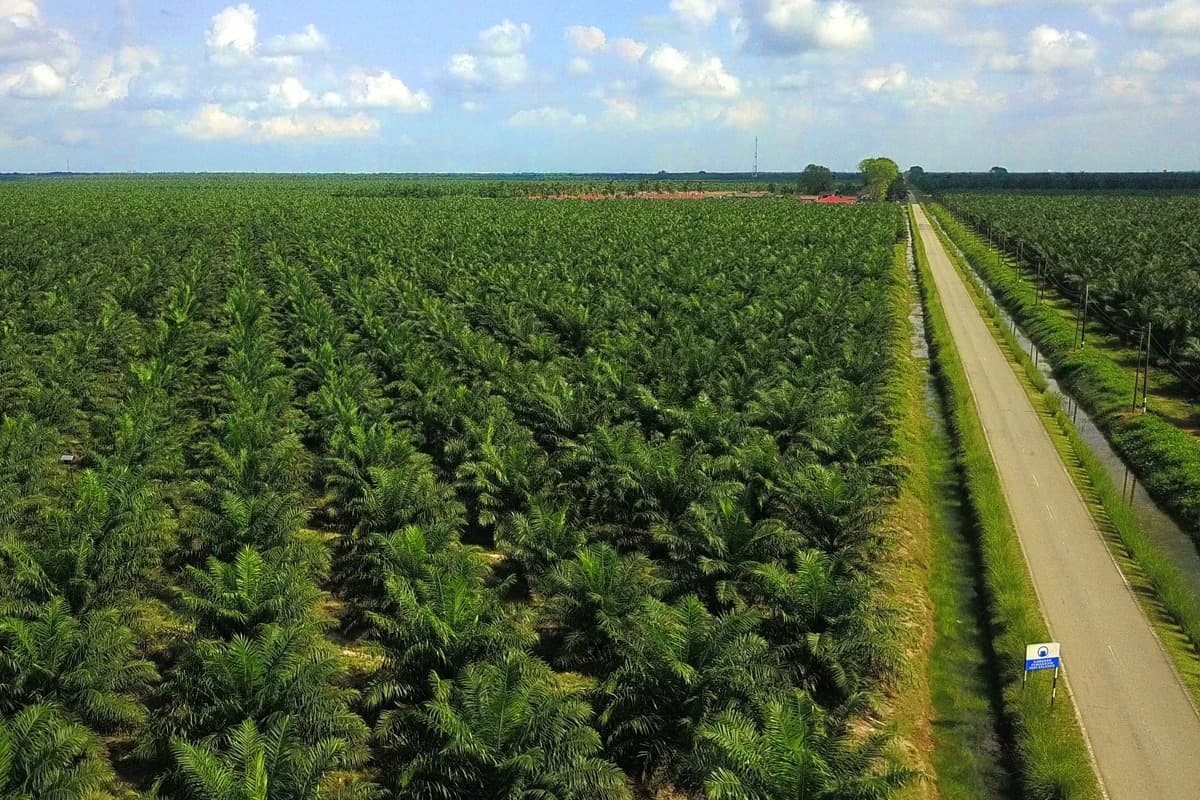
A crop of challenges confronts oil palm planters in Indonesia, from potential land seizures and regulatory uncertainty to forest fires and dry weather threatening yields. Yet, these risks have not diminished the importance of the world’s largest palm oil producer to SD Guthrie Bhd (KL:SDG).
“If you’re going to be in oil palm and you believe in it … you have to be in Indonesia — that’s where the size of the business is,” Mohd Haris Mohd Arshad, president and group CEO of SD Guthrie, tells The Edge in an interview.
SD Guthrie has operated in Indonesia for more than two decades and its local workforce numbers about 22,000, including only 17 expatriates, he says. For the group, building that operation shows its commitment to the country.
Yet, experience and its highly localised operations have not fully insulated the group from the challenges that planters face in the archipelago.
About 3,800ha, or 2% of SD Guthrie’s planted area in Indonesia, is at risk under the country’s plantation land seizure programme. The land forms part of Minamas Plantation, which the group, then known as Kumpulan Guthrie Bhd, acquired from the Indonesian government in 2001.
Indonesian authorities now classify the area as forest land and regard its clearance as illegal.
“We acknowledge that, but then we also say we acquired this plantation [from the government]. We haven’t done any clearing [of forests] in Indonesia at all,” says Mohd Haris.
SD Guthrie is in talks with the Indonesian government to find a solution, he adds. “If you say there’s an overlap now, it is an oversight by the previous owner. [So,] let’s solve it now. We are now working towards finding a solution, which I can’t disclose exactly, but I think it’s very manageable.”
Uncertainty surrounding agrarian reform law
Beyond the threat of land seizures, Indonesia’s newly passed Agrarian Reform Regulation Law has added to uncertainty for planters, particularly over its implications for land ownership and smallholder participation.
The details are “still a bit murky”, says Mohd Haris. His understanding is that the requirement to support smallholder development on an area equivalent to 20% of SD Guthrie’s plantation holdings will become applicable as its cultivation rights (hak guna usaha, or HGU) come up for renewal.
“So, if I had 10ha, 2ha must be with the smallholder. Now, it’s not to say that you must take it from your existing land. [You can] find 2ha for you to work with smallholders,” he says.
The policy is not entirely new, as a similar one known as the Inti-plasma scheme has been practised since 2007, Mohd Haris says.
“Some of our renewals are coming up in 2027, 2028 and all the way until 2032. Those HGU that we are renewing will need to comply with this ruling,” he says.
The challenge in complying lies in finding the additional land for smallholder development, Mohd Haris says.
“Now, that’s going to be quite tricky. With what you see right now ... clearing forests and so forth, it may not be possible. So, you would have to look at shrub land that is available there and then get smallholders to come.”
According to Mohd Haris, arrangements accepted under the previous scheme could offer an alternative, subject to clarification from the authorities.
“For example, can you get the local community to provide services, such as transport services, for you? Can you procure items from them? Create economies within the community there, and that could be used to replace your 20% [land allocation] commitment,” he explains.
“We just need to make sure that that law now, as it fully develops, is aligned to those practices that we’ve been doing in the past.”
Fires beyond its boundaries
Mohd Haris says his first 9½ months at the helm of SD Guthrie have been good, barring the hot and dry weather, as well as the haze. The remark touches on a sensitive issue for SD Guthrie and other large planters, which often find themselves blamed for forest fires in Indonesia.
“This is the reality. Unfortunately, when forest fires happen in Indonesia, the first people that get blamed will be the producers, [as] we are the biggest names, the easiest targets,” he says.
“We have a strict no-open-burning policy, and this applies across all the major responsible producers.”
Despite such policies among major planters, Mohd Haris says slash-and-burn practices remain “fairly common” among Indonesia’s farming communities.
“And the best season to do slash-and-burn among smallholders is during the dry period. A dry period in a non-El Niño situation is okay, as it can be contained. But when you have an El Niño that has been super dry, you can start a fire in one area [and] that fire can easily spread,” he says.
Because fires can spread rapidly in dry conditions, SD Guthrie and its industry peers monitor fires up to 5km beyond their estate boundaries.
“It has been very dry in Indonesia. You can start a fire here, and it will spread very easily, with the wind blowing and all that. It will spread into your area,” he observes.
“When that happens, obviously, when you do satellite monitoring, people will say, ‘It’s happening in [Company A’s] area; so, they must have started it.’ But, actually, that’s not the case because it started in the surrounding community.
“Our job is to make sure we manage this slash-and-burn practice that the smallholders have been doing, to make sure the fire doesn’t get into our area. When it gets into our area, we’ll put it out immediately.”
Another point of contention is the management of peat plantations. Drained peat can dry out and burn below ground, spreading unseen and releasing higher particulate emissions than typical tropical forest fires.
Mohd Haris says no fire incidents have occurred in the group’s 24,860ha of peat plantations in Indonesia, attributing this to careful water-level management.
“There’s a way for you to manage a peat plantation. It is when you don’t know how to manage it well that you will start to expose this peat [to fires], and that’s not what you want.”
As a founding member of the Roundtable on Sustainable Palm Oil (RSPO), SD Guthrie adopts a strict No Deforestation, No Peat, and No Exploitation (NDPE) policy. In response to reports linking the company to Indonesian fires that caused haze across Singapore and Malaysia in September and October, the group publicly rejected the allegations as misleading.
Crop concerns with El Niño
The extraordinarily hot and dry weather this year also spells trouble for SD Guthrie’s crop yields, Mohd Haris says.
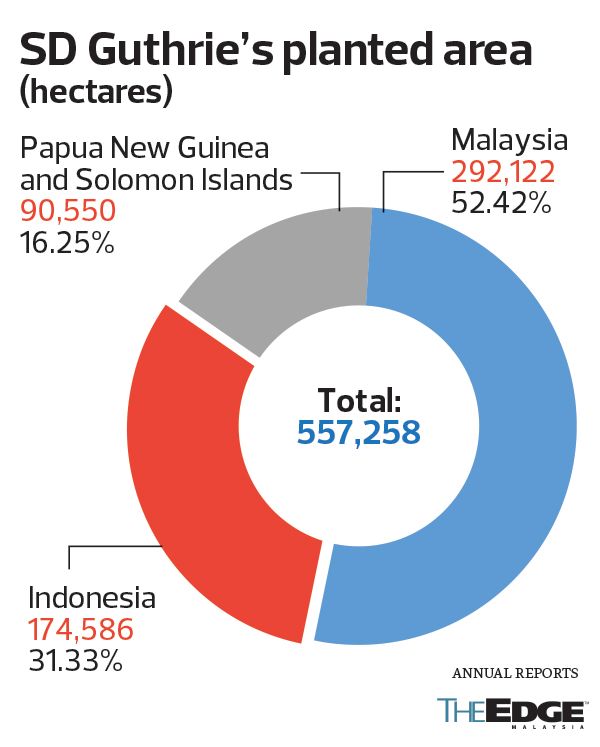
At end-2025, more than half of the group’s planted area was in Malaysia, while 31.3% was in Indonesia and 16.2% in Papua New Guinea and the Solomon Islands.
Of the countries in which SD Guthrie operates, Mohd Haris is most concerned about Indonesia, where dry conditions associated with the ongoing El Niño could pose a threat. The event has been described as one of the most intense on record, earning labels such as “super” and even “Godzilla”.
SD Guthrie’s estates in Papua New Guinea will also be affected by dry conditions, though less severely than those in Indonesia, Mohd Haris says. He adds that this is the first season the group has experienced forest fires in Papua New Guinea, something that was previously “unheard of”.
Meanwhile, its estates in Malaysia have seen decent rainfall and appear less exposed, and are likely to be the least affected. “So, our view is that Indonesia is probably going to suffer the most out of the three countries in which we operate,” says Mohd Haris.
The upside is that supply concerns on account of El Niño, coupled with Indonesia’s biodiesel mandate and strong demand from India post-duty reduction, are expected to support crude palm oil (CPO) prices next year. Hot and dry weather disrupts oil palm fruit formation, with effects — such as smaller, lighter and fewer fresh fruit bunches, and lower oil yields — becoming apparent only months later.
Mohd Haris expects CPO prices to climb to RM5,000 per tonne in 2027, from between RM4,600 and RM4,700 currently.
Save by subscribing to us for your print and/or digital copy.
P/S: The Edge is also available on Apple's App Store and Android's Google Play.