

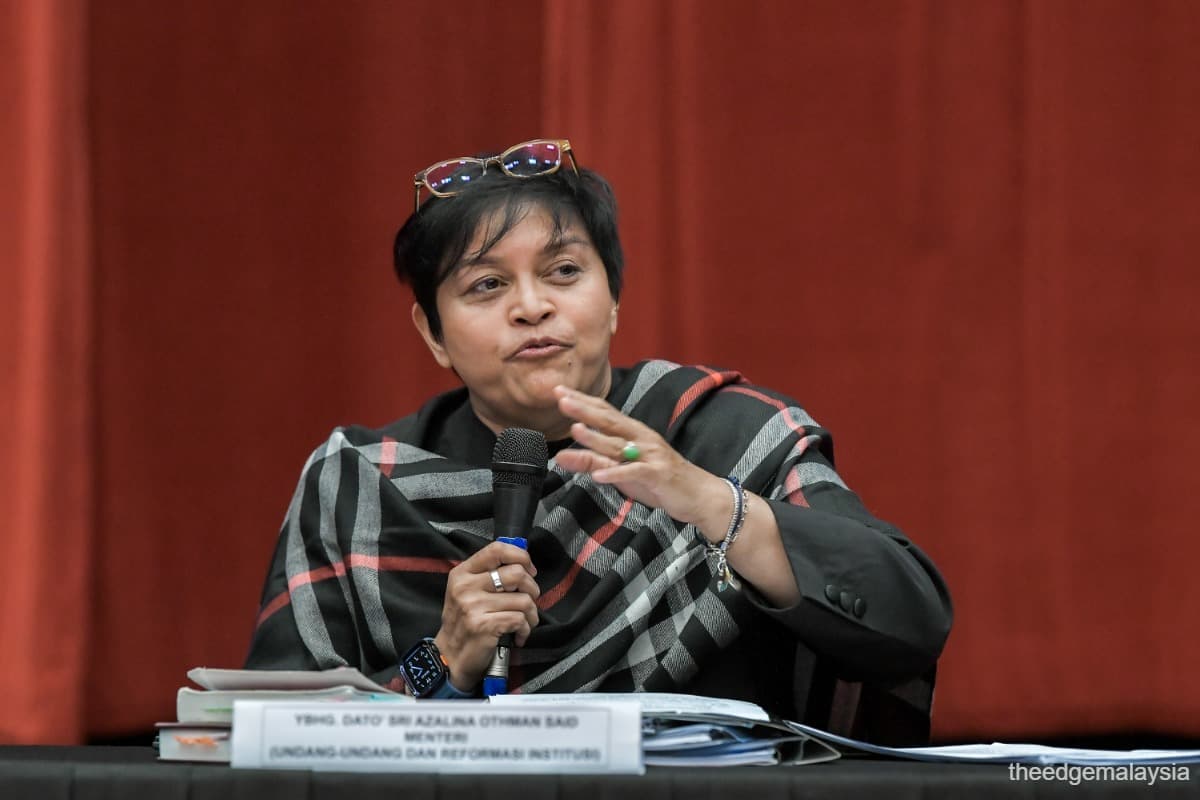
KUALA LUMPUR (Nov 4): Malaysia will examine corporate rescue and business rehabilitation mechanisms, drawing lessons from the US’ Chapter 11 framework, as the next frontier of its insolvency reform agenda, said Datuk Seri Azalina Othman Said.
The minister in the Prime Minister’s Department (law and institutional reform) said premature liquidation often destroys jobs, disrupts supply chains and eliminates economic value that could otherwise be salvaged through debt restructuring.
“A company that cannot pay its debts today is not necessarily a company without an economic future.
“Some businesses experiencing financial distress may still possess valuable products, experienced employees, established customers and productive assets,” she said in her keynote address at the Forum on Asian Insolvency Reform (FAIR) 2026 here on Wednesday.
Azalina outlined five focus reform priorities aimed at encouraging early intervention before distress becomes irreversible, providing commercially practical restructuring mechanisms, safeguarding legitimate creditor rights, preserving jobs and productive assets and bolstering court and institutional capacity.
“Let me emphasise that corporate rescue must never become corporate immunity. Accountability must remain central, and creditors' legitimate rights must be protected.
“Our objective is not to save every company at any cost, but to distinguish between businesses that remain viable and those that require an orderly resolution. Our guiding philosophy must therefore be: Rescue where possible. Restructure where viable. Resolve responsibly where necessary,” she stressed.
Speaking to reporters after her address, Azalina said she has instructed the Malaysian Insolvency Department to assess viable frameworks specifically for small businesses facing debt overhang.
“In my speech earlier, I mentioned that next year, the Insolvency Department needs to look into companies. This is not about winding them up, but rather focusing on rehabilitation, similar to Chapter 11 in the United States. In other words, it would establish its own recovery system,” she said.
Azalina highlighted that smaller commercial enterprises often face stagnation due to indebtedness despite holding assets of value.
“For small businesses, sometimes they are unaware that they own valuable assets. However, due to their high debt burden, these assets cannot be sold, consequently preventing them from continuing their business operations.
“This will be a focus next year, and I have instructed the department to study the matter,” she said.
Uploaded by Tham Yek Lee