


This article first appeared in The Edge Malaysia Weekly on November 2, 2026 - November 8, 2026
THE government’s announcement dated Oct 20 that navigation app Waze would be banned for civil servants sparked a flurry of both confusion and criticism. The ban, attributed to data security concerns over Waze’s Israeli-incorporated data controller and its subjection to Israeli law, took immediate effect.
Following the government’s push to promote TuJu as an alternative, the app experienced a surge in users, and its core navigation feature was temporarily disabled on Oct 22. The government cited the security assurances TuJu offers, but its statements did not say how they were assessed.
Against this backdrop, The Edge examines the financial statements of Prosignal Consortium Sdn Bhd, which developed TuJu with the Malaysian Highway Authority (LLM), to better understand the company behind the app.
Most evident to anyone browsing through the company’s financials would be its lack of revenue in any financial period from its incorporation on Aug 17, 2021, to Dec 31, 2025, according to accounts lodged with the Companies Commission of Malaysia (SSM).
Prosignal Consortium has always been in the red, recording net losses of RM627,346 in the financial year ended Dec 31, 2025 (FY2025), RM69,628 in FY2024, RM113,196 in FY2023 and RM109,802 in its first reporting period, from Aug 17, 2021, to Dec 31, 2022.
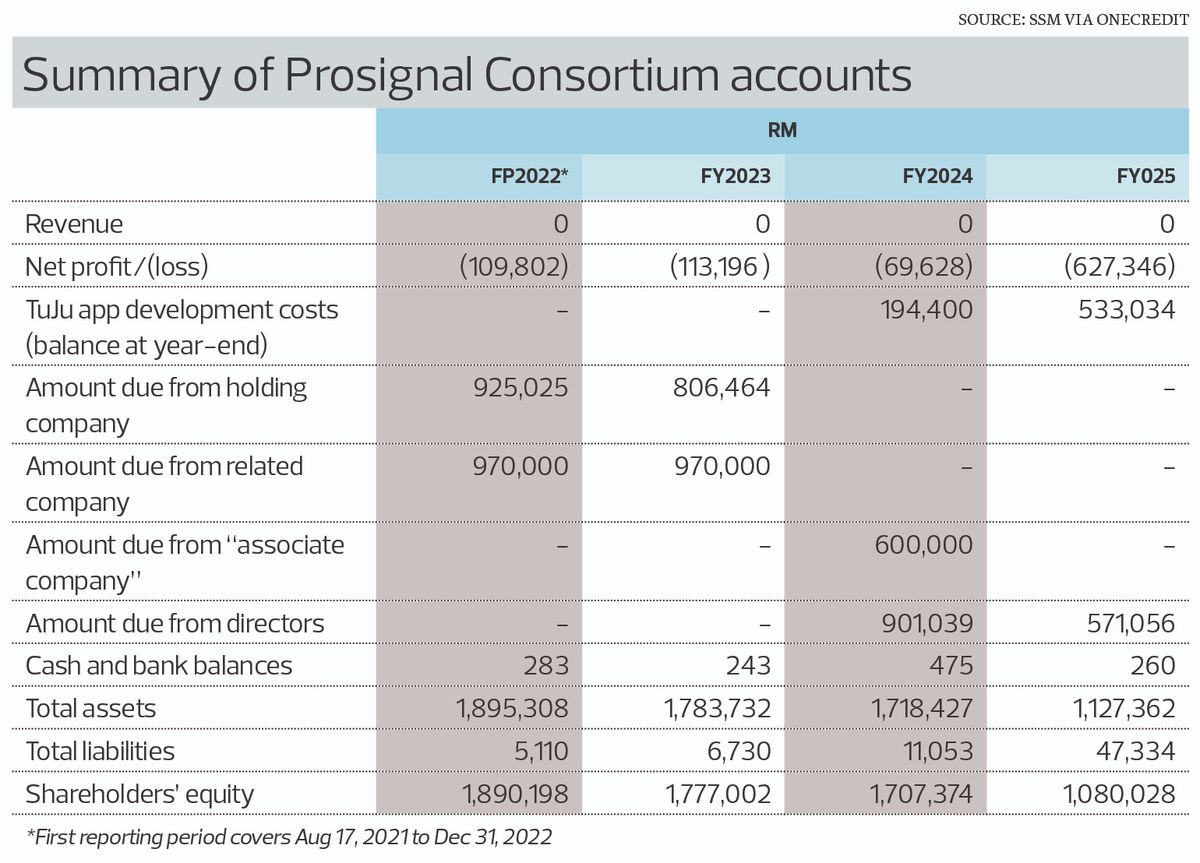
This brought its accumulated losses to RM919,972 at end-2025, against an issued share capital of RM2 million. Shareholders’ equity stood at RM1.08 million, down from RM1.89 million at end-2022.
Prosignal Consortium’s directors’ reports for FY2022, FY2023 and FY2024 described the company as dormant and stated that it had not commenced business operations. However, the company’s FY2025 filing stated that it was carrying on business activities, even though no revenue was recognised during the year.
By end-2025, the company had capitalised RM533,034 for “Software — TuJu Apps” development costs. The figure does not necessarily represent the total cost of developing the application.
Development of a smart highway management system
LLM and Prosignal Consortium signed a memorandum of understanding (MoU) on May 26, 2022, to develop a smart highway management system, including a mobile app for highway operations. The collaboration subsequently produced TuJu.
Datuk Abdul Rashid Asari, whom Prosignal Consortium’s website lists as an executive director, signed the MoU on behalf of LLM when he was its chairman, a position he held until August 2022. Abdul Rashid is the Selangor state assemblyman for Selat Klang.
Another notable individual that had been listed on its website was Prosignal Consortium’s chairman Datuk Muhammed Abdullah, the Undang of Johol. However, this piece of information was removed from the website soon after TuJu made headlines last month.
The Edge’s calls and emails to Prosignal Consortium were unanswered at press time.
According to its website, Prosignal Consortium focuses on smart data technology and infrastructure integration. Its 2025 annual return lists its business as utility mapping and management, construction and facilities maintenance, and general trading and services for government agencies and the private sector.
The company was established five years ago, issuing two million ordinary shares for RM2 million in cash on Aug 17, 2021. Its 2025 annual return still records two million shares. Its FY2022 and FY2023 accounts identify Numpro Sdn Bhd as its holding company, with a 51.5% stake.
The 2024 accounts show that Mohd Edzreen Mohd Din bought 1.3 million shares, while Datuk Manan Amir bought 100,000 shares that year.
As Malaysiakini has reported, the 2025 annual return lists Mohd Edzreen with 65% of the issued shares of the company, Kintan Bersama Sdn Bhd with 30% (600,000 shares) and Manan with 5%. Kintan’s own 2024 accounts record a RM600,000 investment in unquoted shares, without naming the investee.
Mohd Edzreen was appointed director on Feb 5, 2024. Datuk Yasmin Mahmood, Manan and Muhammad Rasyidin Ayub (as Yasmin’s alternate) were appointed on Feb 26, 2024. Yasmin and Muhammad Rasyidin resigned on Aug 13, 2025.
The 2025 directors’ report records the appointment of Selat Klang assemblyman Abdul Rashid effective Feb 3, 2026.
TuJu development cost
Note 4 to the FY2025 accounts lists “Software — TuJu Apps” under development costs, comprising RM194,400 carried forward from end-2024 and a further RM338,634 capitalised in 2025, bringing the total to RM533,034. The FY2024 accounts recorded RM194,400 in development costs without identifying the project.
A schedule appended to Prosignal Consortium’s FY2025 accounts, marked as prepared for management use and not part of the audited financial statements, breaks down RM627,346 in operating expenses. The largest items are RM444,434 for a “launching event”; RM98,200 for salaries, allowances and bonuses; RM42,149 for office rent; and RM23,239 for legal fees.
The schedule bears Prosignal Consortium’s name but carries a different company registration number from its audited accounts. Its total expenses, nevertheless, reconcile with the audited figures. The schedule does not identify which event the launch expenditure is related to.
The company recorded RM627,346 in administrative expenses in FY2025. The audited notes disclose RM98,200 in salaries, allowances and bonuses; RM42,149 in office rent; and RM23,239 in legal fees, among other expenses.
Note 11.2 states that the company had no employees, other than directors, as at Dec 31, 2025, but does not identify who received the RM98,200. Separately, the FY2025 directors’ report says none of the company’s current or former directors received remuneration during the financial year.
Financing
Prosignal Consortium’s balance sheets for 2022 to 2025 report no borrowings at their respective year end. Total liabilities at end-2025 stood at RM47,334: RM33,050 of other payables, which were nil a year earlier, and RM14,284 of accruals. Note 10 describes the amount as unsecured, interest-free and repayable on demand. The accounts do not mention LLM or the MoU, and do not disclose how TuJu was financed.
Separately, Section G of Prosignal Consortium’s 2025 annual return states that the company has “senior management in place of beneficial owner”. The same return lists Mohd Edzreen as holding 1.3 million of the two million issued shares (65%).
SSM’s guidelines identify direct or indirect ownership of at least 20% of a company’s shares as one criterion for beneficial ownership. They require senior management to be named instead where the company has no beneficial owner, a beneficial owner cannot be identified, or the company is still obtaining the information. The annual return does not say which applied.
In 2024, the amount due from the holding company fell by RM806,464 and the amount due from a related company fell by RM970,000, both to nil. The balance sheet shows new balances of RM901,039 due from directors and RM600,000 due from an “associate company”, plus RM194,400 of capitalised development costs. The accounts do not name the related company or the associate company.
In 2025, the amount due from the associate company fell to nil, a decline of RM600,000. Prosignal Consortium capitalised a further RM338,634 and reported a loss of RM627,346.
Amounts due from directors
The accounts recorded RM571,056 as “amount due from directors” as at Dec 31, 2025, down from RM901,039 a year earlier. Note 5 to the FY2024 and FY2025 accounts states that the amount is unsecured, interest-free and has no fixed terms of repayment. The accounts do not identify the directors involved, the purpose of the advances or when they were made. They also do not disclose whether shareholder approval was obtained. In the data tables of the FY2025 SSM filing, the RM571,056 is classified as other receivables due from other related parties.
The accounts were audited by MN Mustaffa & Co, whose audit report does not specifically discuss the balance.
What does the Companies Act say?
Section 224 of the Companies Act 2016 says a company shall not make a loan to a director of the company or of a related company. The section does not apply to an exempt private company, among other exceptions.
Section 2 defines an exempt private company as a private company in whose shares no corporation holds a beneficial interest, directly or indirectly, and which has no more than 20 members, none of them a corporation.
Responding to queries from The Edge, Ivanpal Singh Grewal, a lawyer at AJ Ariffin, Yeo & Harpal, says: “If it qualifies, the wording of Section 224(2)(a) supports exemption from the whole section. If it does not qualify, the advances must fit a permitted exception, such as company expenses, a qualifying housing loan or an approved employee loan scheme. A general personal loan does not become permissible merely because shareholders approved it.”
As at the annual return date of Aug 17, 2025, Prosignal Consortium’s 2025 annual return lists three members, one of them a company, Kintan Bersama, with 30%. A company report compiled from SSM records lists Prosignal Consortium as not an exempt private company for 2024 and 2025.
The accounts do not describe the amount due from directors as a loan and do not say whether any exception in Section 224 applies.
What’s next for TuJu?
On Oct 29, member of parliament for Bagan Lim Guan Eng urged the government to abandon TuJu, find a temporary replacement and conduct an open tender for a new navigation app.
In a Malaysiakini report published the same day, cybersecurity consultant Aaron Ikram Mokhtar called for TuJu and other navigation apps to undergo equivalent cybersecurity scrutiny. Meanwhile, Krishna Rajagopal, CEO of Akati Sekurity, questioned the transparency of data handling and accountability for security incidents involving local navigation apps.
TuJu’s navigation function is expected to be restored on Nov 6, 2026. Only time will tell if it can find its way forward.
Save by subscribing to us for your print and/or digital copy.
P/S: The Edge is also available on Apple's App Store and Android's Google Play.