


This article first appeared in The Edge Malaysia Weekly on November 2, 2026 - November 8, 2026
IT would seem that money raised through borrowings can find its way into federal government revenue as something of a smoothing mechanism to help keep fiscal ratios in check.
When investors buy Malaysia’s government bonds above their face value, “net premium from issuance of government financial instruments” is generated because investors pay extra today for higher-than-market future coupon payments.
Net premium that the government receives today is not a windfall because it means higher future interest payments — it is not a one-time profit like those which arise when a buyer pays the government above book value for an asset sold.
Government bonds — basically debt paper issued by the government — are not assets but an interest-bearing liability.
Under accrual accounting, net premium is amortised over the duration of the debt paper to reduce debt service charges.
Malaysia, which previously mentioned its intention to move from cash basis accounting to accrual accounting, follows a modified cash basis of accounting — which is similar to cash accounting but has selected long-term adjustments on revenue and expense recognition.
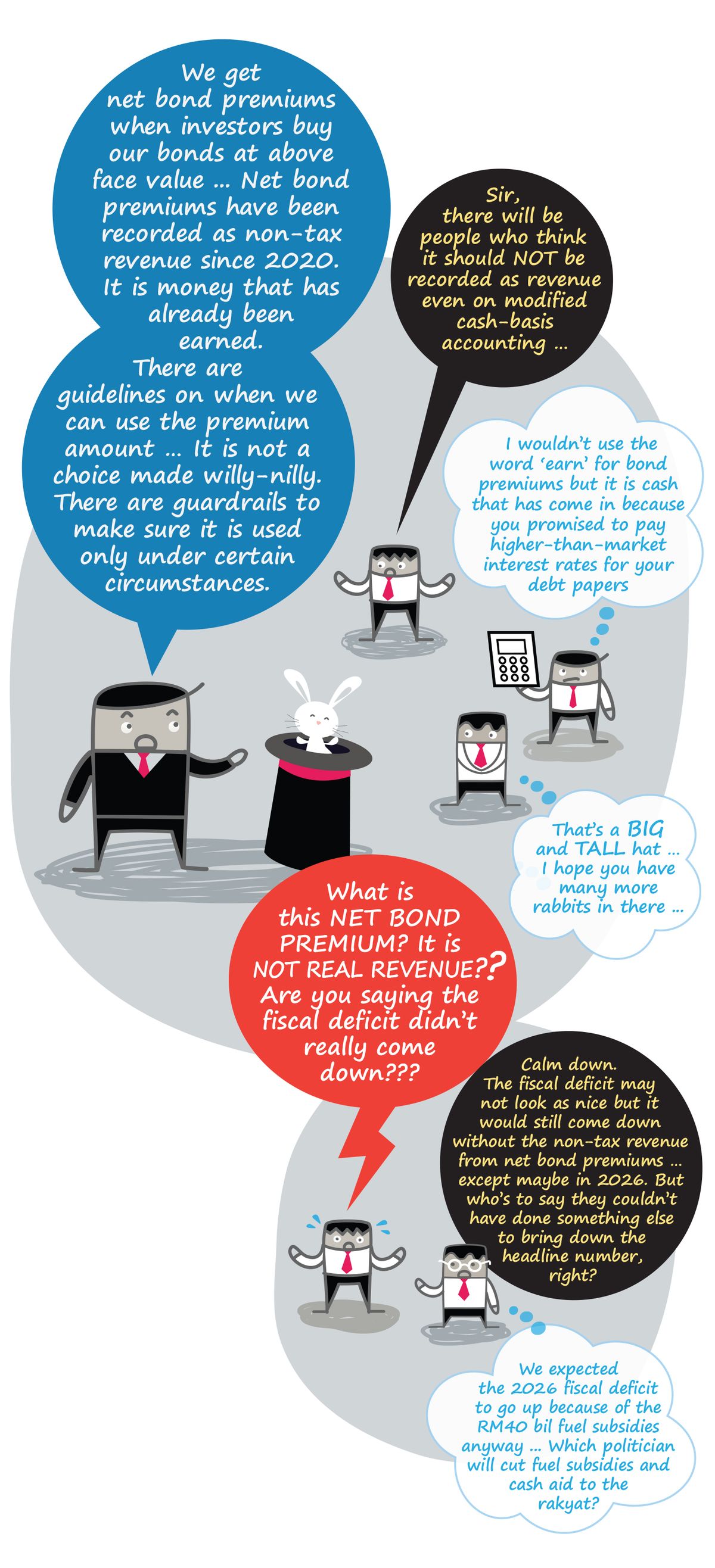
Malaysia accumulates net premiums from bond issuances in a separate account and decides not only the timing but also the amount to transfer into the federal government’s annual national budget as non-tax revenue.
Indications are that the amount of net premium transferred into the national budget may not immediately correspond with the year the bond proceeds are received. The classification of these net premium receipts and their recognition timing were questioned in the 2020 and 2021 Auditor-General’s Reports signed by the then auditor-general Datuk Nik Azman Nik Abdul Majid.
Placing an emphasis on the matter when auditing the federal government’s 2020 financial statement, the 2020 Auditor-General’s Report flagged the transfer of RM6.046 billion net premiums from federal government debt issued in 2017, 2019 and part of 2020 to the 2020 financial accounts as non-tax revenue.
“Surpluses derived from the government’s borrowing activities do not constitute revenue from government operations. As such, it is inappropriate to classify net premiums from the issuance of debt instruments as non-tax revenue. Furthermore, the net premiums should have been transferred in [their] entirety upon receipt,” the 2020 Auditor-General’s Report read, noting that the entire amount should be recorded as non-revenue receipts when they are received.
The Accountant-General’s Department of Malaysia (JANM) disagrees with the National Audit Department (NAD). “Such net premium should be classified under non-tax revenue as they constitute as revenue derived from the government operations in issuing financial instruments,” JANM said in a statement dated July 29, 2021, appended in the 2020 Auditor-General’s Report.
The following year, the NAD continued to note that net premium from bond issuances was still not recognised in the year it was received as how revenue should be recognised under modified cash basis accounting principles — pointing out how only RM1.8 billion, or 57.7% of the RM3.12 billion net premium from government bond issuances in 2021 had been transferred into the consolidated revenue account as non-tax revenue.
The 2021 Auditor-General’s Report also gave some clues on how JANM decides the timing and amount of net premiums to transfer: “Government policy stipulates that a transfer of accumulated funds from the Settlement Account to the Consolidated Revenue Account may be executed if projected revenue collection falls short of the annual estimate by 10%, or if debt-related expenditure exceeds 15% of total revenue collection. The amount permitted for transfer is capped at 80% of the balance in the Settlement Account,” read the report that was signed by Nik Azman on Sept 22, 2022.
There was RM17.58 billion in the “Settlement Account” in 2021, including RM10.904 billion in net premium from issuances of government securities, according to the report.
“The policy of recognising net premiums as non-tax revenue, depending on projected revenue collection performance and the percentage of debt-related expenditure, differs from the modified cash basis revenue recognition principle of recognising revenue in the year it is received,” the 2021 Auditor-General’s Report read.
The subsequent Auditor-General’s Report on the federal government’s accounts for 2022 to 2025 did not raise the same issue. Instead, Auditor-General Datuk Wan Suraya Wan Mohd Radzi, who assumed office in June 2023, focused more on Putrajaya’s debt service charges and fiscal consolidation efforts in accordance with targets in the Fiscal Responsibility Act that was passed by Parliament in October 2023.
The recently released Auditor-General’s Report (Series 2 for 2026) on the federal government’s 2025 financial statement appended feedback from the Ministry of Finance dated June 16, 2026, that reiterated the government’s commitment to fiscal sustainability and pragmatic economic management in generating revenue while ensuring continued support for the people and fostering strategic growth with reduced reliance on debt. Under the 13th Malaysia Plan (2026-2030), Putrajaya aims to reduce the direct debt-to-GDP (gross domestic product) ratio to 60% or below by 2030.
Governance matters
Malaysia adheres to governance principles and does not deliberately sell bonds above face value to generate premiums, Finance Minister II Datuk Seri Amir Hamzah Azizan tells The Edge in a post-Budget 2027 interview, noting that net premiums from the issuance of government bonds have been
accounted for in the same manner since 2020 and is held in a dedicated account managed by the accountant-general. (See accompanying story: “Clear governance rules on net bond premium transfers as non-tax revenue, FM II says”.)
It is not improper for the government to issue bonds which investors are willing to pay a premium for, especially given global competition for funds from sexy but riskier artificial intelligence-related debt paper offering even higher coupons. The auditor-general still signed off the federal government accounts.
Yet the same question remains whether net premiums are labelled as non-tax revenue or non-revenue receipts: should such amounts be allowed to bolster revenue at all — be it at the time the bonds are issued or otherwise? Why should the timing of net premium recognition depend partly on the government’s fiscal position? Shouldn’t any net premium that arises from debt paper be amortised over the duration of the bonds to lower debt service charges? This would be the treatment under accrual accounting.
Otherwise, revenue effectively goes up when net premiums are recorded instead of the sum going to reducing interest charges or operating expenditure over the duration of the debt paper, which may be three years, five years, seven years, 10 years, 15 years, 20 years or 30 years.
This question matters given the emphasis on fiscal consolidation. After all, a ringgit collected from taxes cannot be equivalent to a ringgit received from selling bonds at a premium to face value, even if there is an upfront boost in cash receipt on top of the usual bond proceeds.
Between 2020 and 2025, the federal government recorded RM23.7 billion in net premium from the issuance of government financial instruments as non-tax revenue, the highest being RM7.5 billion in 2023, followed by RM6.046 billion in 2020, our checks on official records show.
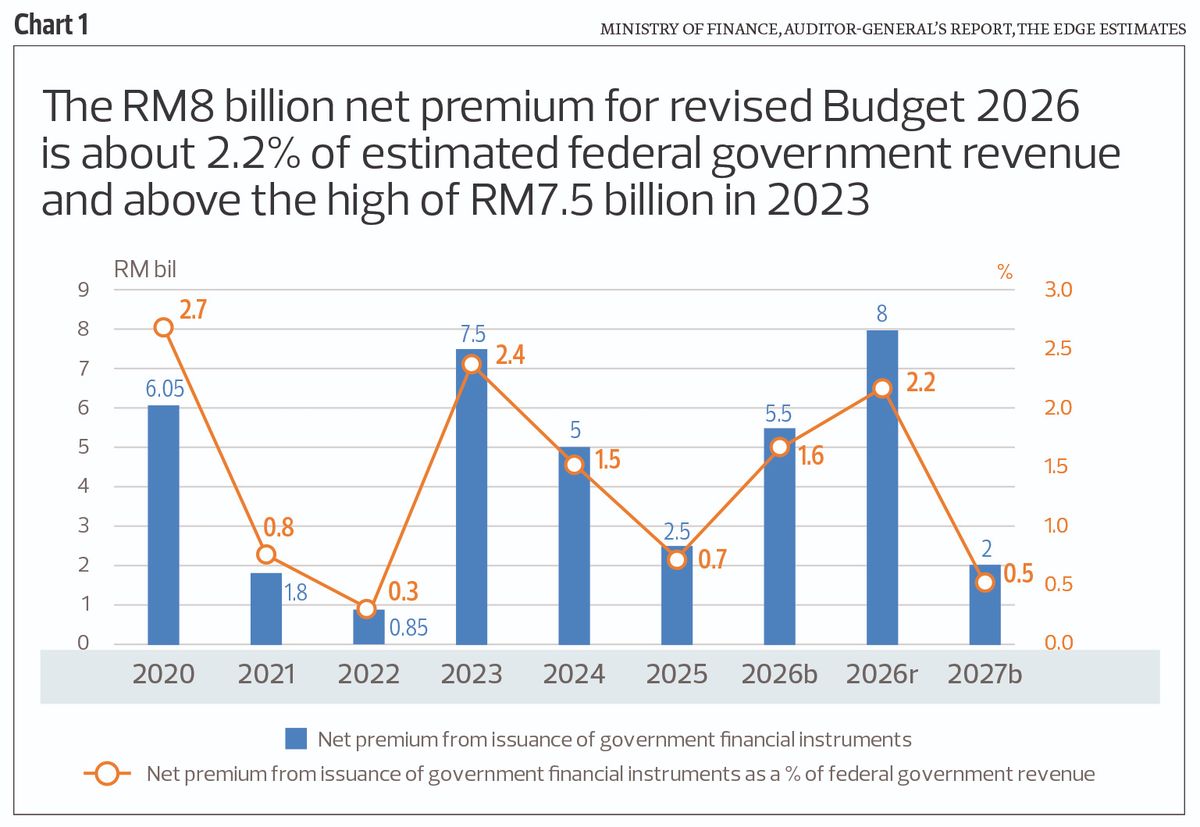
The RM7.5 billion net premium — booked as “other domestic return on investment” — in 2023 was about 2.4% of federal government revenue and 0.41% of GDP in 2023 when the budget deficit had declined to 5% of GDP from 5.5% of GDP in 2022.
The amount recognised as non-tax revenue in a particular year may not necessarily be the same as the amount of net premium generated that year, according to our reading of notes appended in the government’s audited financial statements and budget-related documents.
In 2024, RM5 billion net premium was transferred as non-tax revenue, although new bond premiums that year amounted to just RM3.07 billion, according to audited financial statements. The RM850 million transferred in 2022, was above the RM416 million in bond premium generated that year, which implies the tapping of the account managed by the accountant-general.
The reverse is true in 2023, where RM7.5 billion net premium was transferred as non-tax revenue, lower than the RM8.78 billion generated in net premium that year. Likewise in 2025, RM2.5 billion net premium was transferred as non-tax revenue even though RM3.87 billion net premium was generated from government bond issuances that year.
As higher global oil prices increase fuel subsidy needs, indications are that Malaysia may see a new record-high net premium transfer as non-tax revenue this year.
The revised Budget 2026, saw “net premium from issuance of government financial instruments” pencilled in at RM8 billion, 45.5% higher than RM5.5 billion when Budget 2026 was tabled in October 2025 and beating the RM7.5 billion recorded in 2023.
Putrajaya pencilled in “net premium from issuance of government financial instruments” of RM2 billion in Budget 2027, bolstering non-tax revenue next year (see Chart 1).
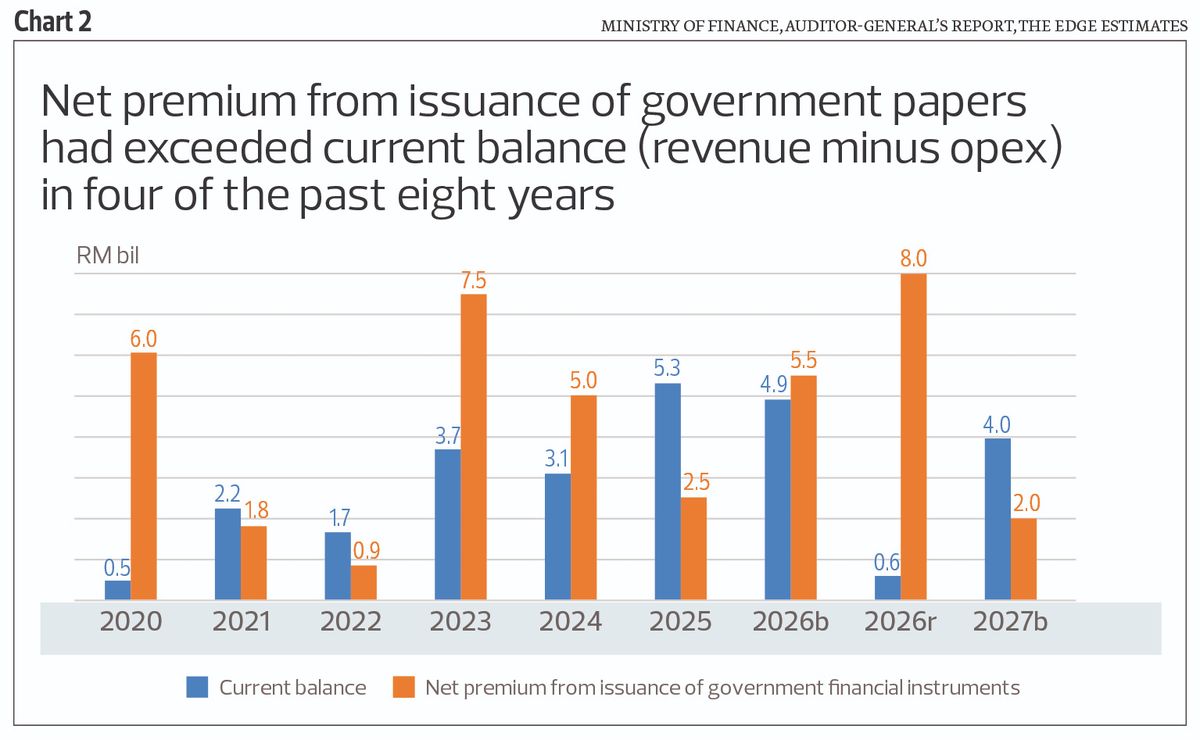
These net premiums are also not small relative to the federal government’s current balance (revenue minus operating expenditure). The Edge’s compilation of net premiums booked as non-tax revenue from 2020 to 2027 show that net premiums had exceeded current balance in four of the eight years (see Chart 2).
The lowest amount of net premium booked as non-tax revenue since 2020 was RM850 million in 2022 and RM1.8 billion in 2021. While notes to its financial statements was not specific on why Putrajaya did not transfer the entire amount of net premiums received in 2021, the decision corresponded with the year it chose to withdraw RM4.088 billion from the National Trust Fund (KWAN) to defray Covid-19 vaccine and vaccine-related expenses as well as the reclassification of RM8.711 billion from operating expenditure (opex) to development expenditure (devex). In 2020, the government took out RM1.567 billion from KWAN and reclassified RM2.776 billion opex as devex.
Impact on revenue and fiscal deficit
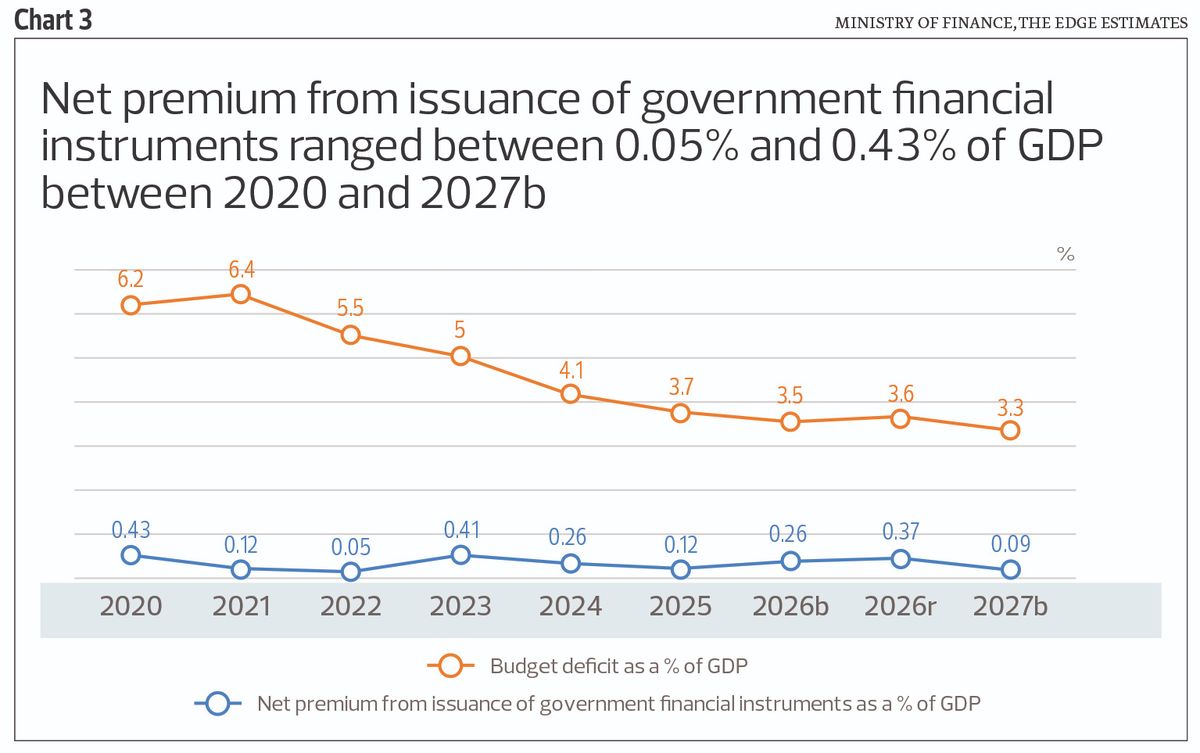
“Net premium from issuance of government financial instruments” ranged between 0.05% and 0.43% of GDP between 2020 and the numbers pencilled in Budget 2027, during which Malaysia had painstakingly reduced its budget deficit from 6.4% of GDP in 2021 to 3.5% of GDP in 2025 (see Chart 3).
Even if Malaysia had chosen not to recognise the net premium as a type of revenue, the federal government budget deficit would have still decreased year on year every year from just over 6.5% in 2021 to 3.76% in 2025, simple back-of-the-envelope workings show.
Removing the RM8 billion net premium recognised as non-tax revenue in the revised Budget 2026, however, could see a year-on-year increase in budget deficit to nearly 4% of GDP in 2026 from just below 3.8% of GDP in 2025, if there is no corresponding decrease in expenses, our workings show. This is given that RM8 billion is about 2.2% of federal government revenue and 0.37% of GDP.
The government can only borrow to fund devex but not opex where debt service charges and fuel subsidies fall under.
As net premium is only pencilled in at RM2 billion for 2027 currently, the impact is not as pronounced next year, being about 0.5% of estimated federal government revenue and 0.09% of GDP next year, according to prevailing estimates.
Budget 2027 estimates debt service charges of RM61.01 billion next year, being 16% of estimated federal government revenue of RM380.82 billion. This is just above debt service charges of RM57.3 billion, or 15.8% of federal government revenue in the revised Budget 2026, which was an improvement from RM58.3 billion and 17% of federal government revenue when Budget 2026 was tabled in October 2025.
As recently mentioned by Amir Hamzah, the “exceptionally strong investor interest” in Malaysia’s recent US$1.5 billion global sukuk issuance — which was 4.7 times oversubscribed as it attracted US$10 billion orders from over 140 high-quality global investors — is a clear vote of confidence in Malaysia’s policy credibility, fiscal management reforms and long-term direction of Prime Minister Datuk Seri Anwar Ibrahim’s Ekonomi Madani framework.
The fact that Budget 2027 documents clearly mark as non-tax revenue “net premium from issuance of government financial instruments” of RM2.5 billion in 2025, RM8 billion in the revised Budget 2026 and RM2 billion for Budget 2027 means investors are not kept in the dark but understand the fine print.
Malaysia, which aims to reduce its fiscal deficit to 3% of GDP by 2028, needs to continue demonstrating it is backing up its words with actions on good governance.
Save by subscribing to us for your print and/or digital copy.
P/S: The Edge is also available on Apple's App Store and Android's Google Play.