

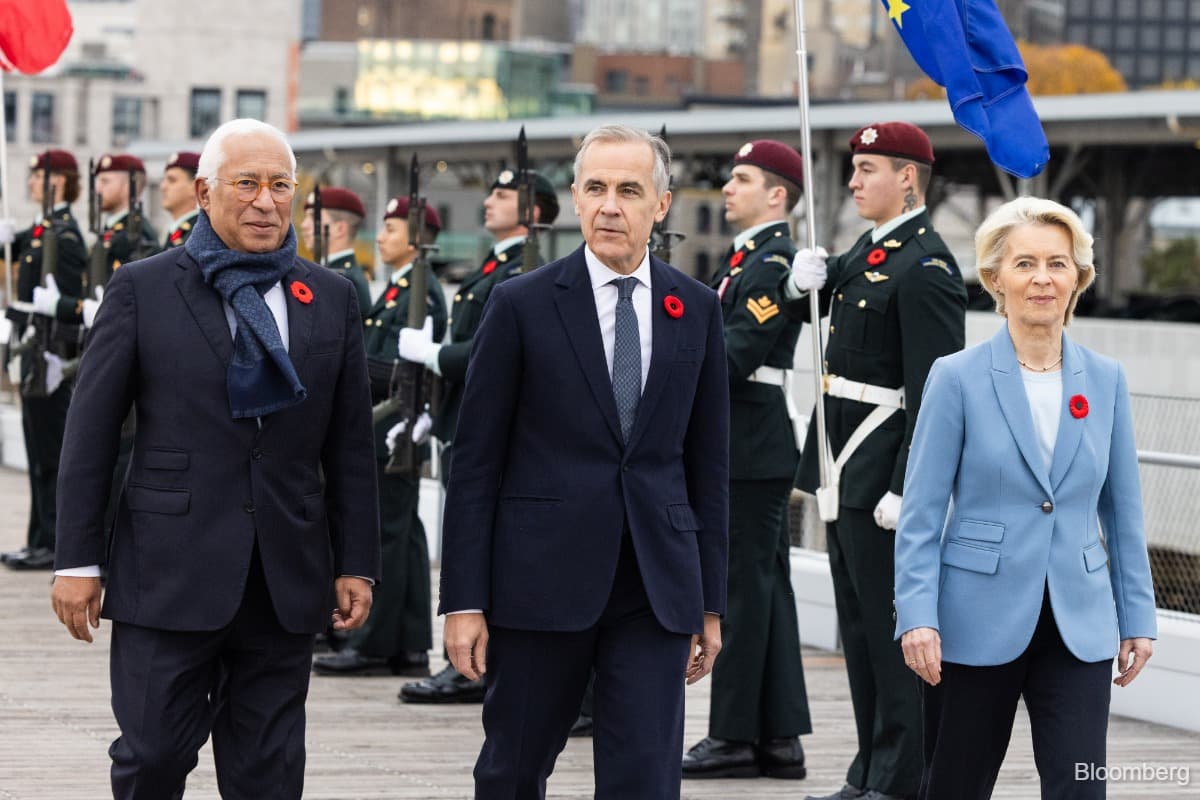
(Oct 31): The European Union (EU) is rushing to forge a new transatlantic alliance just as an old one is falling apart.
The EU is seeking to build a new foundation for its survival as it confronts a growing number of existential problems, many accelerated by its unravelling relationship with the US. And key to its strategy, according to European officials, will be an alliance with Canada.
“We are witnessing a deeper decay in the international order,” European Commission President Ursula von der Leyen said in Montreal ahead of a summit with Canadian Prime Minister Mark Carney. “We can no longer let ourselves be shackled by the limits of the old world order.”
“We will build an alliance for the future, and we start with Canada,” she said.
Canada and the EU are both confronting a future in which a new era of power politics — dominated by the US and China — threatens their security and economic stability. Carney and von der Leyen both spoke in Montreal of cementing an unprecedented alliance that would see Canada become the first “associate member” of the EU, a relationship they see giving them a leg up against pressure tactics and intimidation by the world’s great powers.
At the summit, the EU and Canada pledged to move towards an “ever-closer association” that will include more integrated supply chains, coordinated economic-security policies, defence industry cooperation and more European investment into critical raw materials in Canada, according to the joint statement. They also agreed to begin an assessment on exporting liquefied natural gas to the bloc from Canada.
The agreement also signals plans to build new subsea cable infrastructure to improve connectivity between Canada, Europe and Asia. Canada is reviewing its telecommunications network vulnerabilities as much of the country’s data and voice traffic travels through the US, and there are no Canadian-owned submarine cable connecting it with the rest of the world.
“The world is becoming more dangerous and divided,” Carney told reporters Friday. “The multilateral institutions we once relied upon have weakened.”
“We are working toward the deepest possible partnership, short of accession — with Canada becoming the European Union’s first associate member,” Carney said. “This is about sovereignty. Our ability to live our lives as we wish.”
Leaders on the continent began rethinking transatlantic bonds in earnest after the US published its national security strategy in December, which warned that Europe faces “civilisational erasure” due to decades of economic decline as well as political and cultural failures.
German Chancellor Friedrich Merz criticised the report, saying that the previous conception of the West no longer exists. “At best it’s still a geographical designation, but no longer a normative bond that holds us together.”
French President Emmanuel Macron was even more peremptory in remarks earlier this year.
“Our objective is not to be the vassals of two hegemonic powers,” he said in Seoul. “We don’t want to depend on the dominance, let’s say on China, or we don’t want to be too much exposed to the unpredictability of the US.”
Speaking to international media in February, Macron put it in starker terms, describing threats from the US and China as a “profound geopolitical rupture”, and warned that if Europe didn’t act, “within five years, we will have disappeared”.
Carney said he would meet with von der Leyen and European Council President Antonio Costa in the coming months to determine the “substance, scale and scope” of what Canada’s associate membership would look like. Then in March, Carney’s cabinet will meet with von der Leyen’s political leadership team, called the college of commissioners, to further discuss the work. Carney will then attend a summit with EU leaders in June when they intend to conclude the negotiations.
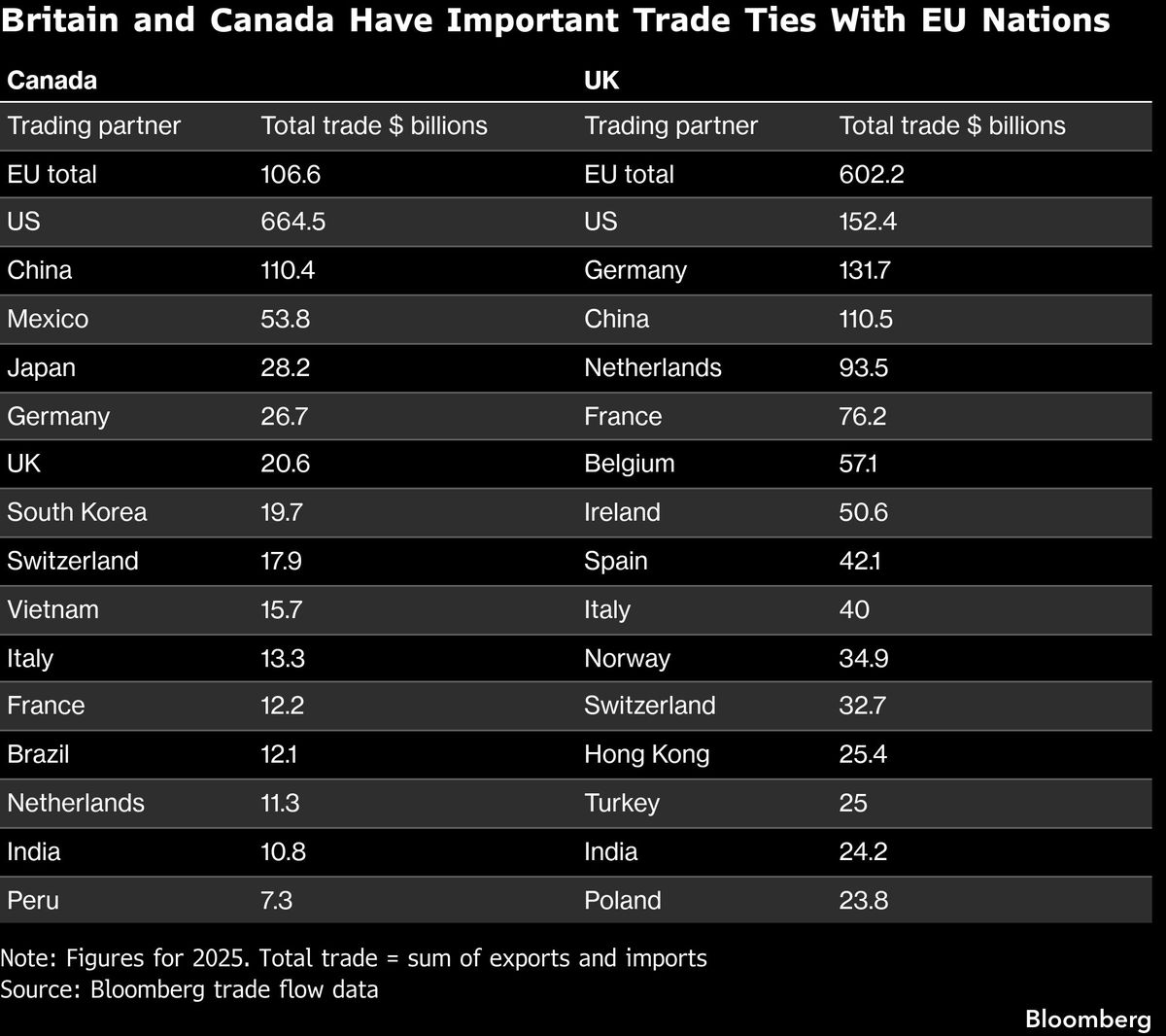
Canada offers an attractive testing ground for Europe’s ambition to build a trusted network. It combines vast reserves of energy and critical minerals with advanced capabilities in artificial intelligence, quantum computing and space, while sharing European concerns about excessive dependence on larger powers, alignment on climate policies and support for Ukraine.
“With Canada, it’s very clear that we have this, let’s say, alignment of values,” EU trade chief Maros Sefcovic said in an interview with Bloomberg. “We can both benefit from this cooperation.”
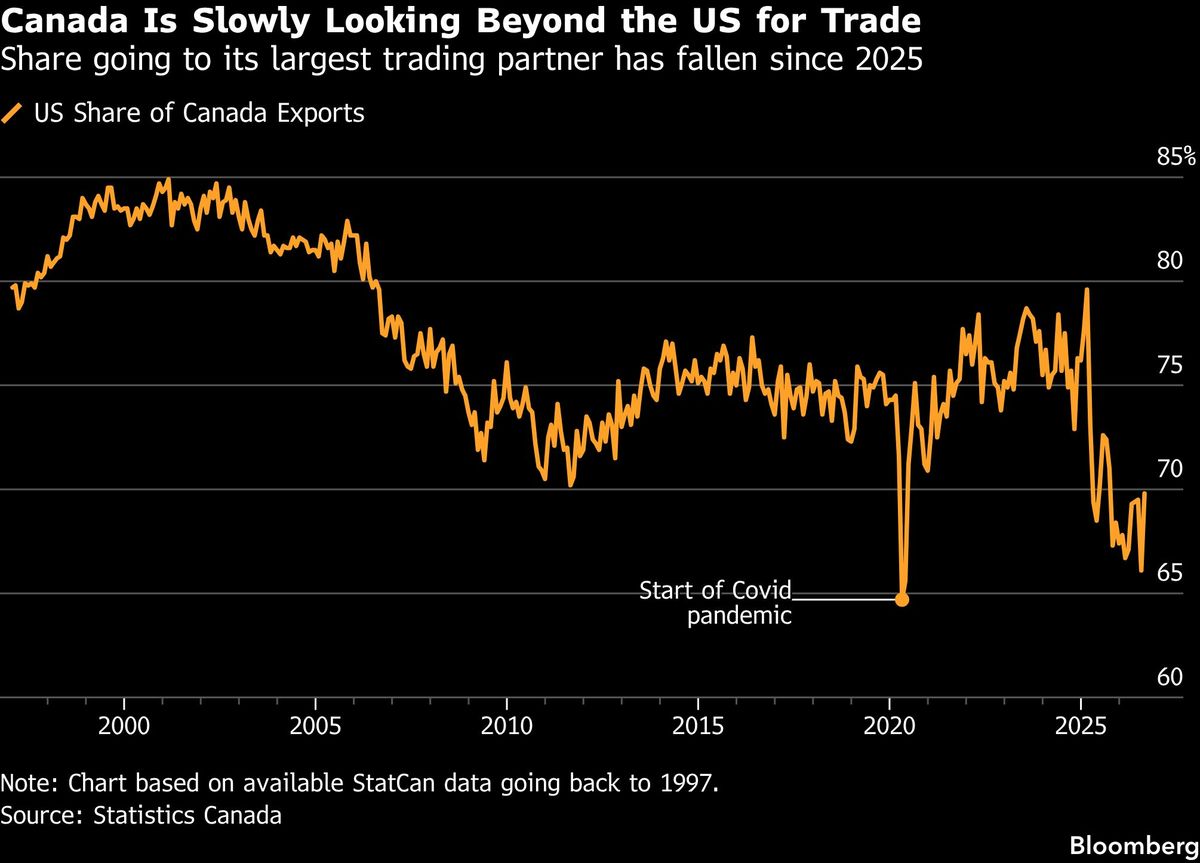
The EU, meanwhile, offers Canada a market of around 450 million consumers, manufacturing capacity and an opportunity to reduce an overwhelming reliance on the US. Carney’s government has yet to reach a trade deal with Trump, and the two sides slapped more tariffs on each other’s goods after negotiations broke down in August. Although talks have recently resumed, there is no sign of an imminent agreement and Trump has threatened to put more tariffs on the Canadian auto sector in January.
Carney said the closer association between Canada and the EU was about “creating opportunity, building prosperity, addressing sustainability and reinforcing sovereignty”.
As to why they should undertake the effort, he said: “So we can live our lives as we choose. Our people can live their lives as they choose and have the full freedoms that people enjoy in the European Union and enjoy in Canada.”
Uploaded by Chng Shear Lane