

(Oct 29): The US economy expanded in the third quarter (3Q) at the fastest pace in a year, supercharged by feverish business investment and a resilient American consumer.
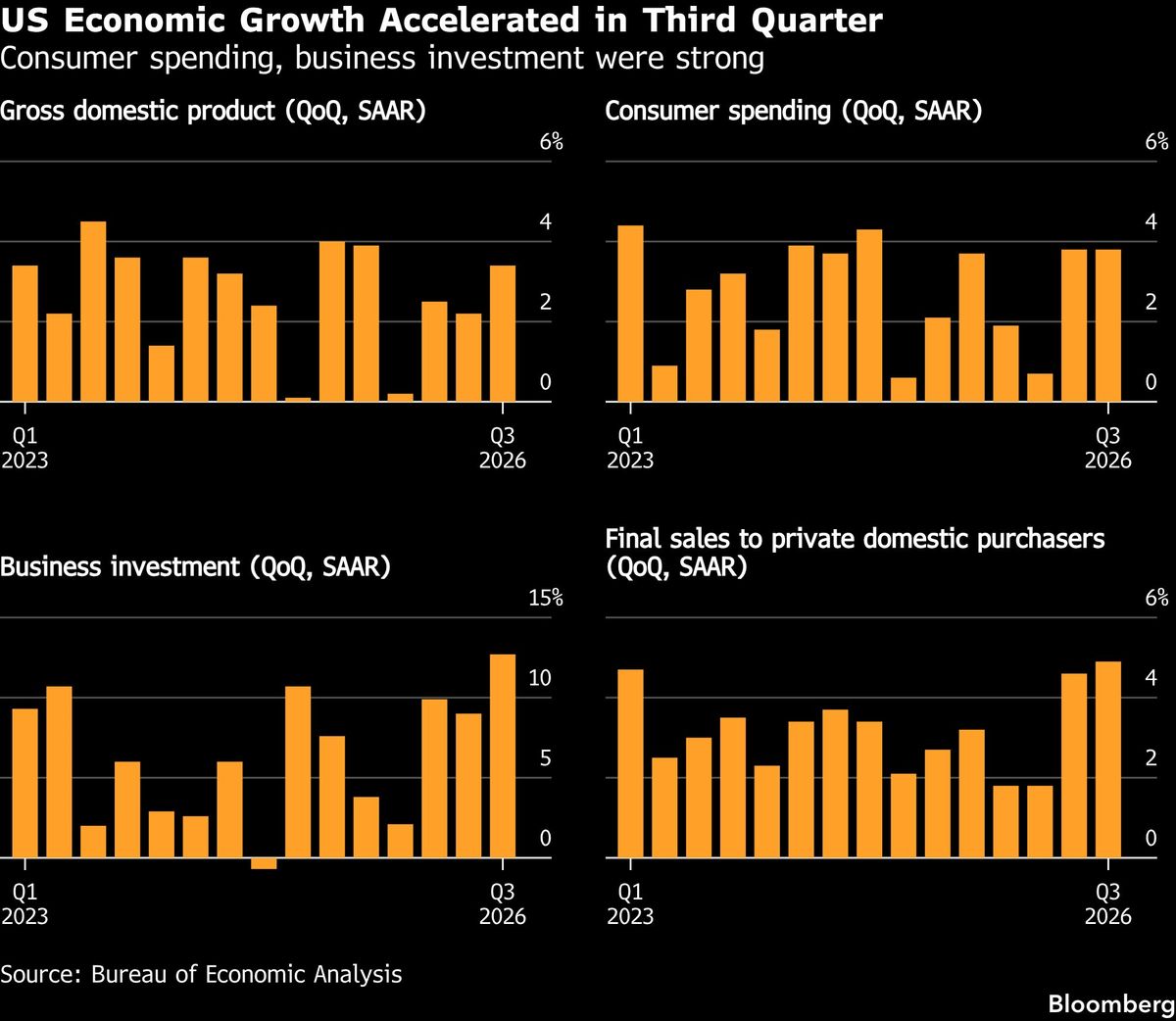
Inflation-adjusted gross domestic product increased an annualised 3.4% in the three months through September after growing 2.2% in the second quarter, according to an initial estimate issued on Thursday by the Bureau of Economic Analysis. The rise in GDP beat the median projection in a Bloomberg survey of economists.
The world’s largest economy continued to be energized by vibrant business spending, largely tied to investment in artificial intelligence. Outlays for equipment contributed more to GDP in 3Q than at any time since 2011 outside of the pandemic rebound.
Household spending was similarly robust, increasing an annualised 3.8% for a second straight quarter, even as rising prices erode paychecks and keep consumer sentiment depressed.
“The print shows an economy that’s performing pretty well under the surface,” said Andrew Husby, a senior US economist at BNP Paribas. “The numbers also reinforce that the economy is supported by the AI buildout and the accompanying tailwinds, though it’s not the only thing driving economic growth.”
The report is the last major reading on the health of the US economy before next week’s midterm elections. The results will determine who controls Congress for President Donald Trump’s final two years in office, with many campaigns targeting concerns around affordability and high prices.
Business investment climbed an annualised 12.7%, the most since 2020. Information processing equipment and industrial equipment outlays both surged.
Net exports subtracted 3.3 percentage points from the calculation of 3Q GDP, the most since early last year. That likely reflected a mix of factors, including a surge in imports — especially equipment for data centers — as well as efforts to get goods into the US ahead of tariffs and supply-chain disruptions.
Residential investment also continued to be a drag as elevated mortgage rates that recently reached 7.5% restrained homebuying and limited construction activity. Inventories, however, added 1.6 percentage points to growth.
Inflation data
Meanwhile, separate figures from the agency showed inflationary pressures mounted in September. The personal consumption expenditures price index — the Federal Reserve’s preferred measure — rose 0.5% last month, the most since March. Excluding food and energy, the so-called core gauge advanced 0.3%. Both figures matched expectations.
That data also showed real personal spending stalled as 3Q drew to a close. Inflation-adjusted spending on goods and services was little changed in September after an outsize increase the month before, restrained by a pullback in spending on autos and other durables.
Moreover, real disposable income fell for the first time since April, and the saving rate dropped to 3.8%, the lowest since the end of 2022.
The Middle East conflict and the Russia-Ukraine war have pushed prices for fuel and other goods higher, weighing on consumer sentiment. The Trump administration’s tariffs are also making some goods more expensive.
Looking ahead, conflict in the Middle East and the Russia-Ukraine war are keeping energy costs elevated across the economy. That risks filtering further into prices of other goods and services.
With the Fed’s preferred inflation gauge at 3.6% as of September, well above the central bank’s 2% goal, investors expect policymakers to raise interest rates at their December meeting. On Wednesday, they kept borrowing costs unchanged.
In a press conference that followed the decision, Fed chairman Kevin Warsh emphasized the strength of the economy while reiterating policymakers’ commitment to containing inflation.
“While uncertainty remains, owing in part to geopolitical developments, domestic spending has been resilient,” Warsh said. “Productivity growth is strong, and capital investment robust.”
“September’s personal income and outlays report paints a troubling picture of the US consumer: Inflation came in hotter, while income growth failed to keep pace. Squeezed by higher prices, consumers held real spending flat even as the saving rate declined,” say Troy Durie, Anna Wong and Andrew Sacher at Bloomberg Economics.
Meanwhile, companies ranging from banks to restaurants have touted on their earnings calls that consumer spending remains resilient.
“As long as the employment rate stays fairly stable, and it appears to be fairly stable in our country, consumers are going to spend because they have assets,” United Parcel Service Inc chief executive officer Carol Tomé said on an earnings call earlier this week. But she noted those without assets are stretched.
Still, companies say higher prices are top of mind for many shoppers. Coca-Cola Co noted that while it expects consumer behaviour to remain “largely unchanged,” households across the income distribution continue to prioritize value.
Separate data out onThursday showed initial jobless claims edged lower last week, remaining near the lowest levels since 1969.
Uploaded by Felyx Teoh