

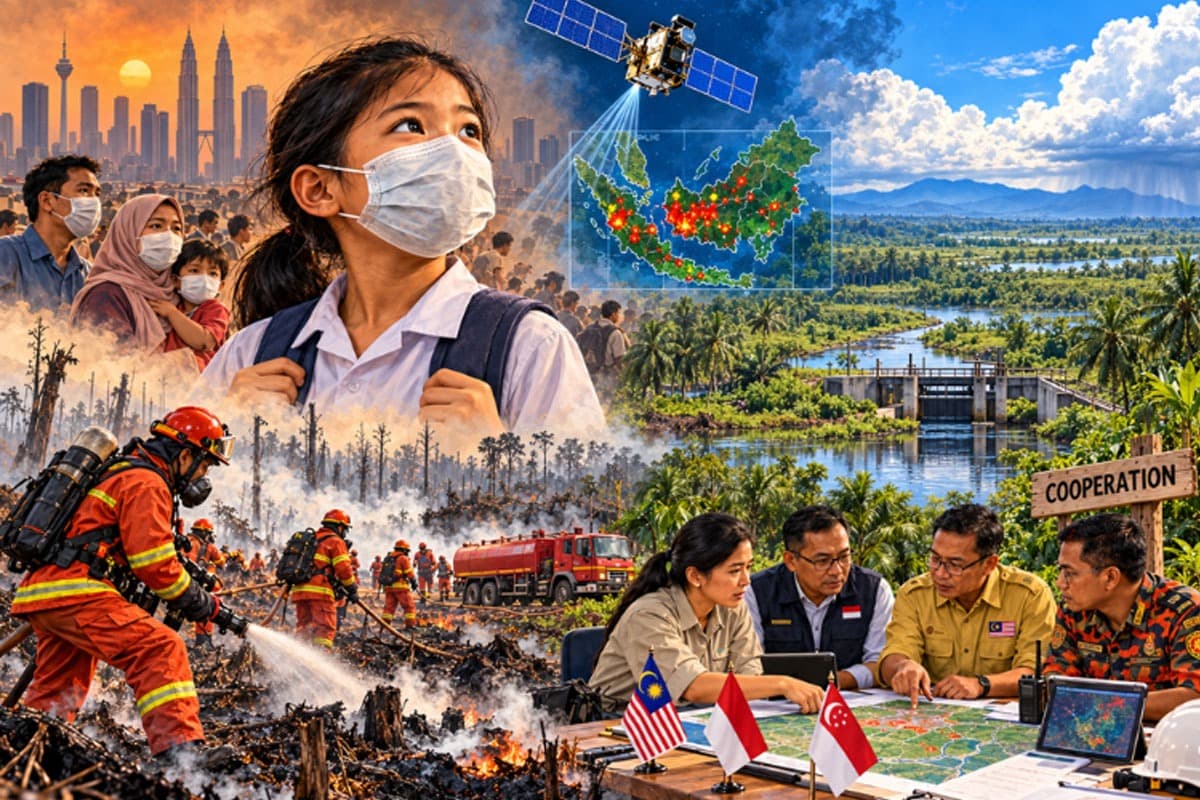
(Oct 29): The first sustained rain after a season of haze brings relief that needs no explanation. Windows reopen. Distant hills return. Parents worry a little less about the air their children are breathing.
But rain can also make unfinished business less visible. The pump awaiting repair, the disputed access route and the unanswered questions about a fire’s origin remain. Only the sky has changed.
That is the danger of treating haze as a seasonal interruption rather than a test of how we manage risk.
When the air is bad, we demand action. When it improves, attention moves elsewhere. The challenge is to carry the urgency of the smoky weeks into the quieter months when prevention can be strengthened.
Having spent much of my working life in plantations, I appreciate the operational difficulties. Experience should sharpen our questions, not soften our scrutiny. Neither an accusation nor an industry explanation should pass unexamined.
For businesses, premature attribution can distort sourcing and financing decisions. Inadequate prevention exposes assets, workers and neighbours to avoidable harm. Getting the facts right serves accountability and sound judgment.
My earlier haze commentaries called for less heat and more light. The next question is practical: what must companies, communities and governments do differently before another fire?
Follow the fire, examine the duties
Imagine a row of terrace houses. Mr A takes sensible precautions. Two doors away, Mr B neglects his. A fire begins at B’s house and spreads in hot, windy conditions. Mr A helps fight it but suffers damage himself.
His burning house does not prove that he started the fire. His efforts with the hose do not settle every question about his preparedness either.
Real incidents come without a narrator who has conveniently identified Mr B as negligent. The sequence must be established through evidence.
A hotspot within a concession deserves prompt investigation. It does not, by itself, identify the ignition point or who struck the match. Flames may originate inside, enter from neighbouring land or flare up from persistent burning.
Equally, evidence of external ignition does not automatically settle whether an operator fulfilled its own duties.
Sound judgment requires us to distinguish where a fire began from whether those managing the affected land fulfilled their responsibilities. Preparedness, cooperation with neighbours and access to vulnerable conservation areas all deserve scrutiny.
Detection, association and causation are related, but distinct. Prevention, land management, reporting and response require examination too.
An operator attributing fire to neighbouring land should substantiate that explanation. Were warnings acted upon? Were crews ready? What happened between detection and response?
Protecting people requires speed; establishing responsibility requires care. Both can proceed together. We need not await a completed investigation to fight a fire, nor announce a verdict before the evidence supports one.
Where wrongdoing or failures are established, appropriate consequences should follow. Where allegations are unsupported, corrections deserve visibility. Fair scrutiny makes accountability more defensible, not less demanding.
Dry ground, difficult fires
Weather belongs in the explanation. Prolonged dryness makes vegetation more combustible, water less dependable and firefighting harder. Heat and wind can compound those difficulties.
Climate risks deserve serious assessment alongside ignition, land management and response. Weather provides context, not an exemption from responsibility. El Niño does not carry a box of matches.
Peat presents an especially punishing challenge because the ground itself can become fuel. Fire can smoulder below the surface and persist after visible flames disappear. Crews may need to return repeatedly to reach buried pockets of combustion.
Extinguishing the flames and extinguishing the fire beneath their feet are different tasks. A falling hotspot count is welcome, but does not by itself establish that the operation is complete.
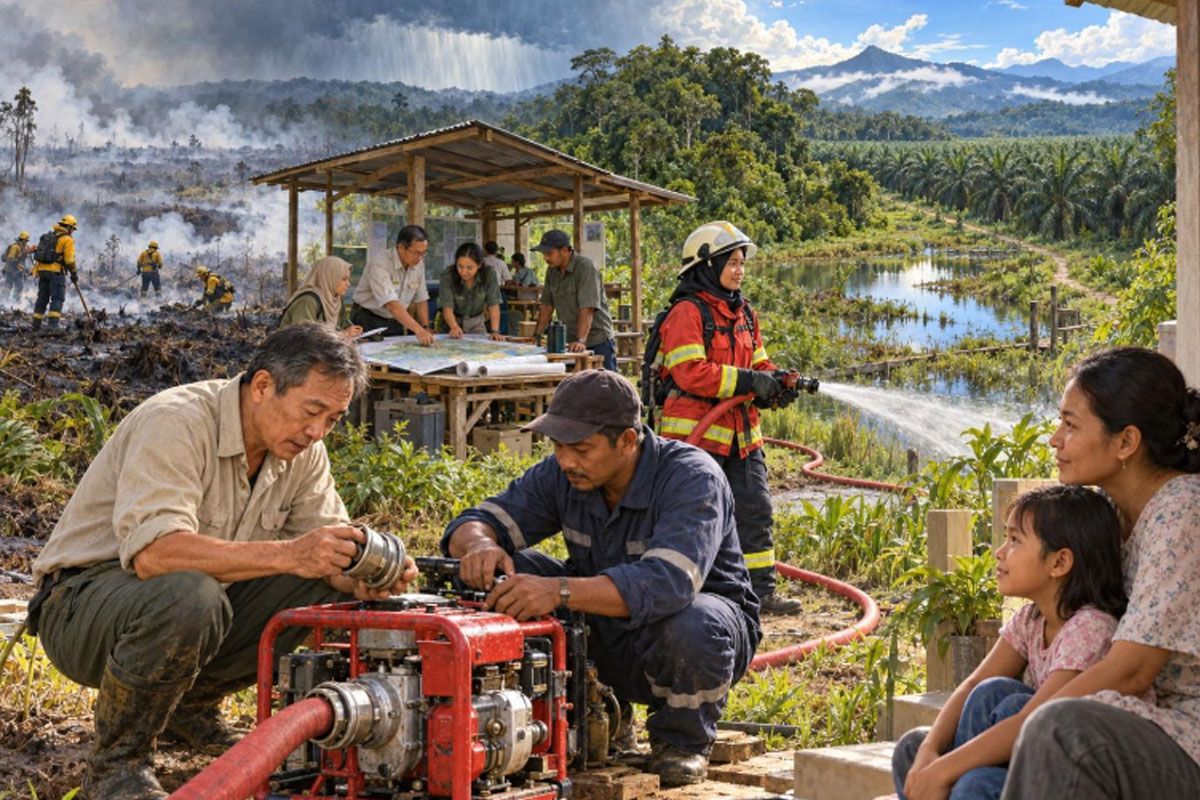
Water can become harder to obtain just when more is required. Transporting it over difficult terrain adds cost and delay. Such constraints deserve examination alongside the adequacy of preparation.
Drainage history matters too. Past alterations can leave peat vulnerable long after conversion. Today’s managers must address known risks within their responsibilities rather than assume that an inherited condition is somebody else’s problem.
Nor is scrutiny exclusively an oil palm matter. Forestry concessions, other agricultural holdings and community landscapes belong in the assessment.
Wherever fires occur, the standard should be consistent: examine conditions, ignition, management and response together. Neither climate nor corporate culpability should become a conclusion selected in advance.
A pump on the register is not water at the fire
For boards, preparedness must mean more than an equipment inventory.
A pump may work perfectly yet be too heavy to carry to the incident. A water source may be adequate during a demonstration but unreliable through prolonged drought. A trained team may already be committed elsewhere.
Preparedness depends on people, equipment, water, access, communications and decisions working together.
Preparedness should be tested where the challenges are greatest. A successful drill beside a convenient water source offers limited assurance about a remote fire beyond the last serviceable track.
What if the nearest water source is unavailable? What if communications fail? What if another incident requires the same crew?
Realistic exercises should reveal weaknesses while there is time to correct them. Management should not discover its limitations for the first time through smoke.
These questions have financial consequences. Fire threatens productive assets, harvesting, transport and cash flow. Suppression and recovery consume resources, while communities and public agencies may bear costs too.
Prevention budgets should reflect that exposure. Maintenance deferred to improve this quarter’s numbers can become a larger obligation later.
Deliberately destroying mature palms producing income generally makes little commercial sense. Those assets represent years of investment and future harvests. But that observation cannot establish what happened elsewhere within a holding. Investigators must distinguish productive areas from development activities.
A grower honouring a No Deforestation, No Peat and No Exploitation commitment would not clear peatland for new planting. Did practice match policy?
Certification provides a framework for scrutiny. It is neither immunity from investigation nor proof of guilt when a hotspot appears.
Boards need to know the remaining vulnerabilities, the resources required and who will complete corrective action. A response plan should work on a dry afternoon as well as it reads in an audit file.
Conservation needs a practical protection plan
Conservation presents a difficult practical question: How do we protect an area that firefighters struggle to reach?
Imagine a forested parcel containing valuable habitat but lacking suitable access for firefighting equipment. During a dry spell, monitoring detects a possible fire. The warning has arrived. Getting people, pumps and water there is another matter.
Opening a route might improve response. It might also disturb vegetation, affect drainage or facilitate encroachment. Leaving access unresolved could expose the habitat to a spreading fire.
Neither decision should be made by slogan.
Planning should begin with existing tracks, waterways, observation points and remote monitoring. Could portable equipment or water relays support safe intervention? Where do these alternatives leave a serious gap?
If additional access is justified, what is the smallest effective intervention? What permissions, ecological safeguards and controls on subsequent use are necessary?
A monitoring trail, firebreak and permanent vehicle road serve different purposes. They should not be bundled together under the reassuring label of “fire access”.
On peat, particular care is needed to avoid works that disrupt water management and increase vulnerability. Any proposal must consider risks created by the remedy as well as the threat.
Operations, conservation, engineering, safety and legal teams should resolve these questions before emergency pressure forces hurried choices.
Organisations often divide responsibilities neatly while risks remain connected. Each department can complete its checklist and still leave a dangerous gap between them.
A conservation map identifies what deserves protection. It cannot, on its own, provide that protection.
When the rains return, keep the water
There is a costly irony in peatland firefighting: water is brought in during drought, yet drainage may carry returning rainfall away.
Appropriate rewetting of degraded peat, using suitably designed water controls, can help reduce vulnerability. But rewetting is not indiscriminate flooding. Restoration areas, existing farms, villages and roads require different considerations.
Structures need maintenance and water-level monitoring. Installing a canal block begins a management task; it does not complete one.
Boards and funders should ask whether the intended water conditions are sustained, risks are reduced and adverse effects are addressed. Counting structures is easier than demonstrating results.
Water also follows hydrology rather than property lines. Effective management may require coordination across neighbouring holdings and with public authorities.
That principle extends to fire response. A plantation manager can direct employees and contractors but cannot simply command neighbouring land users.
Where direct control ends, cooperation becomes essential. Neighbours need arrangements for warnings, verification, mobilisation, water access and communication.
Who receives the first call? Who checks the report? Who coordinates deployment? What happens when several incidents compete for the same resources?
Assistance beyond a concession can protect communities and the plantation itself. It also consumes equipment and workforce capacity. Agreements should recognise those limits while preserving each party’s obligations.
Helping to extinguish a fire should not be confused with evidence of having caused it. Joining a partnership does not discharge an organisation’s own responsibilities.
The government must provide coherent rules, coordination and functioning public capacity. Corporate support can contribute substantially, but should not become the sole substitute for agricultural extension or emergency services.
Smallholders facing poverty need workable alternatives to burning. Prohibition alone supplies neither machinery nor affordable finance. Training, shared equipment and suitable land-preparation methods should reinforce enforcement.
Planning must also consider cumulative exposure. Several individually small burns during the same dry period may create a wider risk and overwhelm local resources. Examining each plot separately can miss the pressure across the landscape.
This calls for coordination, rather than collective blame.
Evidence should travel with the claim
Environmental claims should invite the same basic questions as financial reporting.
What was measured? Over what period? Across which geography? What was excluded or independently checked?
Hotspots, separate fires and burned hectares are not interchangeable. One fire can generate multiple detections. Percentages need a denominator; comparisons need a consistent basis.
Operators with published boundaries are easier to examine than poorly documented activities. The answer is broader scrutiny. Visibility should assist investigation, not become a shortcut for assigning blame.
Buyers and financiers should distinguish unresolved allegations from established breaches while requiring credible remedies for proven failures. Requests for information and investigative notices are steps towards establishing facts, not findings of guilt.
Corporate complexity must not obscure responsibility. Association alone cannot establish misconduct.
Companies should substantiate explanations. Campaigners should disclose methods. Authorities should distinguish preliminary observations from findings. Their duties differ, but confidence should not outrun evidence.
Recognising firefighters does not absolve management. Questioning an allegation does not diminish public suffering.
Nor should public pressure encourage unsafe displays of action. Firefighters need reliable communications, relief crews, escape routes and authority to withdraw when conditions exceed their capabilities.
A delay may reflect poor preparation or a necessary safety decision. The distinction should be examined and explained.
Courage deserves respect. It should not be expected to compensate indefinitely for overdue decisions.
What must outlast the smoke
Three expectations would give these principles practical force.
First, demonstrate preparedness at difficult locations, record weaknesses and track corrective action.
Second, resolve responsibilities and access arrangements before emergencies, including the limits of shared resources and safeguards for sensitive areas.
Third, assess outcomes rather than activity alone. Were warnings acted upon? Did equipment work? Were communities better equipped and firefighters protected? Did interventions cause avoidable ecological damage?
Report unresolved problems as well as achievements. A culture that discourages inconvenient findings may receive reassuring reports until events supply a less comfortable version.
These habits matter beyond haze, including flood preparedness, infrastructure maintenance and emergency planning. Known risks require decisions, resources and follow-through.
Asean shares one sky. Smoke needs no passport; cooperation should cross borders just as readily. Shared warnings, data, equipment and expertise can improve protection while investigations establish responsibility. Neighbours can demand accountability and offer practical help at the same time.
Prevention rarely provides the drama of rescue. A serviced pump, a functioning water-control structure or a trained village team may avert an incident that never becomes news. That absence is worth funding.
Let us support firefighters, estate workers, villagers and volunteers, and pray for their safety and return home. May rain replenish water supplies and bring sustained relief.
But clearer skies must not cloud our resolve. Rain can clear the air. It cannot service a pump, settle responsibilities or implement an overdue decision.
That work remains ours.
Joseph Tek Choon Yee is a former president of the Malaysian Estate Owners’ Association and past chief executive of the Malaysian Palm Oil Association