


This article first appeared in City & Country, The Edge Malaysia Weekly on October 26, 2026 - November 1, 2026

Property management is one of the less visible professions in Malaysia’s property sector. Yet, as strata living and mixed-use developments grow in popularity, the role is becoming increasingly important, demanding skilled managers who can oversee more than a single property type.
In this sixth and final part of Strata Sense, a collaboration with Henry Butcher Malaysia (Mont Kiara) Sdn Bhd (HBMK), City & Country examines the role of the professional property manager.
Managing a mixed-use development calls for a different skill set from running a purely residential or purely commercial block. One call on maintenance, security or access can affect other components such as hotel guests, retail operators, office tenants and residents all at once, each with their own operating hours and expectations.
For HBMK, this is work that demands empathy, positivity and a genuine desire to see things done properly.
“It’s in how you care for people, and how you put that interest into the profession,” says HBMK managing director Low Hon Keong.
At its core, a manager is the professional custodian of the asset. The role spans preventive maintenance, financial sustainability, legal compliance, risk management and the day-to-day expectations of owners, occupants and operators.
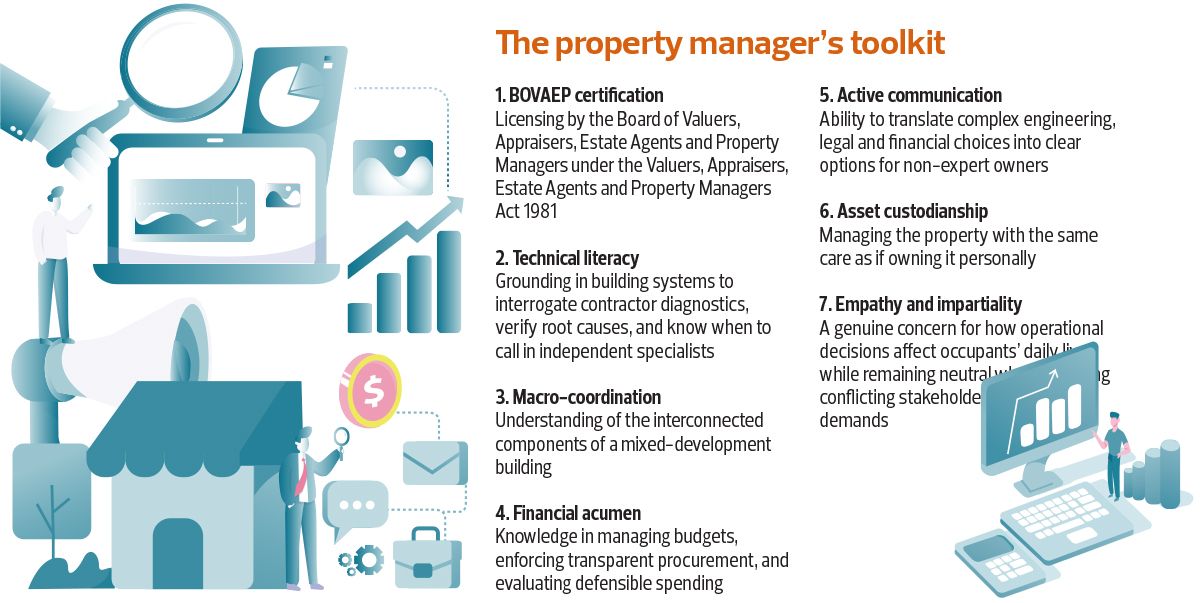
As a regulated profession in Malaysia, any party managing property for a fee must operate within the framework set by the Board of Valuers, Appraisers, Estate Agents and Property Managers (BOVAEP) under the Valuers, Appraisers, Estate Agents and Property Managers Act 1981. This means certain registrations and certifications are mandatory, and all managers are required to meet the relevant competency and registration requirements based on their route of practice.
While qualifications are necessary, they are only the entry point, Low says. Competency and empathy are what truly distinguish skilled managers.
“A property manager may not be an owner of the building, but we have to manage it with the same care and responsibility as if we did.”
That line of responsibility becomes even more complex in a mixed-use development. Two buildings completed at the same time with similar specifications can diverge sharply in value over a decade, explains Low.
The difference is rarely in the original construction, but in what happens during the years of operational decisions, maintenance priorities and financial discipline.

Technical and operational discipline
Low explains that property management in a mixed-use environment is a coordination business. On any given day, a manager may juggle security incidents, cleaning standards, mechanical and electrical (M&E) breakdowns, contractor performance, resident complaints, arrears, insurance matters and committee instructions — often within the same few hours.
Preventive maintenance schedules, inspection routines, contractor key performance indicators, incident reporting, procurement controls, complaint tracking, financial reporting and escalation procedures form the backbone of daily operations.
Coordination is non-negotiable in an integrated mixed-use development, stresses Low. A leaking pipe in a residential block can easily flood the retail premises below; an ill-maintained F&B exhaust system risks compromising the air quality for residents above; while a bottleneck at the loading bay can paralyse traffic flow across the entire development.
To prevent operational friction, managers must maintain a macro view of the overall development rather than addressing issues in silos.
Technical literacy is equally critical, Low points out. While a manager is not expected to replace an engineer or specialist contractor, having a solid grasp of building systems is essential to asking the right questions.
For instance, when a contractor recommends replacing a pump, managers should be able to investigate the root cause, verify the diagnostic tests conducted, explore repair viability, and determine whether the issue stems from a recurring design or operational flaw.
The same discipline applies to lifts, chillers, waterproofing, fire protection, electrical systems, façade systems and water pumps. Repeated water leakage in the same area should not result in repeated patching. If leaks keep reappearing, the management must investigate where the root cause lies.
Low says technical knowledge allows the manager to recognise when routine maintenance becomes a risk-management issue and when an independent specialist needs to be brought in.
He likens managing a mixed-use development to flying an aircraft.
“You will have a lot of switches to look after because it is complicated, but you must know every single switch’s functionality,” he says.
Communication, responsibility and due diligence
If building systems form the hardware of property management, the “software” is its human side: communication, empathy and sound judgement. Managers must constantly balance competing, valid interests — whether aligning a hotel’s need for 24-hour access with residents’ demand for tight security, or retail operators’ drive for foot traffic with homeowners’ desire for quiet.
Low says the manager must remain impartial, balancing the legitimate but often competing needs of hotel, retail, office and residential components.
A manager must understand the development inside out and act as a bridge between stakeholders to resolve issues before they escalate, he adds. Beyond technical expertise, this requires a genuine concern for how decisions affect residents’ daily lives, as well as an investment of time in listening, explaining and problem-solving.
Committee members are owners volunteering their time. They may be lawyers, accountants, doctors or businessmen, but they are not necessarily building-management professionals, Low says. Managers, therefore, have a professional responsibility to explain the implications of decisions taken.
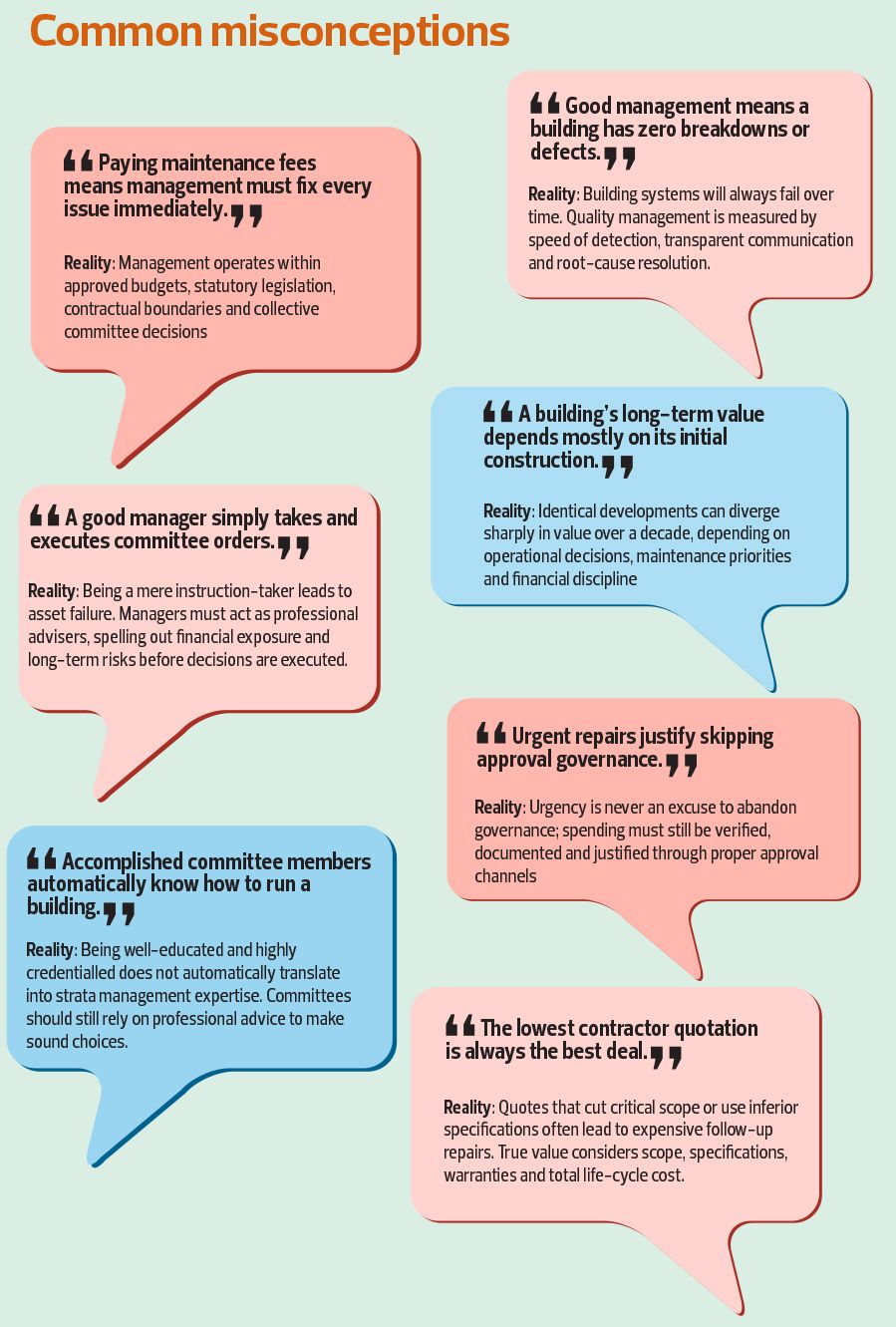
If a committee wants to postpone a major repair to keep maintenance charges low, the manager’s job is not simply to say “okay”, explains Low. The responsibility is to explain what is deteriorating, what could happen if the work is delayed, the estimated financial exposure and the available options, he says.
Ultimately, certain decisions belong to the management committee (MC). But the manager’s accountability on the ground means documenting recommendations, following up on decisions, monitoring implementation and escalating significant risks.
Low stresses that the relationship should be a partnership rather than a one-way instruction chain. “There must be co-existence with the MC and manager working together as a team,” he says.
Due diligence in property management is not a once-a-year audit exercise; it is a daily habit, according to Low. It shows up in how quotations are evaluated, how incidents are investigated and how risks are escalated.
Financial discipline and procurement integrity are central. Every ringgit spent belongs to others; so, each expenditure must be defensible. That means proper budgeting, transparent procurement, competitive quotations or tendering where appropriate, clear scopes of work, evaluation criteria, approval authority and documentation.
Procurement integrity does not mean automatically choosing the cheapest quotation. If one contractor quotes RM100,000 and another RM130,000, the lower price is not necessarily cheaper if it excludes critical works, uses inferior specifications or leads to another RM80,000 repair two years later, Low points out.
The manager’s role is to help the committee compare scope, specification, competency, risk, warranty, life-cycle cost and value, rather than simply comparing the number at the bottom of the quotation, he says.
There will also be situations where the easiest decision is to approve an urgent expenditure immediately. Financial discipline means resisting that pressure where possible, verifying the need, documenting the justification and maintaining the proper approval process. Urgency should not become an excuse for abandoning governance.
HBMK task force model
For HBMK, this structure is carried out on the ground. The building manager reports to an area manager, who oversees multiple sites and provides an additional layer of oversight and support. The area manager, in turn, reports to Low, ensuring that decisions are aligned across the portfolio.
This arrangement calls for a task force, not a lone operator. The on-site building manager is never expected to shoulder the full burden alone; support is built into the structure.
“The building manager will report to the area manager, and they will give them advice and solutions. If there’s a larger case, they will redirect it to me,” Low says.
This means that when a complex issue arises, the building manager can draw on the area manager’s experience across other sites, while Low provides the final layer of judgement on financial, legal and reputational implications.
Daily coordination is reinforced through structured briefings. Building managers conduct morning reviews not just with the management team but also with security and cleaning supervisors. Decisions made at MC meetings are then cascaded down, with clear next steps assigned to each stakeholder group.
When management fails
Failures in property management do not always stem from a lack of competency, according to Low. They can also arise from inadequate staffing, poor systems, weak supervision, excessive portfolio size, conflicts of interest, poor procurement controls, pressure from stakeholders or a permanently reactive culture.
A major problem occurs when the manager becomes an instruction taker rather than a professional adviser, he says. If management simply executes every instruction without explaining the consequences, the instruction may have been followed technically, but the MC may not have been properly advised.
The opposite problem also occurs: managers acting beyond their authority. For example, a property manager might approve a charge exceeding the MC limit without tabling it at an annual general meeting. Alternatively, a manager might authorise repairs based on a single quotation, failing to obtain the three competitive quotes required by the MC. Competency, therefore, includes understanding both when to lead and when the decision belongs to the MC, says Low.
He also points out that committee members may be highly accomplished in their own fields but still lack building-management expertise.
“Property management requires multiple disciplines from M&E to accounts, insurance, administrative tasks, as well as day-to-day operations. Feedback from the manager is crucial for the MC to make decisions,” Low explains.

What owners should expect
Owners should expect transparency, competency, responsiveness, proper financial controls, preventive maintenance, accurate records and early warning of significant risks.
A common misconception is that because owners pay maintenance charges, management should resolve every issue at once. In reality, property management operates within budgets, legislation, contractual obligations, common-property boundaries and decisions made collectively by owners.
Another misconception is that good management means there are no problems, Low says. Every building will have breakdowns, defects and complaints. The better measure of good management is how quickly problems are identified, how transparently they are communicated and whether the underlying causes are addressed.
Low sums up the expectation: Managers should have strata management knowledge, relevant experience in similar developments and a strong financial and accounting backbone.
“They should be able to carry out monthly reportings, expenditure, collection and balance sheet items very clearly for the committee so that they can report it in the annual general meetings,” he says.
“The key is understanding every stakeholder involved in managing and maintaining common areas. A good manager identifies risks early, presents options clearly, documents decisions, and gives the building the best chance to protect its safety, finances and long-term value.”
Increasingly important role
The property management industry in Malaysia still needs greater recognition of its function as a professional asset-management discipline rather than simply an operational service, says Low.
Buildings are becoming increasingly complex, with integrated developments featuring sophisticated M&E systems, smart technology, electric-vehicle charging and multi-tiered security across components with vastly different operating requirements. Simultaneously, owners demand greater transparency, sustainability, higher service standards and cost efficiency.
On a macro level, Low says the legal framework needs to be revised.
“The Strata Management Act needs to be amended — it is long overdue. There are many loopholes that do not suit current and new developments. The last thing we want is for people to take advantage [of these loopholes] and disrupt harmony in strata communities.”
Save by subscribing to us for your print and/or digital copy.
P/S: The Edge is also available on Apple's App Store and Android's Google Play.