

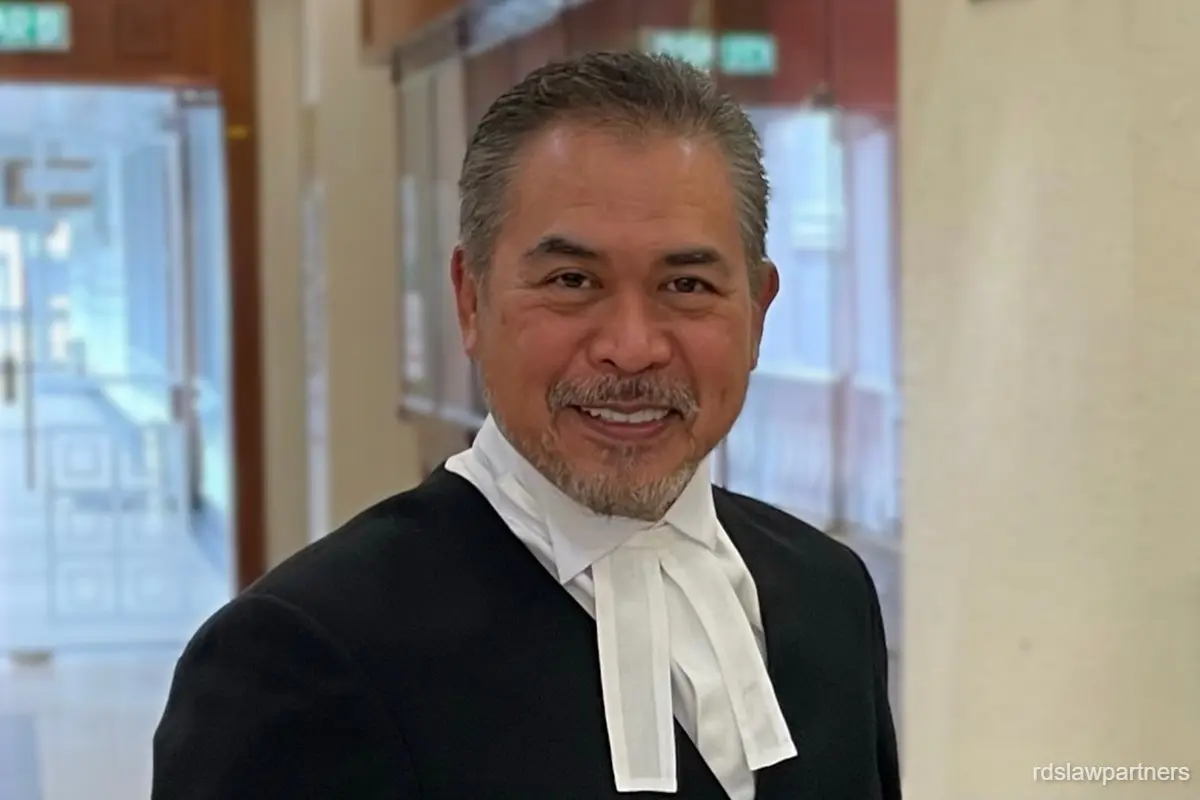
PUTRAJAYA (Oct 29): The Court of Appeal (COA) has reversed a High Court decision and granted leave (permission) for lawyer Rosli Dahlan to challenge the Police and the Public Prosecutor's move to seize his four Amanah Saham Nasional Bhd (ASNB) accounts under the Anti-Money Laundering, Anti-Terrorism Financing and Proceeds from Unlawful Activities Act (AMLA).
The unanimous three-member COA bench led by Datuk Dr Choo Kah Sing said that the High Court judge had erred in his decision to deny Rosli’s leave for judicial review on Aug 14, 2024.
“This court is of the considered view that the appellant (Rosli) has demonstrated a prima facie arguable case, that the procedural orders may have been affected by mala fide (bad faith), collateral purpose, irrationality, or abuse of power,” Choo said in the bench’s brief grounds.
“Whether those allegations can ultimately be established is a matter for a substantive hearing. The learned High Court judge therefore erred in refusing leave for this preliminary stage,” Choo said.
The appellate bench, which also comprises Datuk Nadzarin Wok Nordin and Datuk Seri Latifah Mohd Tahar, set aside the High Court’s decision and remitted the matter back to the High Court for a full hearing on its substantive merits before a different judge or judicial commissioner.
Choo noted that at the leave stage, the court’s role is strictly limited to determining whether an application is frivolous or vexatious, and whether a prima facie arguable case exists, rather than resolving contested questions of fact, or weighing evidence.
“This court is of the considered view that the learned High Court judge approached the matter at a level of scrutiny more appropriate for a substantive hearing than for a leave application,” he said.
In allowing the appeal, the COA was of the view that Rosli had crossed the required threshold to pursue his judicial review, to challenge the Public Prosecutor's orders issued against his assets under Section 50 of AMLA. This deals with the deputy public prosecutor’s exercise of power.
“Accordingly, the appellant (Rosli) has crossed the relatively low threshold required at the leave stage,” Choo said, and granted costs to Rosli.
The court then sent the case back to the High Court for a full judicial review and set Nov 9 for a case management.
Rosli was represented by Chetan Jethwani, Harvinderjit Singh, Amiratu Al Amirat, Ho Yu Fei, and Shavita Devi Raja Mohan.
The AGC, Police, and others were represented by senior federal counsel Normastura Ayub, and federal counsel Zulkiefli Sulaiman.
The seizure orders for the accounts were issued on Jan 12, 2024, and were revoked on Oct 17 of that same year. All of Rosli’s accounts have been unfrozen since then.
High Court’s previous ruling by current chief justice
On Aug 14, 2024, High Court judge Tun Wan Ahmad Farid Wan Salleh, who is currently the chief justice, had dismissed Rosli’s leave application, ruling that the deputy public prosecutor (DPP) had not acted in bad faith (mala fide) when issuing the seizure orders.
Wan Ahmad Farid held that a DPP acting on information provided by investigating officers did not, on its own, constitute mala fide without further evidence of collusion between the police and the prosecution. The High Court had also reasoned that judicial intervention was premature while police investigations were still ongoing.
However, in his application, Rosli contends that the seizure orders were tainted by mala fide, abuse of power, collateral purpose, and reliance on false information supplied by investigating authorities.
He claims the police’s actions were linked to a report lodged by AirAsia Bhd against i-Serve Sdn Bhd concerning RM48.4 million in top-up transactions.
Rosli, who had previously acted as legal counsel for i-Serve in several forfeiture cases, alleges that the examination and subsequent seizure of his four ASNB accounts on Jan 18, 2024, were executed not for legitimate investigative purposes, but to victimise and embarrass him.
In a separate, earlier judicial review, Rosli had successfully obtained leave to challenge the freezing of his and his wife’s bank accounts as well as a travel ban, where the court found the police had acted in bad faith.