

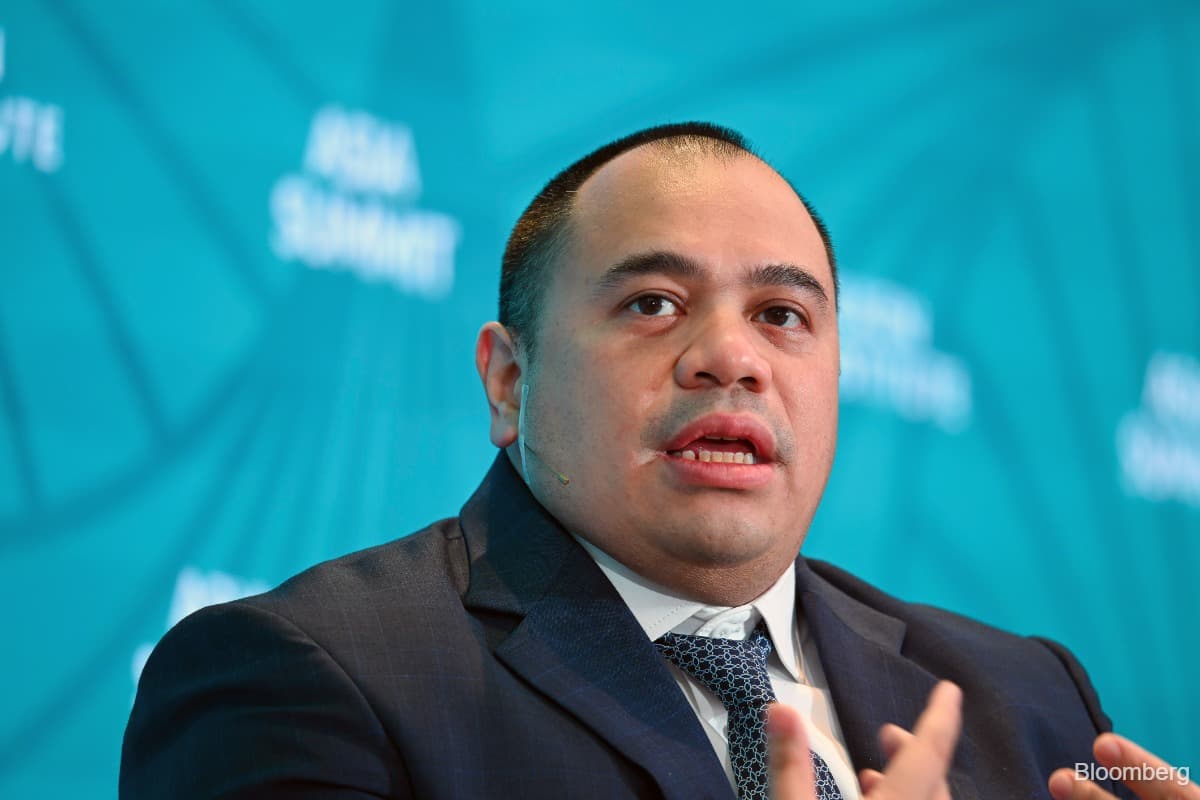
(Oct 29): Pandu Sjahrir, the prominent Indonesian wealth fund executive who has publicly supported MSCI Inc’s scrutiny of the nation’s stock market, is the co-owner of a brokerage sanctioned in connection with a stock-market manipulation probe.
Pandu, who as chief investment officer of Danantara has become a key liaison with global money managers, indirectly owns a 27.5% stake in PT Supra Sekuritas Indonesia, according to company records.
People with knowledge of the matter, who asked not to be identified discussing sensitive information, said Supra Sekuritas was the company referred to as “SS” by Indonesia’s Financial Services Authority this month when it announced sanctions against more than a dozen entities for violating regulations in cases related to market manipulation. The statement, which only listed the firms by their initials, came in the wake of MSCI’s surprise threat to downgrade the country to standalone status — a more severe punishment than previously considered.
The previously unreported revelation risks complicating Indonesia’s efforts to regain New York-based MSCI’s confidence and prevent billions of dollars in capital outflows. The nation’s benchmark stock index has dropped around 10% since the index provider’s warning on Oct 15, the worst performance in Asia.
MSCI has repeatedly raised concerns about opaque ownership and the potential for coordinated trading in one of Southeast Asia’s biggest equity markets, while pressing authorities to strengthen regulation, surveillance and enforcement. As a top executive at Danantara, which reports to President Prabowo Subianto, Pandu has pitched the country to investors at global forums in places like Washington, Davos and Tokyo.
“Pandu has increasingly become the face of Indonesia to the international investment community,” said Bhima Yudhistira Adhinegara, executive director of the Center of Economic and Law Studies, a Jakarta-based think tank.
A spokesperson for Pandu confirmed in a statement that he’s a minority shareholder of Supra Sekuritas in his personal capacity, noting that the investment is passive.
Pandu has never served on the company’s “board of directors, board of commissioners, or management, and has had no role in its daily operations, trading activities or compliance decisions”, the spokesperson said. “His ownership should not be confused with responsibility for the company’s actions.”
Pandu fully respects the FSA and “supports strong and fair enforcement of capital market regulations”, the spokesperson said, adding that he “remains committed to supporting transparency, good governance and investor confidence in Indonesia’s capital markets”.
In recent months, MSCI has privately signalled to Indonesian officials, including Pandu, that the market’s problems have not been fixed, according to people familiar with the matter.
MSCI talks
Pandu has publicly supported MSCI’s scrutiny, describing its warning as a much-needed wake-up call to improve the Indonesian stock market’s liquidity and transparency. The alumni of Stanford Graduate School of Business had estimated a downgrade to frontier-market status alone could trigger US$25 billion (RM102 billion) to US$50 billion in outflows.
Pandu met with MSCI chief executive Henry Fernandez in late September in New York and asked for recommendations on what Indonesia could do to avoid a reclassification, people familiar with that gathering said. On Oct 13, Pandu participated in a Danantara-organised event on the sidelines of IMF meetings in Bangkok that MSCI also attended.
Pandu “has held talks with MSCI previously and has expressed his support of Indonesia’s financial reforms”, his spokesperson said. “He believes that transparency and good governance are essential to maintaining investor confidence.”
The FSA didn’t single out Supra Sekuritas’s owners in announcing sanctions, and Pandu himself hasn’t been accused of any wrongdoing. The regulator, which didn’t divulge any names, said it fined three companies a total of 2.1 trillion rupiah (US$117 million or RM470 million) while levying unspecified financial penalties on other brokerages involved as well as punishments for certain individuals at the firms.
Financial penalties
The announcement of fines earlier this month was part of the biggest series of financial penalties ever laid out by the FSA — a sweeping response to MSCI’s downgrade threat. The Indonesian regulator said on Monday that it will name sanctioned entities after an appeals period, but didn’t provide a timeline.
Pandu owns 99.99% of PT Asha Artha Sehati, which in turn holds a 27.5% stake in Supra Sekuritas, according to Bloomberg calculations of shareholding shown in company registration records. The brokerage, formerly known as Supra Securinvest, has been a trader of shares in Indonesian coal miner PT Dian Swastatika Sentosa, one of the companies at the heart of the recent regulatory sanctions.
Representatives for the FSA and Indonesia Stock Exchange didn’t immediately respond to requests for comment. Representatives for Dian Swastatika also didn’t respond to a request for comment for this story.
A Supra employee reached by telephone said no one was available to comment. An email sent to the address listed on the company’s website bounced.
Pandu bought into Supra Sekuritas in late 2023, company records show. A company controlled by veteran financier Yonggi Tanuwidjaja holds the remaining 72.5% interest. Yonggi didn’t respond to a request for comment.
After years of relatively limited trading, Dian Swastatika’s shares more than quadrupled in 2024 and nearly tripled in 2025. By August 2025, Dian Swastatika’s market capitalisation had ballooned to more than US$30 billion, large enough for MSCI to select it for inclusion in its benchmark indices.
Within days, however, the index provider announced it was cutting the stock’s weighting after receiving feedback from market participants, citing uncertainty around the company’s free float.
‘Good governance and transparency’
Supra Sekuritas has been a major conduit for trading in Dian Swastatika shares. Over the past 12 months, it handled some 60.6 trillion rupiah (US$3.3 billion) of transactions — more than three times any other broker — and was the largest net buyer, data compiled by Bloomberg show.
Dian Swastatika said in an Oct 19 statement that it respects the FSA’s authority and will cooperate with regulators, underscoring its commitment to “good governance and transparency”. It didn’t address the substance of the alleged trading activity.
There’s no indication that Pandu profited from his investment in Supra Sekuritas or had any knowledge of its trading in Dian shares. The interest that Pandu holds in Supra Sekuritas through Asha is a relatively small part of his overall business and investment footprint.
Asha has about 41 billion rupiah of paid-up capital, compared with about 58 billion rupiah at Dara Permata Sehati, a vehicle owned almost entirely by Pandu that is known as Sjahrir Family Investment. In 2024, Newton Capital — a unit of Pandu-controlled Paloma Capital — provided an interest-free 883 billion rupiah loan to broadcaster Net Visi Media.
His broader business career spans energy and private capital. Pandu spent 15 years helping run PT TBS Energi Utama, a listed group rooted in coal mining that has expanded into waste management, renewable energy and electric mobility. He directly held about 0.6% of its shares at the end of April.
Pandu was also a managing partner at Indies Capital and a founding partner of AC Ventures, which have reported managing more than US$1 billion and US$500 million, respectively. Those figures reflect capital managed for investors, rather than Pandu’s personal assets.
MSCI has said it will make a decision on Indonesia’s market status by the end of June 2027.
Uploaded by Chng Shear Lane