


(Oct 28): The Bank of Canada (BOC) hiked interest rates to ward off upside inflation risks posed by higher energy prices, and said it may need to raise borrowing costs further.
Policymakers led by governor Tiff Macklem raised the benchmark overnight rate to 2.5% on Wednesday, the first increase in more than three years. The hike was expected by markets and was the consensus of Bay Street economists in a Bloomberg survey.
“Governing Council decided to increase the policy rate to reduce the risk that continuing high energy prices spread broadly to the prices of other goods and services,” the bank said in its statement.
“There could be a need to increase the policy rate further, but given uncertainties, Governing Council agreed to proceed carefully.”
Since September, the central bank has been increasingly worried that higher oil prices resulting from the conflict in the Middle East would bleed through to the prices of other goods and services.
Now, the bank expects yearly inflation won’t return to the 2% target until the middle of 2028.
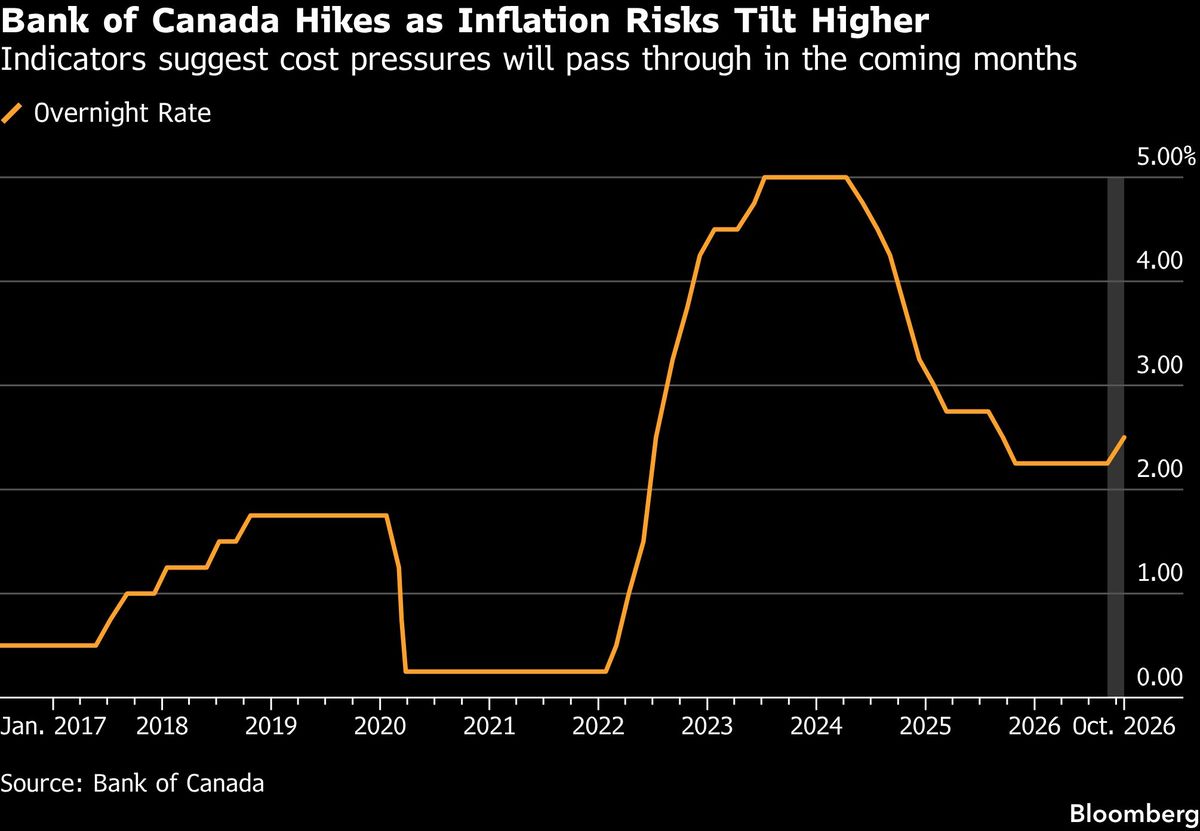
“With the outlook for inflation substantially higher and the economy showing resilience, an increase in the policy rate is needed to reduce the risk that elevated energy prices could spill over and become generalised inflation,” Macklem said in prepared remarks.
The loonie was little changed after the BOC decision, trading at C$1.4046 per US dollar. It has gained about 1.3% against the US currency in October so far. The price action in Canada rates was also muted with two-year yields edging lower, but remaining within the day’s range.
In the monetary policy report accompanying the decision, policymakers made major upward revisions to their inflation forecast, and now expect the yearly change in the consumer price index to be 3.1% in 2027, from its previous 2.0% projection.
“The main argument for an increase was that energy prices are higher, they are expected to remain higher, and costs pressures are building,” Macklem said. Governing Council agreed there was “less scope for monetary accommodation,” he said.
But Macklem also said the central bank had discussed holding interest rates steady. The main arguments for a pause include that increased inflation is concentrated in energy, there’s still slack in the economy and the tariff dispute with the US will weigh on growth, he said.
“Governing Council agreed we would take future decisions one meeting at a time,” Macklem said.
There’s no resolution in sight for the war in Iran, and oil prices are almost as high as they were in the early weeks of the conflict. As of Wednesday morning, Brent crude was trading just below US$115 (RM469.74) a barrel.
Charles St-Arnaud, chief economist at Servus Credit Union, said he’d be surprised if the bank didn’t hike again in December, despite Macklem’s non-committal language. Pausing “would require weakening economic activity or slower inflation than expected,” he said.
In the monetary policy report, the bank provided insights from Prima, its new forecasting tool. The model points to higher input costs such as energy causing more persistent increases for consumers, as those producer prices have filtered through the economy.
Officials also raised Canada’s growth outlook and expect the economy to expand 1% in 2026, and 2% in 2027 and 2028. Previously, the bank saw growth at 0.7% in 2026, and 1.8% in 2027 and 2028. The bank is no longer forecasting core inflation pressures.
The bank attributed the higher growth in part to federal measures, including Prime Minister Mark Carney’s so-called productivity mega deduction and the ramp-up of major projects.
Despite that strength, the economy is still struggling to find its footing. The labour market has shed jobs two months in a row, while US tariffs and reduced immigration are creating headwinds for some sectors. The housing market is also weak.
Macklem and senior deputy governor Carolyn Rogers will speak to reporters at 10.30am Ottawa time.
Uploaded by Felyx Teoh