

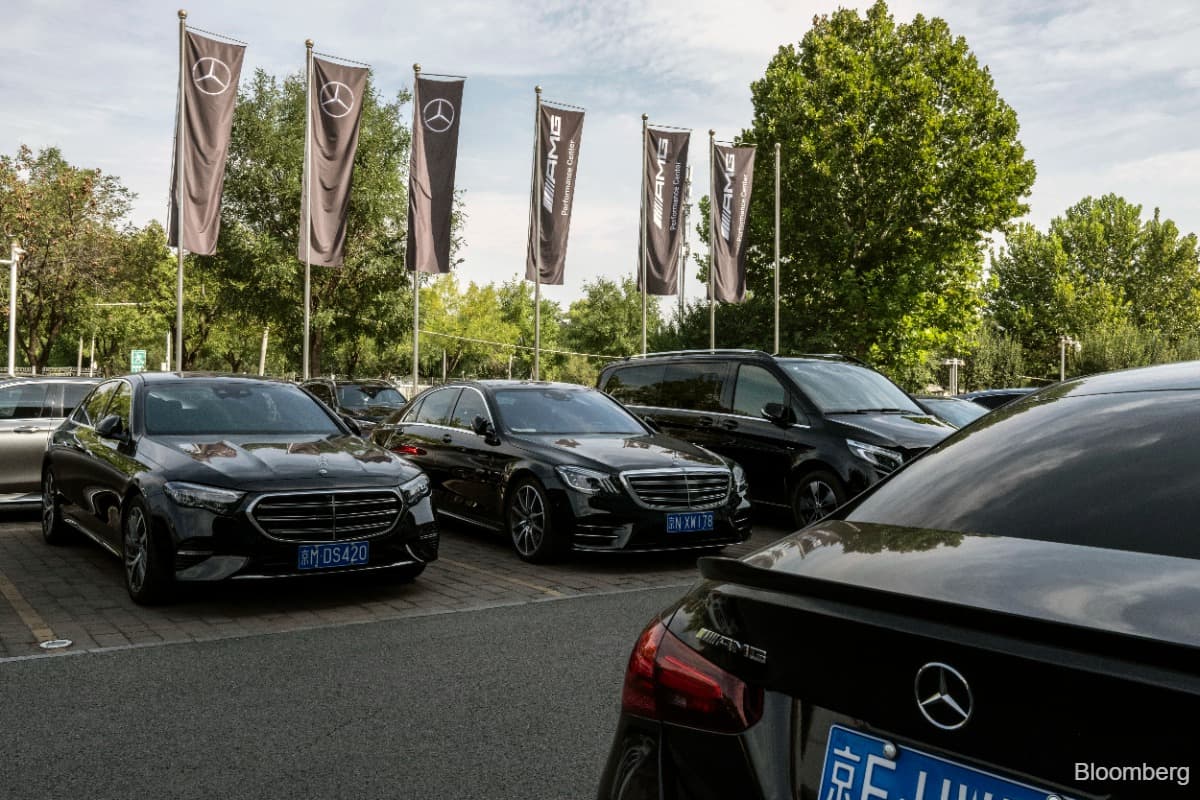
(Oct 28): Mercedes-Benz Group AG is preparing a broader overhaul of its China strategy after the luxury-car market deteriorated more sharply than expected, insisting it has no plans to retreat from what remains the world’s largest auto market.
Chief executive officer Ola Källenius said conditions in China are “deteriorating beyond what we had thought would happen this year”, with weakness intensifying further in the second half. The downturn has been particularly severe at the upper end of the market, where Mercedes has traditionally held a strong position and generated some of its richest margins.
Källenius said Mercedes is reviewing everything from its product line-up to sales, production, sourcing and technology in China, with a broader strategy to be presented in 2027.
“There is not a play where you put China aside,” he told analysts on Wednesday. “It has to be one of the pillars of your strategy.”
The reassessment comes as Mercedes pushes ahead with its biggest product and cost overhaul in years. Third-quarter revenue fell 4.5% to €30.7 billion (US$34.1 billion or RM139.9 billion), while adjusted group earnings before interest and tax declined 15%, the German carmaker said on Wednesday. A day earlier, Mercedes lowered its outlook, citing a worsening China slump and higher costs.
At the core cars division, adjusted earnings more than halved to €560 million in the third quarter, and the margin narrowed to 2.5% from 4.8%, reflecting the weaker contribution from China as well as currency and product-launch costs.
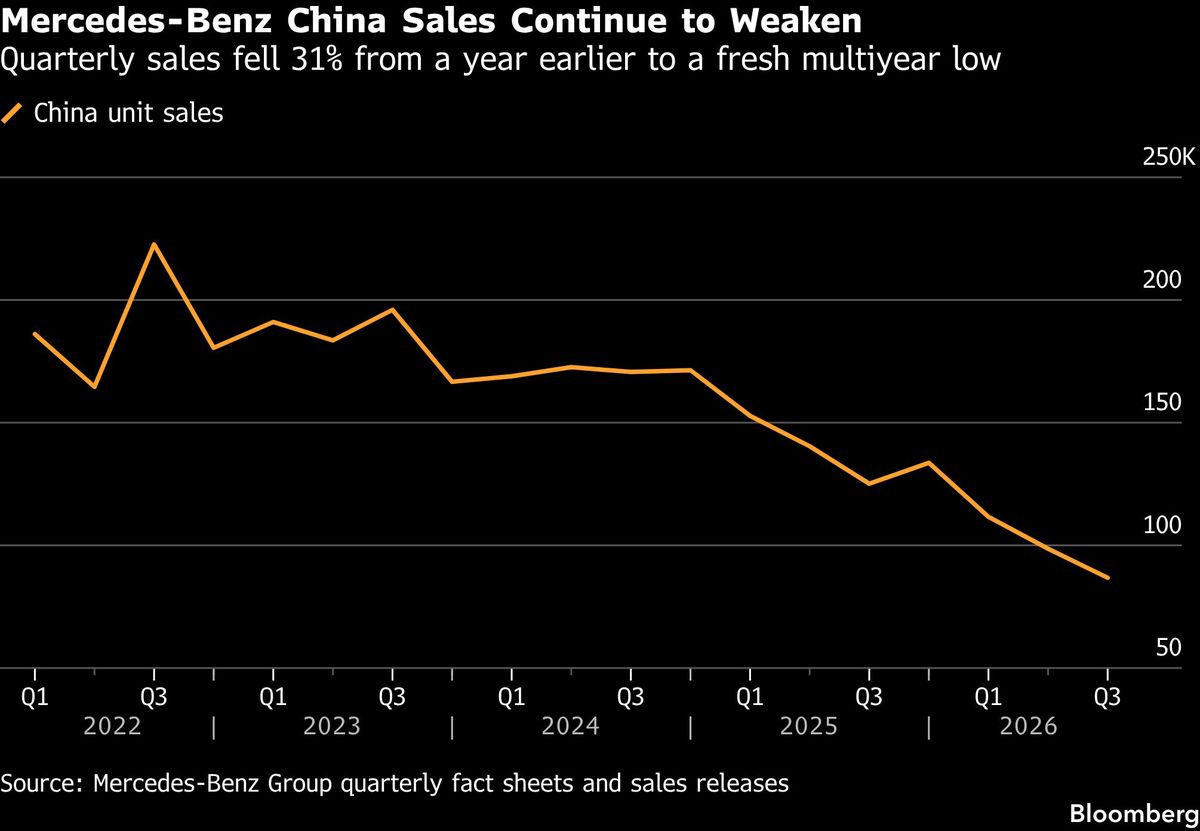
Mercedes vehicle sales in China fell 31% in the third quarter from a year earlier, extending a decline driven by weaker luxury demand, fierce price competition and increasingly sophisticated domestic rivals.
Mercedes shares fell less than 1% on Wednesday in Frankfurt, following Tuesday’s 3.9% decline. The stock has lost more than a third of its value this year.
Källenius said Mercedes isn’t treating the decline as a reason to downgrade China to a niche market. Beyond its sheer size, the country remains important because of its fast-moving technology ecosystem and the growing global reach of Chinese suppliers and automakers, he said.
The company is instead trying to remake the economics of selling cars there. A coming electric E-Class was developed from what Källenius described as effectively a “white sheet of paper”, with a product tailored more closely to Chinese buyers and sourcing shifted much more heavily into the country.
Mercedes will get close to sourcing the vehicle entirely in China for local production, Källenius said, helping cut variable costs significantly compared with its previous model. The company also plans to price the car realistically for local market conditions rather than relying on the economics that underpinned its China business in the past.
Still, Källenius ruled out chasing volume at any cost. Mercedes won’t adopt the “fire sale market-share-at-all-cost” approach pursued by some competitors, he said, underscoring the tension between protecting the brand and competing in one of the world’s fiercest price wars.
Chief financial officer Harald Wilhelm said the company expects its new-model momentum to strengthen further in 2027, alongside continued reductions in variable costs. But he declined to predict where China will be by then, saying the company would give a clearer assessment when it reports full-year results in February.
The comments add to signs that Mercedes increasingly sees China as a structural challenge rather than a temporary cyclical downturn. For years, CEO Ola Källenius has pursued a strategy centered on selling fewer but more expensive cars, relying heavily on models such as the S-Class, Maybach, G-Class and AMG range to support margins.
That calculation has become harder as China’s property downturn weighs on luxury spending and local rivals challenge Mercedes on price, software, electric technology and increasingly design.
Mercedes is responding with both cost cuts and its largest-ever product offensive. More than 40 new or refreshed models are due by the end of 2027. The electric CLA and GLC are already being rolled out, with new versions of the C-Class, S-Class, GLE and GLS among the vehicles intended to revive demand.
The company is also targeting material-cost savings of around 8% compared with 2024 levels, with substantially deeper reductions planned in China, and is shrinking an industrial footprint built for stronger volumes. Voluntary redundancy programmes are being used to reduce the German workforce.
The pressure extends across Germany’s auto industry. BMW AG and Volkswagen AG have also warned that deteriorating conditions in China are hurting earnings, highlighting how quickly a market that once generated outsized profits has become one of the sector’s biggest structural problems.
Volvo Car AB CEO Håkan Samuelsson said last week that the market for Western-developed cars in China isn’t coming back.
Uploaded by Tham Yek Lee