

(Oct 28): Being one of Washington’s closest partners no longer means reliably funding the US deficit.
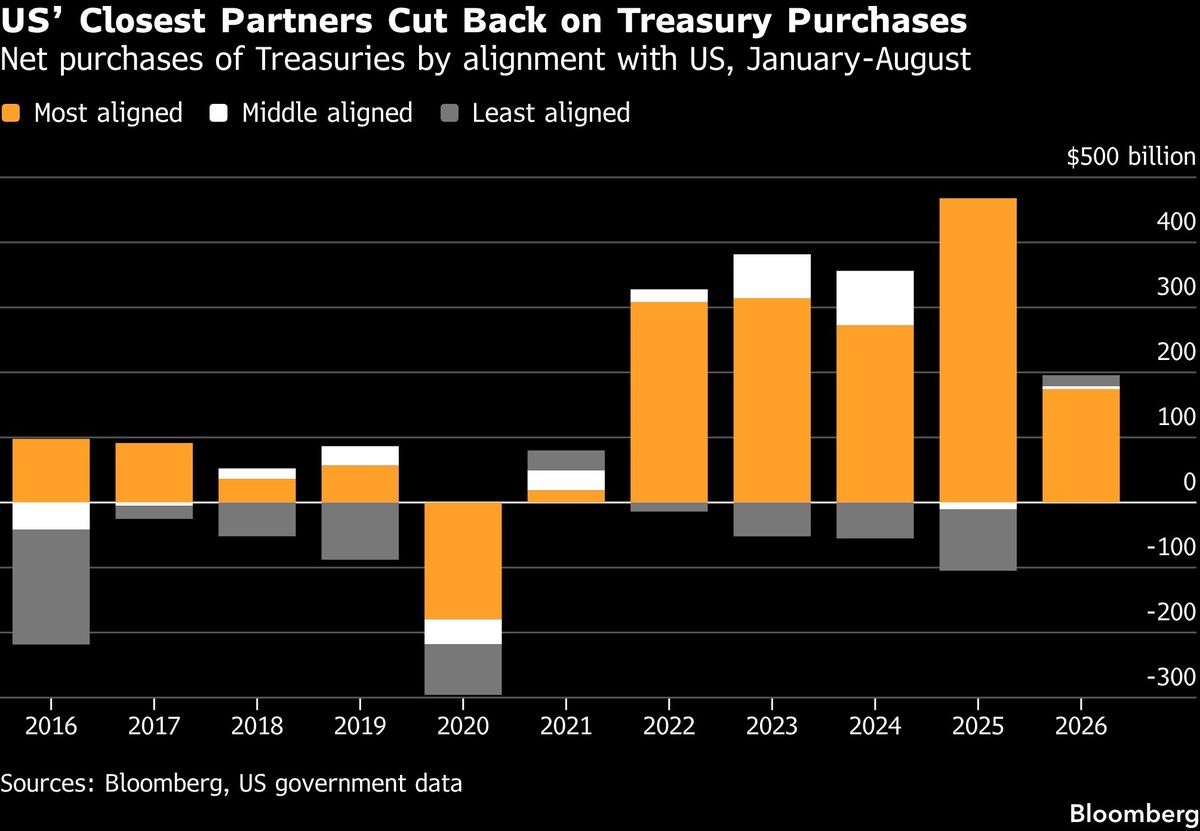
Countries and regions most aligned with the US bought a net US$174.3 billion (RM711.97 billion) of Treasuries, excluding bills, in the first eight months of 2026, according to an analysis of Treasury and State Department data. That was the lowest for the period since 2021 and down more than 60% from a year earlier.
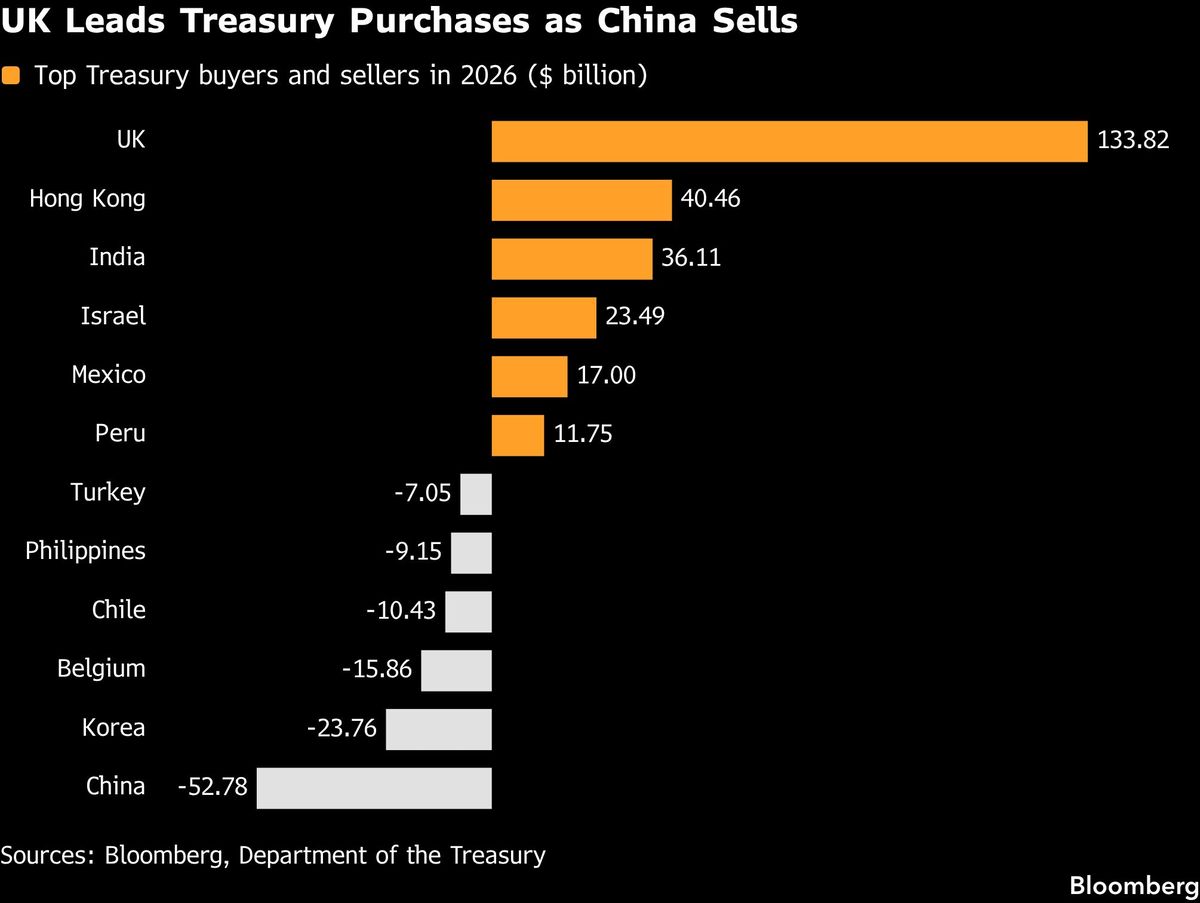
The shift is noteworthy in Asia, where economies running large surpluses are putting less of that money into US debt. Japan, the biggest foreign holder of Treasuries, bought just US$389 million in the first eight months — down 99% from a year earlier. South Korea sold US$23.8 billion, the most for the period in records going back to 1977. Taiwan was also a net seller.
There’s no single explanation for the shift. Governments have said little about any plans to move away from Treasuries, and the data don’t separate government buying from private investment at the country level. Several factors may be contributing, including weak currencies, rising yields at home, growing demand for stocks and unease over US policy.
“The Treasury market isn’t losing foreign buyers — it’s losing automatic buyers,” said Masahiko Loo, a senior fixed-income strategist at State Street Investment Management, which oversees over US$6 trillion. “An increasingly unpredictable US makes large structural overweights and the automatic recycling of capital into Treasuries harder to justify.”
The US government’s debt pile has climbed past US$40 trillion, leaving the world’s largest economy more reliant on investors to fund its spending. At the same time, President Donald Trump’s tariffs and uncertainty over US policy have spurred concerns about the dollar’s longer-term outlook. And with yields rising in markets from Japan to Europe, global investors have more alternatives to Treasuries than they once did.
Asia’s big savers have typically converted their surpluses into dollars and parked the money in Treasuries. This year, weakening currencies eroded their buying power and pushed governments to dip into reserves.
The yen sank to its weakest level in four decades, and data suggested Tokyo sold some of its Treasuries and other securities over the summer as it sought to support the currency. The won fell to its lowest since 2009 before recovering.
Governments haven’t shed much light on their approach. In May, a senior Japanese Finance Ministry official suggested that selling Treasuries to prop up the yen is counterproductive, saying authorities are mindful of the risks of selling their holdings. The Bank of Korea said in September it plans to broaden investments beyond US bonds for a portion of its reserves managed by domestic asset managers.
Classification
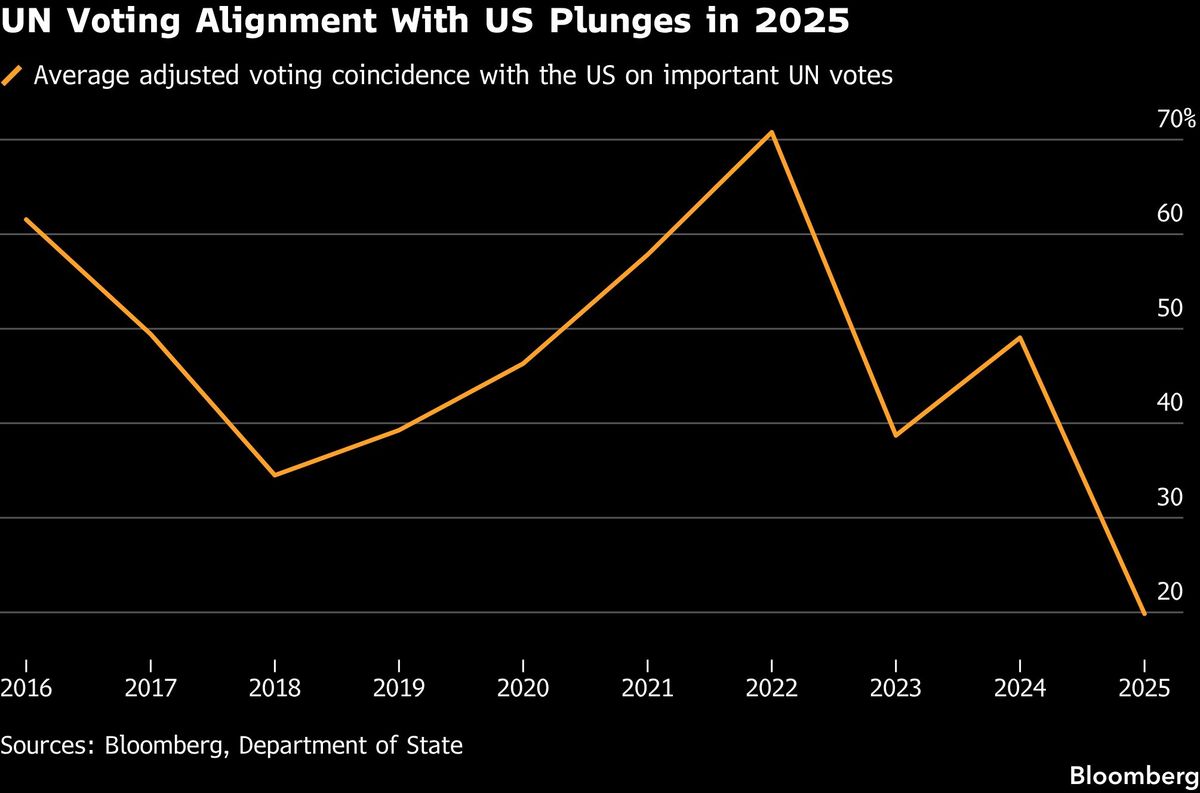
Alignment can be subjective. This analysis, an update of one first published in February, classifies countries as most-, least- and neutrally-aligned by how often their votes on key United Nations resolutions match those of the US, using State Department data. The approach is commonly used in academia to determine allies and adversaries.
For example, longtime military ally Australia was classified as most-aligned, China as least, with America’s neighbour Mexico falling into the neutral bucket.
The figures are net purchases — buying minus selling — of Treasuries with an original maturity of more than one year. They cover 57 countries and regions and include both official and private investors.
The Treasury data may attribute securities to the country where they are held through custodians or intermediaries, rather than to the nation of the ultimate owner. Holdings and purchases attributed to financial centers such as the UK and Belgium may therefore partly reflect investors elsewhere.
More choices
Even when Asian money is flowing overseas, Treasuries aren’t necessarily the default first choice.
Korean investors prefer stocks, while Taiwan’s money has shifted towards equities and deposits, according to Brad Setser, a senior fellow at the Council on Foreign Relations and a former US Treasury official. “So some friends with big surpluses haven’t been big net buyers,” he said.
Setser sees this as part of a broader “dereservification” trend, in which more foreign assets are held outside traditional central-bank reserves and instead flow through pension funds, state banks and other large institutions. That doesn’t amount to de-dollarisation, but can mean less “official demand” for Treasuries, according to Setser.
"Elevated dollar funding rates continue to erode returns on Treasuries just as rising domestic yields have improved opportunities in JGBs," says Andre de Silva, Markets Live strategist at Bloomberg Strategists.
Higher yields elsewhere are also giving investors options. Korea’s Kiwoom Asset Management remains cautious on Treasuries and sees Japanese government bonds as relatively attractive, said Yang Joo Kyung, head of global fixed income.
Japanese investors have more reason to keep their money at home too. With domestic yields at multi-decade highs, the extra return they can earn from investing overseas has narrowed.
“Japan is a US ally, and we’ve certainly seen some signs that there is a kind of gradual unwind of the carry trade,” said Oliver Levingston, G10 foreign-exchange and rates strategist at BofA Securities, referring to the practice of borrowing cheaply in yen to invest in higher-yielding assets elsewhere.
That doesn’t mean the US is running out of buyers. Private investors, including hedge funds, banks and mutual funds, have stepped in, boosting their share of federal debt to about 70%, near the highest since 1990.
But they’re more sensitive to price. For Treasury Secretary Scott Bessent and Federal Reserve chairman Kevin Warsh, that means markets can react sharply if investors grow uneasy about monetary policy, the economy, widening US deficits or signals coming from the White House.
That sensitivity contributed to benchmark 10-year yields rising above 5% this year. They climbed about three basis points to 5.02% on Wednesday.
Least aligned
The countries least aligned with Washington bought US$17.1 billion of Treasuries from January through August, reversing four straight years of selling over the same period. That’s a tenth of what US-aligned countries bought.
China remains the biggest seller, ahead of Korea, though some analysts believe Beijing might have channeled some transactions through other nations, including Canada. Belgium — whose holdings are thought to include some Chinese accounts — ranked third. The UK, Hong Kong and India were the biggest buyers.
“China’s continued reductions are consistent with a longer-term diversification trend, even as the underlying motivations are harder to establish,” said Laura Cooper, London-based head of macro credit at Nuveen.
This isn’t the first time US-aligned countries have pulled back from Treasuries. They sold sharply in 2020, when the Covid-19 pandemic triggered a global scramble for liquidity.
Even so, the US$32 trillion Treasury market remains unmatched in its depth, liquidity and near round-the-clock trading, while the dollar retains its role as the world’s dominant reserve currency.
Foreigners still owned US$7.85 trillion of Treasuries as of August, near an all-time high, though their share of the market has shrunk to less than a third from a peak of 52% in 2012.
“When you look at the alternatives, they’re pretty few and far between,” said Robert Tipp, head of global bonds at PGIM. “So you have had a rebalancing and consistent runoff from some countries, but it’s been absorbed by others.”
Foreign investors aren’t abandoning US assets either. Some of that money is shifting into American equities and corporate debt, suggesting investors remain keen on US companies even as appetite for government debt cools.
And the buyers filling the gap are likely to demand more compensation than the friendly nations that used to fund Washington with little fuss.
“The Treasury will fund itself — the question is the price and the volatility of the price,” said Shoki Omori, Deutsche Bank AG’s chief fixed-income strategist for Japan. “What the level cannot buy back is the patient, price-insensitive money the allies used to supply.”
Uploaded by Felyx Teoh