

This article first appeared in The Edge Malaysia Weekly on October 26, 2026 - November 1, 2026
With the Ministry of Housing and Local Government (KPKT) preparing to mandate recycling facilities across all shopping malls, retail operators must begin investing substantial time and capital into recycling initiatives, mainly centred on waste separation at source systems and logistics partnerships to move segregated waste out of the property.
Speaking to several early adopters, ESG finds that the long-term success of mall recycling relies on an early start, sustained operational commitment and strong participation from tenants and shoppers.
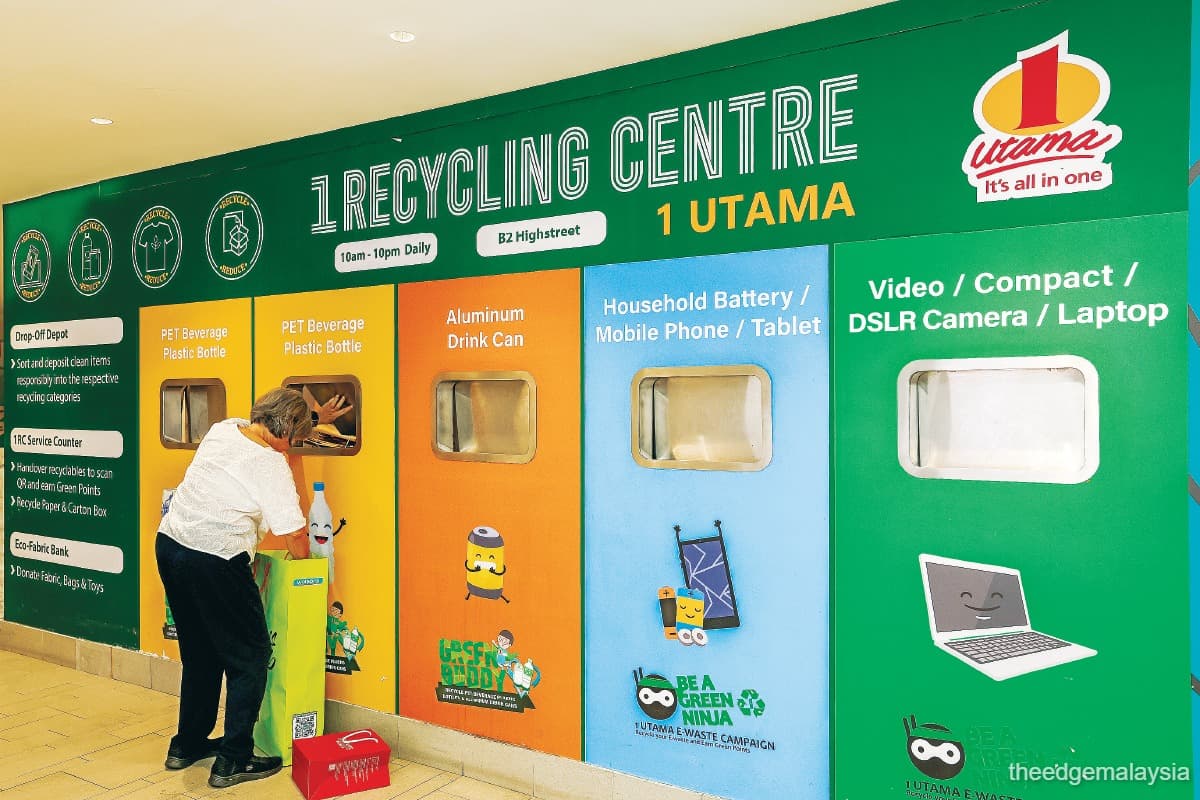
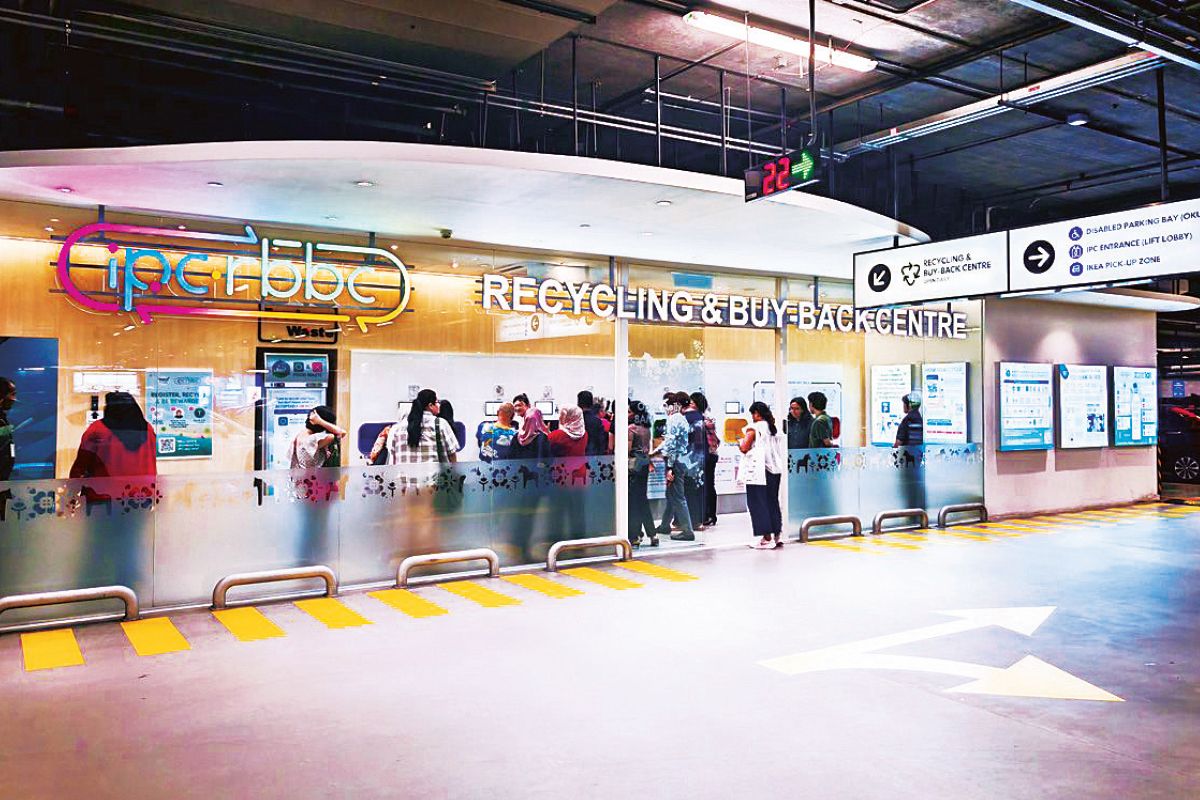
1 Utama Shopping Centre and IPC Shopping Centre have been running their respective recycling hubs — the 1Recycling Centre (1RC) and the Recycling and Buy Bank Centre (RBBC) — since 2009.
Meanwhile, malls under Pavilion Real Estate Investment Trust (KL:PAVREIT) only began implementing recycling facilities two years ago, with Pavilion Kuala Lumpur and Pavilion Bukit Jalil being the most mature properties in its portfolio. The highlight of Pavilion REIT’s recycling facilities is its major organic waste operations located at Pavilion Bukit Jalil.
Having a head start allows these malls to build both waste volume and community engagement, which Mark Tan, acting general manager of IPC, identifies as one of the operational model’s biggest hurdles.
“For recycling programmes to succeed, they must be convenient, accessible and supported by ongoing education and awareness efforts,” he says.
IPC recently achieved a recycling rate of 83%, making it one of the highest within the Ikano Group portfolio.
Meanwhile, 1 Utama collects roughly 14,000kg of carton boxes, 5,000kg to 7,000kg of paper and 100kg to 300kg of aluminium cans and PET bottles monthly. On a daily schedule, the mall collects 1.4 tonnes of food waste from its tenants.
In 2025, Pavilion REIT diverted 649.6 tonnes of waste from landfills, representing a 7% diversion rate out of 9,253.5 tonnes generated. This included 460.9 tonnes of recyclable materials such as paper, plastic and metal, and 188.6 tonnes of food waste, which was converted into 17.6 tonnes of fertiliser.
Though KPKT has yet to release any guidelines, these malls are confident that they can adapt to the regulations as their groundwork is already in place.
“For 1 Utama, if there is a protocol or policy that [KPKT] requires malls to follow, then we will, of course, adhere to that. But besides that, when it comes to material recycling and such, if they have a guideline, I believe we have already covered quite a fair bit. If not, then we can just expand our list of recycling materials,” says Jeremy Fong, public relations and sustainability senior executive at 1 Utama.

Dedicated waste separation hubs for recycling
To facilitate effective recycling activities, waste separation is needed. Both 1 Utama and IPC have their own approaches in separating waste before sending it off to their recycling partners. The shopping centres have set their main recycling hubs for shoppers in parking lots for ease of access. 1 Utama’s 1RC is in one of its B2 parking lot lobbies and the RBBC is in IPC’s B1 parking lot.
Fong shares that the 1RC has bin categories for polyethylene terephthalate (PET) bottles, aluminium cans, paper, cardboard boxes and cartons for shoppers to dispose of their waste.
“Our workers will check all the materials and weigh them. [For items that cannot be recycled,] the shoppers will need to take them back and find another way to dispose of them … Once our bins are filled up, the workers will bring them to the loading site and have them ready for our vendors to collect,” Fong says.
1 Utama also accepts glass via its collaboration with Glass Loop, a pilot initiative by Lasaju Consulting to streamline glass recycling activities and increase the collection of glass.
IPC’s RBBC works similarly to 1 Utama’s 1RC, with bins for paper, cardboard, plastic, metal, polystyrene, aluminium cans and drink cartons. But instead of bringing the materials to a counter, shoppers must deposit the waste themselves.
To ensure that the waste is disposed of responsibly, the RBBC has guides and instructions printed on the walls to guide shoppers in identifying the right bins. If there is still any confusion, the staff stationed at the hub can answer any queries.
IPC also actively conducts awareness initiatives, community engagement activities and educational programmes at the RBBC to deepen participation and understanding.
“We organise sustainability-themed workshops and team-building programmes with corporate organisations, schools and community groups, using these sessions as opportunities to share practical knowledge about waste segregation, recycling and responsible consumption,” says Tan.
Meanwhile, Pavilion REIT has installed designated recycling bins for paper, plastics and aluminium cans in its malls.
In Pavilion Kuala Lumpur, the waste collected from bins is brought to the loading bay, where three lorry slots previously reserved for business have been converted into an area where waste is collected and sorted. From there, workers are assigned to further separate waste manually.
Textile waste is also collected at 1 Utama and the two Pavilion malls. The latter engage with Life Line Clothing Malaysia, a used textile collector, and Upcycle4Better, an organisation that recovers textile waste.
“At Pavilion Bukit Jalil, the average monthly collection from clothing donation bins increased from 190kg in April to 238kg in May, representing an increase of roughly 25%. At Pavilion Kuala Lumpur, newly introduced clothing donation bins recorded about 85kg of collection in their first month of operation,” says Datuk Phillip Ho, CEO of Pavilion REIT.
E-waste is another non-recyclable material that is addressed across the malls. Both 1 Utama and IPC have included a specific bin for e-waste, with instructions on what is and isn’t allowed.
“For e-waste, there are so many categories and sizes. We put in our policy that you are allowed to bring any handheld e-waste, as long as you are able to carry it,” says Fong.
Meanwhile, Intermark Mall, which is also under Pavilion REIT, has introduced an e-waste recycling initiative in partnership with Electronic Recycling Through Heroes, or ERTH.
Throughout the mall, dedicated collection bins are put in place to accept a wide range of electronics including phones, laptops, computers, USB and storage drives, memory cards, and small household appliances such as kitchen appliances, vacuum cleaners and irons. To date, around 40kg of e-waste has been collected.
“These items are sent to a government-licensed recycling facility, where they are sorted and dismantled, hazardous components are safely removed, and valuable materials such as copper, aluminium and other metals are recovered, refined and returned into manufacturing supply chains,” explains Ho.

Rewarding recycling behaviour
To keep shoppers engaged with recycling activities, some malls use incentivisation programmes.
Ho shares that Pavilion Kuala Lumpur has installed a reverse vending machine (RVM) in collaboration with SWCorp, where shoppers are able to dispose of PET bottles and aluminium cans into the machine and earn reward points via the RVMplus app. Users can then use the points to redeem drinks from nearby vending machines.
“To ensure these facilities remain effective, accepted waste streams are clearly defined and communicated to shoppers through clear signage, wayfinding and usage guidance. Proper maintenance, regular collection and working with the right partners are equally important to ensure the facilities are used as intended,” he says.
Meanwhile, 1 Utama and IPC utilise their existing QR-based point systems to reward shoppers for engaging in recycling activities. Shoppers in 1 Utama can collect Green Points, while IPC’s RBBC allows shoppers to earn Tack Points from its Tack Club programme.
Additionally, 1 Utama has its ForestONE game, where shoppers can convert their Green Points into ForestONE water to nourish a virtual tree. Once the virtual tree is fully matured, 1 Utama will plant a real tree in 1 Utama’s Arboretum. Only native Malaysian trees and endangered species are planted, such as merbau, keruing and belian. So far, 1 Utama has planted more than 200 trees from the ForestONE game.
“Gamification is how we try to make something fun for [our shoppers]. They are able to collect green points and either use the points for games, or convert them into UPoints, which is cash, and use it in our stores,” says Fong.

Food waste is turned into fertiliser
1 Utama, Pavilion REIT malls and IPC all have in-house solutions to address food waste and turn the organic matter into compost to be used as fertiliser.
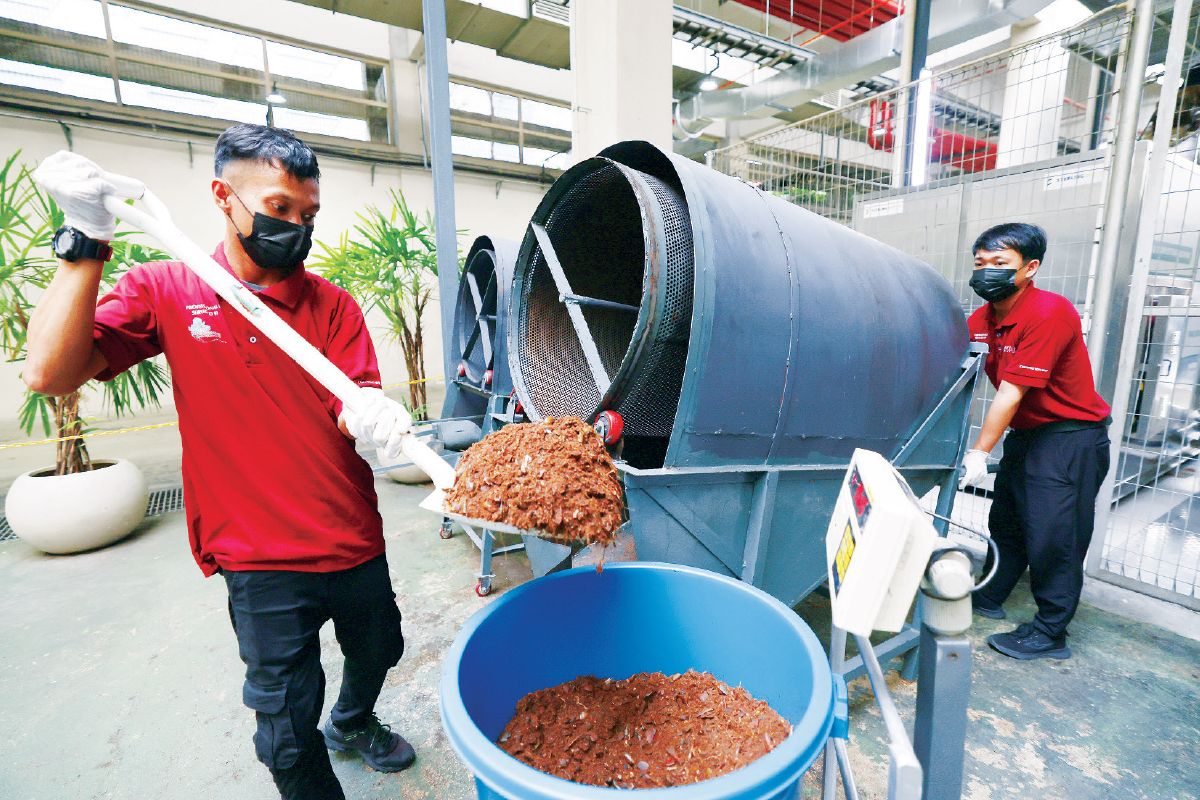
1 Utama has a centre in the mall called WISE (waste innovation for sustainability and environment) With Food where a machine heats and ferments food waste over 16 hours before it is bagged as compost.
All food and beverage tenants are to bring the food waste in bins that have been prepared, and each batch that is delivered will be weighed and recorded. Each tenant is also given a card to identify and track the waste provided.
From the 1.4 tonnes of food waste collected daily, 700kg to 800kg of compost can be collected. The compost is sold to shoppers and used by the mall itself for its rooftop garden.
Shoppers are also given a space to view the machine in action, which gives 1 Utama an added layer of transparency on how it operates the machines.
For some of Pavilion REIT’s malls, tenants that have agreed to participate in the sustainable disposal of food waste will have their bins shipped to Pavilion Bukit Jalil, which houses the main facilities to treat food waste and treats roughly 200 tonnes of food waste per year.
Pavilion Bukit Jalil’s food waste composting machine is in an outdoor area that was originally an empty space outside its electrical rooms.
“We found this area accessible because of the ventilation, and it’s also easy to access. Whoever wants to deliver food waste, even when there is no staff, can still place the bins there,” says Ho.
Food waste from tenants and from other Pavilion REIT properties such as Intermark Mall and Pavilion Hotel are also brought to the facility through colour-coded bins for traceability. The machine does not use any enzymes during the boiling process to maintain the organic content of the compost.
Once the food waste sludge is cooked for 24 hours, the workers will pour the grinded compost into a trommel to sift out non-organic waste that was was missed during the initial collection. The compost is given out free to shoppers, and a portion is saved for the Kuala Lumpur City Hall.
Additionally, Pavilion Bukit Jalil has installed a water recycling mechanism to take water from air handling units and be reused for multiple purposes, one of which is to clean the food waste bins.
Ho shares that Pavillion REIT is working on increasing the optimisation of compost generated from the machine. He explains that the machine is supposed to be able to generate 20% compost from the amount of food waste that is added, but because waste separation at source is still not well practised in Malaysia, the machine is currently only able to generate 10% of compost.
“We eventually want to increase the number of tenants as well, but this process requires a lot of education. If they come in with food waste that has too much soup, it makes it harder to process because it will take a longer time to cook,” says Ho.
IPC deploys an in-house biodigester to process its food waste. Rather than producing compost on-site, the biodigester pre-treats food waste before it is transferred to authorised waste management partners.
The RBBC does not limit food waste collection to just its tenants, as shoppers are also allowed to drop off food waste there. Items such as food residue, kitchen waste and expired or contaminated food can be brought into the hub and placed into a dedicated fridge.
IPC is unable to share any names, but it claims to work with audited and licensed vendors that are government-approved to deal with food waste.
KLCC Convention Centre leverages sustainability to attract international event organisers
Kuala Lumpur City Centre (KLCC) Convention Centre is proactive in its sustainability commitments to stay competitive in the business event sector on an international scale.
Tiffany Chung, director of sales and marketing at the KLCC Convention Centre, says the venue’s core clients are international delegates, and when bidding for conferences, being able to prove its sustainability is how the convention centre stands out.
“When you have an event here, you can claim that it is a sustainable event because the venue is sustainable. We are using this as a marketing tool [that is backed up by data] for us to increase our competitive edge,” says Chung.
At the venue, a dedicated recycling station has been installed to accept paper, bottles and cans, alongside other types of waste such as e-waste, light bulbs and old sneakers. The collected waste will then be delivered to a trusted vendor for recycling.
To further address supply chain and sorting challenges, the convention centre’s waste bins feature precise visual indicators to prevent cross-contamination. Housekeeping teams will handle further sorting to ensure recyclables are clean and dry before being collected by third-party recyclers.
The team also tackles food waste. Leftover food scraps from the central kitchen are sent directly to an in-house composting machine supplied by a local vendor. Designed to handle organic scraps, as well as compostable items like tissue paper, the machine processes the materials into compost.
“Nothing goes to the landfill. When we put our food waste inside, the microbes will break it down and compress it. Once that is done, it will be taken out [and sent to our partner] for composting,” says Chung.
To prevent greenwashing allegations, the convention centre is able to share recorded data and provide walkarounds for potential clients to prove its efforts.
According to its 2025 sustainability report, the venue is the first convention centre in Malaysia to be certified under ISO 20121 event sustainability management system. It achieved a 32% reduction of Scope 1 and 2 greenhouse gas emissions and a 79% waste recycling and recovery rate.
KLCC Convention Centre also focuses on the smaller details, such as overhauling its current array of chairs to reduce water consumption.
“We bought many new chairs so that we don’t have to cover them with linen. Imagine cleaning the seats and having 1,000 to 2,000 linen cloths to be washed. We invested in this so that we would not need to waste detergent and water,” Chung explains.
Other efforts include using only glass bottles to avoid single-use plastics and purchasing FSC-certified paper for every event.
“About 75% of the material used in the convention centre is certified to support sustainable sourcing. We are also very strong on local sourcing. Last year, we hit 65%, and this year we’ve hit about over 70% already. This is being managed by our procurement team,” she says.
The venue has also transitioned to using renewable energy to power the building by purchasing Tenaga Nasional Bhd’s (KL:TENAGA) Green Electricity Tariffs from the grid. Chung says this decision was made because on-site solar panels yielded limited output relative to the building’s scale.
Originally, LED lights were installed to replace the old lighting system and reduce electricity consumption, but Chung says this move did not make a significant difference, prompting the venue to source green energy as a solution, despite electricity making up most of its cost.
The KLCC Convention Centre views these high financial costs as a necessary investment, and the agenda is supported by key decision-makers, which is why it can commit to its sustainability activities.
“Sustainability needs C-suite commitment. If the C-suite is not committed to it, it will never work,” says Chung.
Save by subscribing to us for your print and/or digital copy.
P/S: The Edge is also available on Apple's App Store and Android's Google Play.