

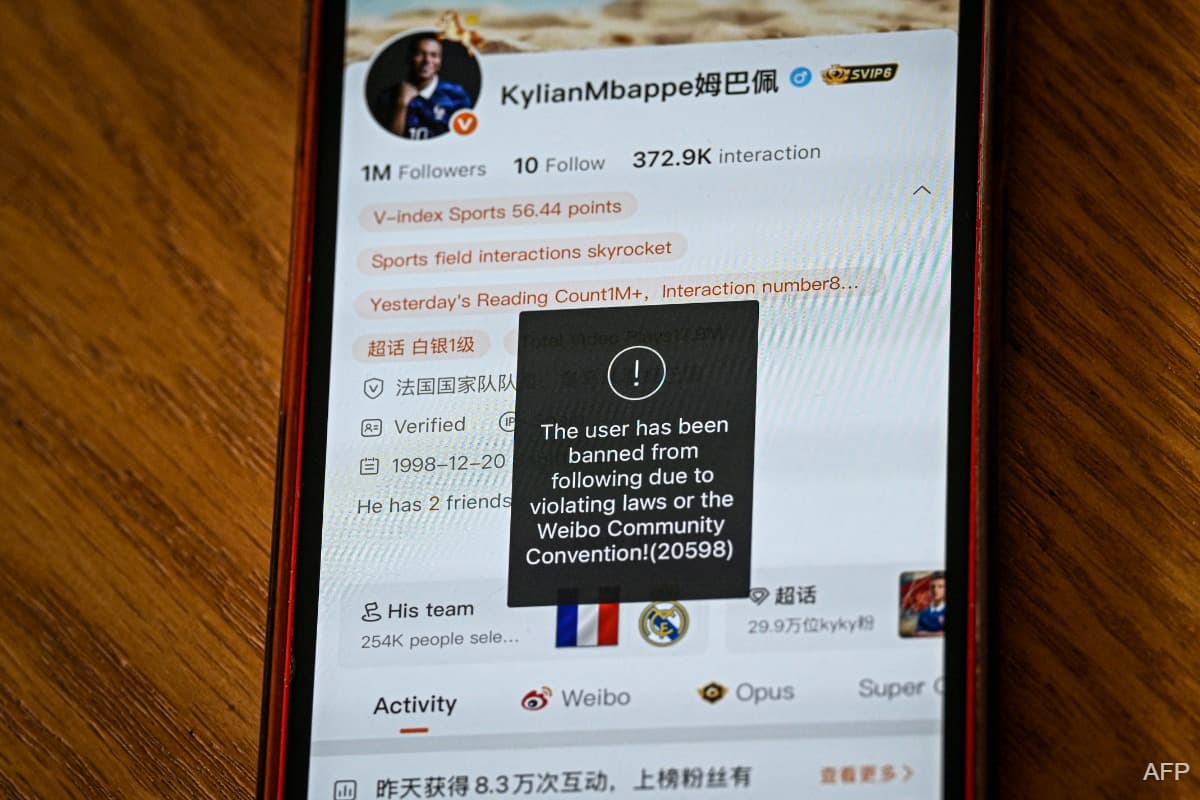
(Oct 28): The rapid backlash against French football star Kylian Mbappe over a perceived insult to Mao Zedong underscores how little room for error remains for celebrities and global brands seeking to tap China’s lucrative market.
Mbappe quickly apologised Tuesday, but criticism continued to spread across Chinese social media. Major mainland consumer brands severed ties with him, Chinese state television blocked his matches and some international sponsors removed posts featuring the athlete.
The episode highlights the mounting risks for international brands operating in China, where an offhand remark can quickly ignite consumer backlash. Shares of Mbappe sponsors On Holding AG, Eastroc Beverage Group Co and China Mengniu Dairy Co fell Tuesday as investors weighed the business impact of having a high-profile endorsement lose its value almost overnight in the world’s second-largest consumer market.
“China has undoubtedly grown both more sensitive about how it is represented overseas, and more capable of retaliating,” said Jeremy Chan, a senior analyst at Eurasia Group. “A comment like Mbappe’s would probably have been ignored a decade ago in China, but today it is seen as unacceptable. Meanwhile the power of the Chinese consumer market is too strong for even a global star like Mbappe to ignore.”
Mbappe’s remarks came in an interview in which he was asked to react to an internet meme of himself that appeared to depict Mao, modern China’s founding father. In his apology, he called the comments “ill-judged”.
China has a growing football fan base despite failing to qualify for the World Cup for more than two decades. The sport is the country’s second most popular, behind basketball, according to Ampere Analysis. More than 200 million viewers watched this year’s tournament in North America on CCTV’s livestreaming platforms by the end of the group stage, state media said.
‘Grey area’
That popularity makes foreign football stars valuable marketing assets but also leaves their sponsors exposed. The current political environment is particularly sensitive — officials are being cautious ahead of a major Communist Party meeting this week and as preparations ramp up for next year’s party congress, a once-every-five-years gathering that sets the country’s top leadership, according to Dan Wang, a director at Eurasia Group’s China team.
The Mbappe incident illustrates “how little grey area is left for foreign companies operating in China”, she said. “Doing business in China increasingly requires companies to be politically attuned.”
The official newspaper of China’s ruling Communist Party reinforced that message Wednesday, warning that global celebrities risk losing their commercial appeal if they offend local audiences.
“Once a line is crossed or the public is offended, all the glamour will quickly dissipate, and one may even face backlash,” the People’s Daily said. “Learning to respect different countries and cultural backgrounds is an essential lesson.”
New playbook
Eastroc and Mengniu swiftly cut sponsorship ties with Mbappe on Tuesday, moves the outlet said were justified on both principle and commercial grounds.
Still, backlash has persisted online even after his apology. “Not everything can be resolved with an apology; some things are simply unforgivable,” one user wrote Tuesday night on Weibo. On Wednesday, another called his response “damage control, not genuine remorse”.
“Chinese consumers understand the power and scale of their buying power. ‘I didn’t know’ is no longer a valid excuse in their eyes for cultural missteps,” said Jessica Gleeson, head of retail consultancy BrighterBeauty in Shanghai. “As your largest customer base, they expect you to do your homework.”
The fallout has also spread to international sponsors. Earlier Chinese media reports said LVMH Moët Hennessy Louis Vuitton SE’s Dior had deleted some posts featuring Mbappe, a longstanding global ambassador. Swiss sportswear brand On, which recently signed a 10-year partnership with the player, removed posts related to him from its Chinese social media account.
How long the fallout lasts may be the next test. Foreign brands have weathered similar controversies by apologising and waiting for attention to move elsewhere, but that strategy has become less reliable, said Mark Dreyer, a Beijing-based sports analyst and author of Sporting Superpower.
“The playbook used to be, the company would put out a short, very apologetic Chinese post on Weibo and then lie low and wait for the next incident to come along,” Dreyer said. “But I think the NBA incident changed the game because it became so global.”
The US basketball league spent years rebuilding in China after a 2019 comment supporting Hong Kong protesters by Daryl Morey, then general manager of the Houston Rockets. Hennes & Mauritz AB and Nike Inc have also faced consumer boycotts over comments on Xinjiang.
More recently Louis Vuitton saw China sales slump after winning a trademark dispute against local company Molly Tea, drawing criticism from consumers who saw the luxury giant’s action against a much smaller local business as unfair. Lululelmon Athletica Inc has also seen its business in China impacted this year after perceived slights.
“No brand or individual is exempt from China-sensitive topics, especially foreign brands and public figures who earn from Chinese consumers,” said Olivia Plotnick, founder of Shanghai-based consultancy Wai Social. “Companies and celebrities with China exposure should have an action plan in place that includes explicit decision rights and communication standards.”
Uploaded by Chng Shear Lane