

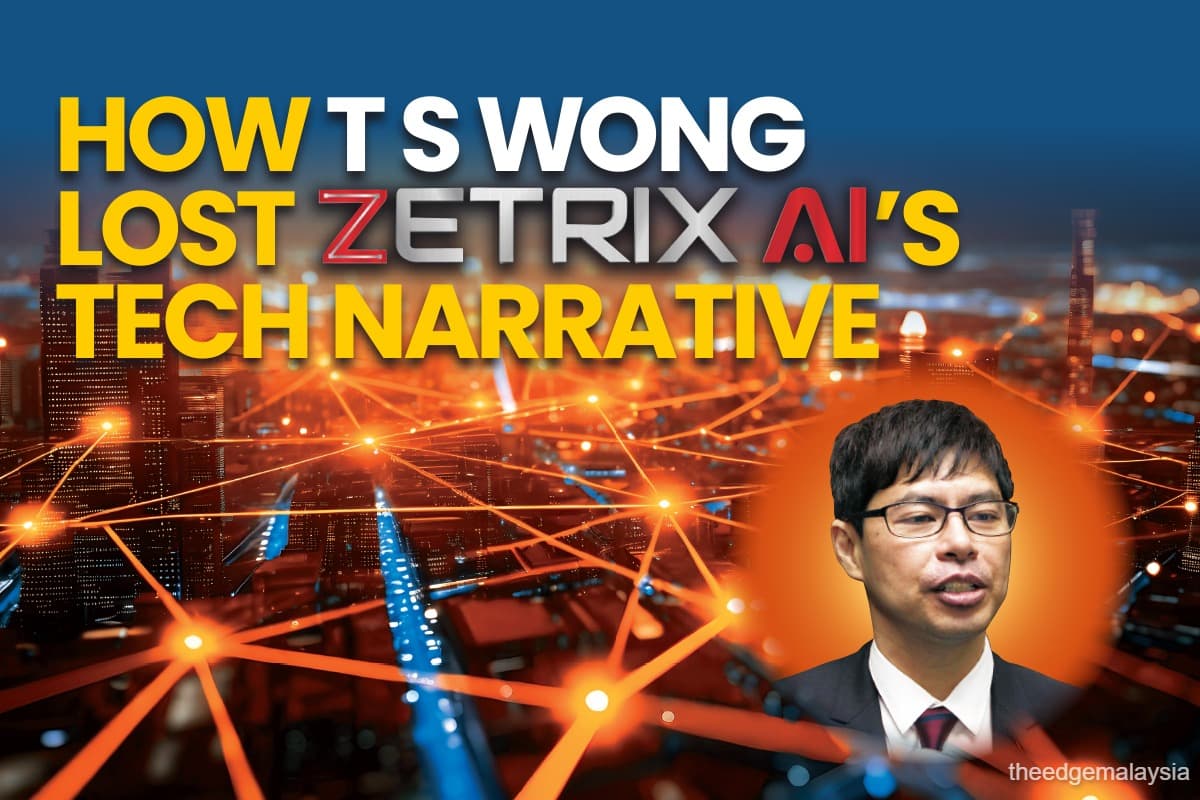
This article first appeared in The Edge Malaysia Weekly on October 26, 2026 - November 1, 2026
ON a busy mid-afternoon in the first week of September, Wong Thean Soon, or better known as T S Wong, walked into a quiet restaurant for a casual meet-up.
He greeted those at the table with a smile and asked for a glass of water, while the others who had arrived earlier ordered a round of masala tea.
His demeanour spoke volumes of his troubled state of mind. Wong’s phone, which was on silent mode, was buzzing non-stop but he did not answer the calls.
He was distracted as he spoke about Zetrix AI Bhd (KL:ZETRIX), his flagship company, which had been under relentless selling pressure. It was not difficult to understand why. At the time, the company was already the talk of the town as brokers put out orders to sell its stock.
In mid-June, Zetrix AI’s market capitalisation was about RM6 billion as its share price was hovering around 75 sen. Less than three months later, on Aug 28, the stock hit limit down, closing at 29.5 sen. Three trading days after the market opened, following the limit down, the selling pressure was unabated, signalling that Wong was in no position to reverse the situation.
By the first week of September, his interest in the company had halved to 15%. As at Oct 21, it was negligible, barely 1.84%, Bursa Malaysia filings show.
In fact, the single largest shareholder now is the Social Security Organisation (Socso) with 2.7%, followed by International Finance Corp (IFC) with about 2.5%, according to the shareholder list as at Oct 6. (See “Rudderless, with no clear controlling shareholder” on Page 72.)
IFC, the investment arm of the World Bank, had invested in Zetrix AI at 78 sen per share in February this year to support the company’s blockchain technology push into Asean. However, the sharp drop in share price had shaken investor confidence in Zetrix AI and its products.
The reason for the meeting with Wong in September was to ask him to explain what Zetrix AI’s blockchain and artificial intelligence (AI)-related products’ selling points were, and why they justified the RM3.7 billion development cost the company had incurred, in addition to the cause of the first round of share selldown.
It is worth noting that more than 50% of the RM3.7 billion in development cost was spent in the last 18 months. In the first half of this year, the company had invested RM900 million in development cost.
Wong said that the bulk of the developement costs were paid to labs in China that are training personal AI agents, emphasising that this is a costly endeavour.
According to a Malaysian Rating Corporation (MARC) rating analysis in 2025, Zetrix AI had achieved strong revenue growth from its blockchain platform. The rating agency said that since its launch in late 2023, Zetrix AI had recorded about 5.2 million transactions involving more than 750,000 accounts.
As for its AI-related products, Wong explained that the company was entering the personal AI space, which was the next phase of the modern economy. He believed that personal AI solutions would eventually replace app-based applications. In short, the area had great potential, but huge investments were needed to tap it.
He said Meta Platforms’ recent release of its personal AI agent, Muse, could help explain his foresight in putting large sums into AI-related products that few could understand.
From Wong’s perspective, the RM3.7 billion for developing Zetrix AI’s blockchain and AI-related solutions was relatively lower than what tech giants had spent on similar products.
The company started as MyEG Services Bhd, which provided the gateway for e-payment services for government departments. Its main customers were the Road Transport Department and the Immigration Department.
It shot to prominence with the increased broadband penetration of households and its online services were widely used for the renewal of road tax, driving licences, insurance and permits for unskilled foreign workers and domestic workers.
The year 2018 proved to be the turning point for Zetrix AI. Barisan Nasional (BN) lost to Pakatan Harapan in the general election and Zetrix AI suffered the consequences. By 2023, the government had opened up the e-government payment gateway business. (See “What’s left in Zetrix AI?” on next page.)
Zetrix AI began developing its blockchain technology in 2021-2022 and rolled it out in 2023. A year later, it ventured into the development of AI-related services. The diversification came with a development cost of RM3.7 billion as at end-June 2026. When things went south for Zetrix AI, the huge development cost spooked investors.
Asked if he would have done things differently in hindsight, Wong said he probably would not have spent so much on developing the technology.
The trigger
Until today, the cause of the Aug 28 meltdown at Zetrix AI cannot be pinned down.
An investment banker points to some financing-related share transactions that started around end-July and continued until mid-August in several tranches.
“The selldown was probably triggered by parties who took up the shares in return for providing Wong with short-term financing. The parties probably sold the shares and caused the trigger,” says the banker.
According to filings, Wong “crossed” a total of 53 million shares in several tranches between July 27 and Aug 17. The transactions were done at an average of 71 sen each.
“The crossing of the shares was due to a financing arrangement,” the filings state.
Industry sources say, however, that the number of shares transacted for short-term financing was closer to 100 million. They believe that the selling began a day before the selldown on Aug 28, when Zetrix AI closed at just below the 60 sen mark.
On the morning of Aug 28, the selling intensified. At the closing bell, the shares had plunged to 29.5 sen from 59.5 sen, triggering a limit down. Daily trading volume had spiked to 1.047 billion shares.
Bankers say the limit down triggered a cascading effect on the financing facilities Wong held with several brokers.
Based on the latest annual report, his direct and indirect stake held via Asia Internet Holdings Sdn Bhd of close to 30% is mostly pledged to brokers. In fact, according to court documents, brokers were already asking Wong to top up his share margin facilities a month before the stock hit limit down.
A top-up of share margin facilities occurs when there is insufficient collateral to back the financing extended to the individual. In most cases, the top-up is done by putting additional shares or money into the margin account.
“Wong failed to regularise his position with the brokers. And when the limit down happened, it triggered a default on all his margin facilities with various brokers,” says a source.
PN17 looms
The immediate concern for Zetrix AI is dealing with bondholders who had invested RM2 billion in the company’s Islamic debt instruments issued in 2024. The entire amount has been drawn down and a redemption of RM215 million is due in March next year.
The bid-to-yield maturity of the RM215 million paper is now 8.2% compared with 5.4% six months ago. The higher yield denotes the higher returns that investors seek to hold the debt paper to maturity.
The crux of the issue is that the latest shareholding shows Zetrix AI to have breached one of the covenants of the Islamic debt paper — the one that requires Wong to be the single largest shareholder in the company at all times.
A banker says the bondholders could waive some of the covenant’s conditions but redemption is unavoidable.
Based on normal listing rules, when a company defaults on its debt paper, it is flagged as financially distressed and put into the PN17 category.
“The bondholders could consider waiving conditions related to Wong’s shareholding. But they certainly would want visibility of how the company is going to redeem the paper,” says the banker.
“Exacerbating the situation is the fact that the chance of refinancing the debt or raising new money is almost nil unless Zetrix AI gets a white knight.”
Without additional funds, the company’s existing technology for blockchain and AI applications would eventually be out of date as these assets require constant investments for upgrades.
As put by an official of Zetrix AI who did not want to be named, most of the technology products are at the end stage of development and would require more money for commercial launch.
Fifteen years ago, Wong was the tech whizz-kid of the Malaysian corporate scene. When the company was called MyEG Services, it had a finger in almost every segment of the government’s technology services. From the processing of payments to the handling of documents for foreign workers, Zetrix AI was the chosen service provider.
Zetrix AI’s high point was in 2013/14 when it was given the mandate by the Customs Department to install software at point-of-sales terminals nationwide as part of the government’s implementation of the goods and services tax (GST).
The company commanded a market cap of RM10 billion in early 2018, shortly before the 14th general election that led to the fall of BN.
It was one of the biggest losers on Bursa Malaysia, plummeting 73% within a month after the polls amid concerns that it could lose the public contracts in hand.
True enough, the GST was replaced with the sales and service tax in 2018, forcing Zetrix AI to diversify away from government-related projects.
Right now, the situation is nothing short of a calamity for the company and Wong. The bigger casualties, however, are the bondholders, brokers and minority shareholders who are staring at losses unless the company’s technology products are as good at generating earnings as Wong claims.
Read also: Save by subscribing to us for
your print and/or
digital copy. P/S: The Edge is also available on
Apple's App Store and
Android's Google Play.
Cover Story: What’s left in Zetrix AI?
Cover Story: Rudderless, with no clear controlling shareholder
Cover Story: HeiTech Padu: Collaboration with Zetrix AI for NIISe project lapsed