

This article first appeared in Capital, The Edge Malaysia Weekly on October 26, 2026 - November 1, 2026
The results of the US midterm elections, taking place on Nov 3, are expected to have some bearing on Malaysian equities, although analysts are of the view that corporate earnings, bond yields and the Iran war matter more to the local market.
The upcoming US elections will determine whether the Republicans retain control of both chambers of Congress. The Democrats need a net gain of four seats respectively in the House of Representatives and the Senate to take control.
As the political battle heats up, The Edge analysed historical midterm elections and the subsequent performance of the S&P 500 as well as the FBM KLCI to see whether history offers any clues as to what might happen next.
Polls and prediction markets
US President Donald Trump is polling low numbers. A New York Times/Siena poll published last Wednesday put his approval rating at just 34%, the second lowest going into any midterm elections since 1946 and just above Harry Truman’s 33% that year, while a separate Reuters/Ipsos poll that closed on Oct 19 showed an approval rating of only 31%.
Prediction markets are similarly tilting towards the Democrats. At the time of writing on Oct 22, Polymarket had priced in a 92% probability of the Democrats taking control of the House and 67% for the Senate, with Kalshi indicating broadly similar odds.
Polymarket put the likelihood of a Democratic sweep at around 65%. Models are less bullish. Decision Desk HQ’s forecast, cited by UOB Global Economics and Markets Research as at Sept 28, gave the Democrats a 52% probability of winning both chambers of Congress, 23% for a Democratic House with a Republican Senate, and 23% for Republicans retaining both.
Historically, US midterm elections have tended to punish the incumbent president’s party. UOB notes that the president’s party lost House seats in 18 of the 20 midterm elections from 1946 to 2022, and that the average change across all 20 elections was a loss of about 26 seats. The only exceptions were 1998, under Bill Clinton, and 2002, under George W Bush.
The electoral outcome may not change US policy as much as the probabilities suggest, because much of what moves markets remains within the authority of the White House. Both UOB and Bloomberg Intelligence (BI) stress that tariffs, sanctions and foreign policy largely remain in the president’s hands. Should the Democrats take control of Congress, they would not necessarily be able to prevent Trump from pursuing those policies.
Following the US Supreme Court’s decision to strike down tariffs imposed under emergency powers in February, the Trump administration has increasingly turned to other trade laws, namely Sections 301 and 232, which provide alternative routes to imposing duties. Meanwhile, must-pass bills, including a debt-ceiling extension and the annual spending bills, will require the cooperation of the White House.
Historical effects on the S&P
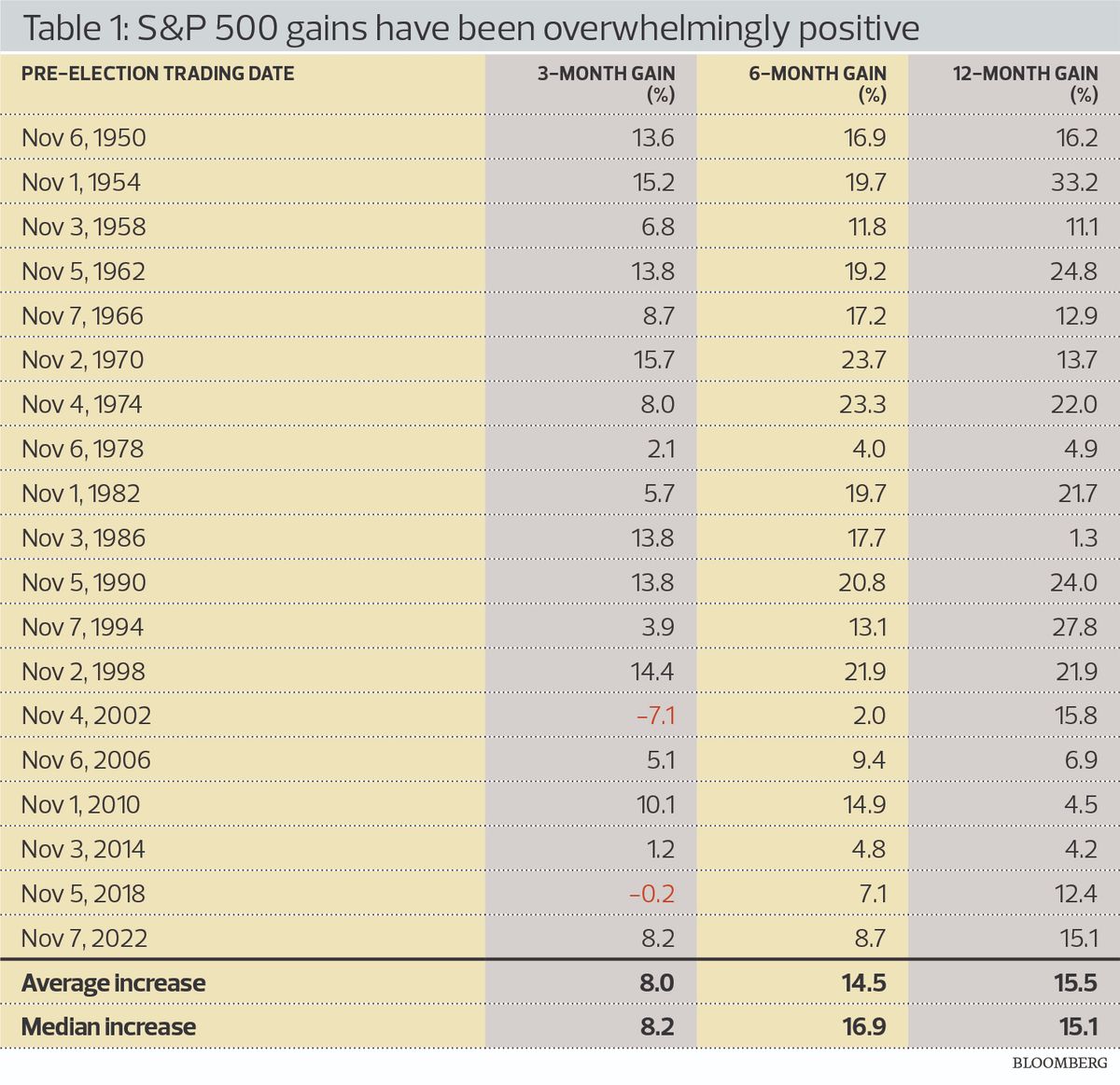
The historical numbers appear encouraging for Wall Street. An analysis of Bloomberg data by The Edge shows that the S&P 500 recorded positive 12-month gains after all 19 midterm elections from 1950 to 2022, with an average gain of about 15% (see table). Six-month gains were similarly positive in every instance, although the index was lower three months after two elections, by 7% in 2002 and by 0.2% in 2018.
The positive gains were not confined to a handful of exceptional years. Over the past 19 midterm elections, the median 12-month gain was also about 15%, broadly matching the average. The S&P was higher a year later whether neither chamber, one chamber or both changed hands. Nevertheless, the elections themselves may not be the cause, since the returns also reflect monetary policy, corporate earnings and the wider economy.
Whether history will repeat itself remains uncertain, especially as the current elections take place against a backdrop of rising interest rates and what may be a prolonged geopolitical conflict.
Historical effects on the FBM KLCI
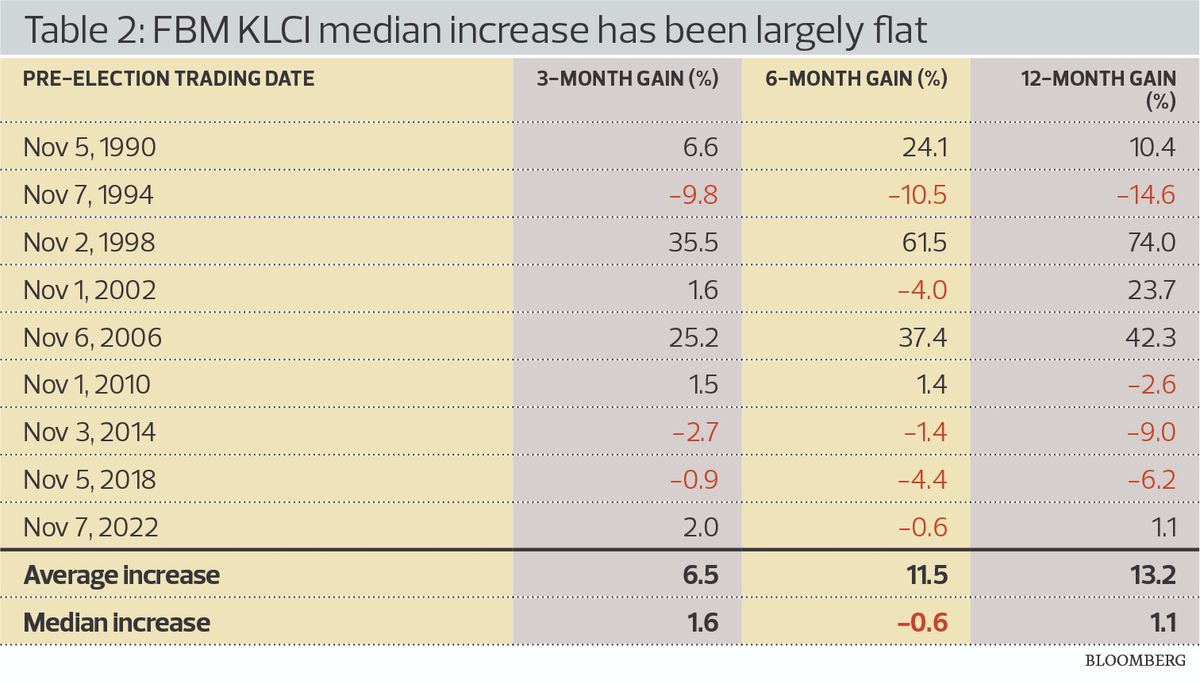
The FBM KLCI exhibits a far less consistent pattern following the US midterm elections. Across nine elections from 1990 to 2022, Malaysia’s benchmark index recorded an average 12-month gain of 13%. But its median increase was just 1%, with a positive return in only five of the nine periods.
In the six-month period following the US midterm elections, the FBM KLCI saw an average gain of 12% while the median return was down 1%. The average gains of the two benchmark indices look alike.
Over the same nine midterm elections, the S&P 500 saw gains of 5%, 11% and 15% after three, six and 12 months respectively, against 7%, 12% and 13% for the FBM KLCI. The difference is consistency. The S&P was higher after six and 12 months in all nine periods. The FBM KLCI was higher in four of nine after six months and five of nine after 12 months, while its median 12-month gain was a measly 1%, against 15% for the S&P.
The Malaysian market’s average return was boosted substantially by two exceptional periods: a 74% gain in the 12 months following the 1998 midterm elections, as markets recovered from the Asian financial crisis, and a 42% increase after the 2006 elections, amid a broader Malaysian equity rally in 2007.
Positioning ahead of the elections
Despite Wall Street’s historical record, not all investors are positioning for another post-midterm rally.
With a divided US government increasingly likely, Ian Yoong, a former investment banker and a high-net-worth investor, sees downside risks for US equities. He points to substantial billionaire backing of Republican candidates as a sign of how much congressional control matters to wealthy investors.
Americans for Tax Fairness, a progressive advocacy group, counts 172 billionaire families spending more than US$1.7 billion on this year’s elections, with 113 of them mostly for the Republicans and 45 mostly for the Democrats.
In Yoong’s view, a poor showing by Republican candidates would likely affect the US equity markets, making a case for reducing exposure ahead of the vote. He also expects pushback on artificial intelligence (AI) capital expenditure (capex), which he says has driven the outperformance of the sector.
“It would be best to keep your powder dry and stay on the sidelines, with 30% to 40% cash at this juncture. Not investing is a decision,” Yoong advises.
Conversely, an analyst who spoke on condition of anonymity takes a different view. The analyst says a divided US government would be positive, especially for emerging markets, because it helps rein in the unilateral actions by Trump that have been the source of market volatility over the past two years.
He has not changed his positioning specifically for these midterm elections, citing concerns about the sustainability of the AI capex and rising bond yields as more pressing issues. Instead, he is increasing his domestic exposure.
“Overall, I am increasing exposure to Malaysian equities, especially those sectors that have derated despite being relatively insulated from higher bond yields and any potential AI spending slowdown, due to attractive valuations,” he says.
The analyst rates the midterm elections outcome a four out of 10 in importance. Corporate earnings remain the main long-term driver of returns and for now, bond yields may matter more than the election results, he stresses.
The 10-year US Treasury yield surged to an intraday high of 5.34% on Oct 1, the highest since early 2002, before retreating to around 5.04% on Oct 22.
Imran Yusof, head of MBSB Investment Bank Research, expects reduced US policy uncertainty to benefit capital markets, including Malaysia’s, by reducing risks to corporate earnings growth. He adds that greater congressional oversight of the US budget could calm bond markets, which should be positive for equities.
Imran puts the importance of the US midterm elections at eight out of 10, but says the impact will be more indirect. “The highest impact, in our opinion, will still be the Middle East conflict,” he says.
In his view, the result may open a path to de-escalation, which could let oil prices normalise and, in turn, ease inflation and interest rates. MBSB IB Research treats that as its base case for the fourth quarter of 2026 and its preliminary view for 2027.
Winners and losers
Few sectors have a clean midterm trade, largely because most of the decisions that move them sit with the White House, not Congress. UOB’s reading is that a Democratic House with a Republican Senate would be the classic divided government, historically benign for equities. Meanwhile, BI argues that what regulators and the US president do matters more than which party wins.
Large US banks stand to benefit. BI says regulators are racing to finish rule changes before Trump leaves office, which could free up US$18 billion of capital across lenders such as JPMorgan, Bank of America and Citigroup, should the rules be finalised as expected.
Retailers, grocers and carmakers are more exposed. BI expects tariff risk to run into 2027 regardless of who controls Congress because the administration now relies on trade laws that need agency investigations, not congressional approval. Defence contractors face a quieter fight, as a Democratic House could constrain the increases in Trump’s US$1.5 trillion defence and military budget request for FY2027. BI, however, expects missile defence and munitions replenishment to retain bipartisan support.
For Malaysia, the analysts The Edge spoke to see bond yields and oil prices as bigger swing factors than the vote. UOB expects the 10-year US Treasury yield to reach 5.5% by the end of the third quarter of 2027, and says the pressure comes from the US Federal Reserve’s rate hikes and inflation, not the elections. UOB adds that the US budget tussles feed into the volatility of US Treasuries, of which Asian insurers are among the large holders.
The analyst who asked not to be named says financial stocks have weakened recently on concerns about mark-to-market losses on bond holdings. He believes the impact will be relatively limited and considers such fair value losses a one-off.
Financial stocks that he likes are Public Bank Bhd (KL:PBBANK), AMMB Holdings Bhd (KL:AMBANK), RHB Bank Bhd (KL:RHBBANK), Hong Leong Financial Group Bhd (KL:HLFG) and Syarikat Takaful Malaysia Keluarga Bhd (KL:TAKAFUL).
Oil remains the other consideration. BI says Trump’s actions on the Iran war and sanctions may count for more than the election results for US energy producers. CIMB Treasury and Markets Research sees the Iran war as the more consequential near-term market driver, while UOB says the Fed, US finances and the Middle East conflict matter as much as the vote.
The analyst favours local upstream oil and gas names as protection against an energy price spike, such as Dialog Bhd (KL:DIALOG), Hibiscus Petroleum Bhd (KL:HIBISCS), Petra Energy Bhd (KL:PENERGY) and Bumi Armada Bhd (KL:ARMADA), the last through its exploration rights in Indonesia.
Bumi Armada signed the Jalu gas exploration production sharing contract in Indonesia on May 20, but PublicInvest Research says meaningful exploration spending is not expected until 2027, limiting the near-term effect on earnings. Exploration rights are not the same as producing oilfields.
The analysts The Edge spoke to put other drivers ahead of the US midterm elections: the Middle East conflict, bond yields, AI spending and corporate earnings for the local market. History points to a rally in US equities following the elections, although Bursa has been far less consistent. Stock selection remains key for local investors.
Save by subscribing to us for your print and/or digital copy.
P/S: The Edge is also available on Apple's App Store and Android's Google Play.