

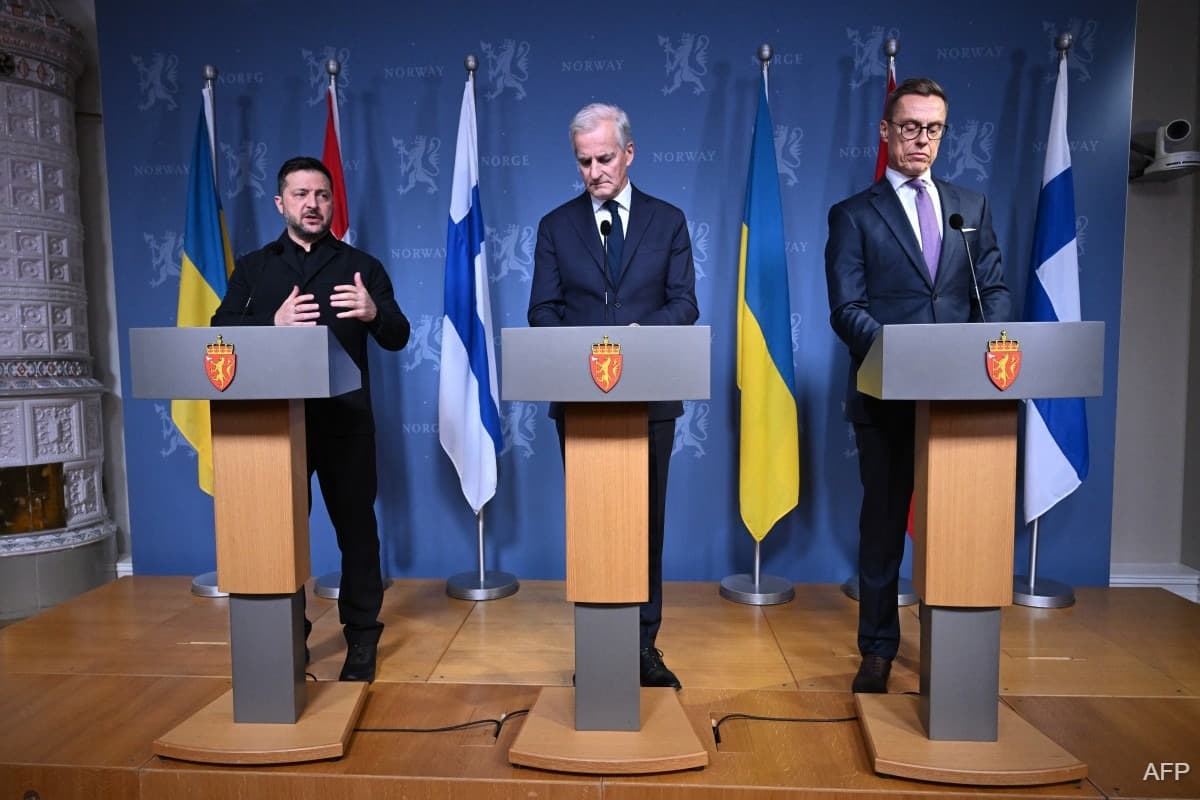
(Oct 27): Finland’s President Alexander Stubb and Norway’s Prime Minister Jonas Gahr Støre held a phone call with Russian President Vladimir Putin to discuss the prospects for a peace deal in Ukraine.
Stubb and Støre initiated the call that took place on Tuesday, in consultation with Ukraine, they said in a joint statement, confirming an earlier Bloomberg News report.
“The discussion was frank and substantive,” Stubb said. “Ending the war requires direct discussions.”
Putin “emphasised that achieving a just and long-term peace is possible only if the legitimate interests of the Russian Federation are fully and unconditionally taken into account,” according to a Kremlin readout of the call. The three leaders agreed to maintain “direct phone contacts,” it said.
Following the call with Putin, the Nordic leaders spoke with Ukrainian President Volodymyr Zelenskiy in what Stubb termed “a good phone call”.
“Alex and Jonas made it clear to the Russian leader that real de-escalatory steps are needed regarding our energy and infrastructure,” Zelenskiy said in a post on the X platform.
The talks follow a revived effort to get peace negotiations on track in the war Russia started that’s now in its fifth year. US President Donald Trump’s special envoy Steve Witkoff visited Putin in St Petersburg last week, after holding talks in Oslo with Zelenskiy and the two Nordic leaders.
The call was the first direct contact between Putin and top European leaders allied with Kyiv since French President Emmanuel Macron spoke with his Russian counterpart in July last year.
Ukraine’s European allies are seeking a seat at the table on discussions about European security, and both Støre and Stubb have used their countries’ shared border with Russia as justification for why they should be part of the talks.
“We are neighbouring countries to Russia,” Stubb said in the statement. “The outcome of this war will have a direct impact on our and the broader European security.”
The aim of the call was to convey messages directly to Putin regarding future negotiations to help end the war, Støre and Stubb said, adding that the call related to trilateral talks involving Russia, Ukraine and the US planned to take place in Abu Dhabi next month.
Civilian casualties in Ukraine jumped by 85% in September as Russia increased drone and missile attacks, according to the United Nations. At least 328 civilians were killed and 2,105 injured in attacks last month, UN human rights monitors said.
Kyiv mayor Vitali Klitschko said one person was killed and 14 injured, most of them students, after a Russian strike near a university dormitory overnight.
Ukraine has continued long-range drone-and-missile attacks inside Russia over the past week, targeting military and industrial sites, while civilian infrastructure and residential property have also been damaged. Since Friday, strikes have killed at least 11 people in regions bordering Ukraine and left dozens injured, according to regional authorities.
Ukraine says its forces struck sites linked to Russia’s defence industry, including several chemical plants and a battery plant, as well as a petrochemical facility and logistics hub in Omsk, roughly 2,500km (1,550 miles) from Ukraine.
Stubb and Støre, who were both in Helsinki at the time of the call, said they were not speaking on behalf of Europe as a whole.
Still, the call drew criticism from Danish Prime Minister Mette Frederiksen, who told local broadcaster TV2 that it wasn’t coordinated with other European leaders. She said she’s “very sceptical” over what she called a solo initiative by Norway and Finland.
Kremlin spokesman Dmitry Peskov said after last week’s talks that Russia regarded Norway and Finland as new participants in efforts to resolve the war in Ukraine. Russia will see “whether they can do so at all”, he said.
Ukraine’s relations with the US are at a new low after Trump struck a diesel deal with Putin earlier this month and tensions flared over the slowing of Starlink internet connections that are vital to Kyiv’s ability to defend against Russian missile attacks. Budget needs are spiraling and the country lacks the air defenses needed to fend off Russia’s expected winter onslaught.
Officials from Ukraine, Russia and the US have held sporadic talks throughout the war and the issues that need to be resolved in any peace deal, particularly on territory and security guarantees for Kyiv, are fairly clear to all sides.
There’s no sign so far that Putin’s ready to sit down with Zelenskiy for direct negotiations. The Kremlin readout said the leaders welcomed the agreement to resume trilateral talks with the US and Ukraine in the first half of November.
Other matters still unresolved include the shape of Europe’s security architecture after the war ends, Stubb said last week. That’s where the Finnish leader and Støre are looking to have influence as they tag team on the diplomacy, drawing on their friendship and careers that have intersected over the past 15 years.
They resist Russia’s demands of a broad-based roll back of the North Atlantic Treaty Organisation from Eastern Europe and push back on Russia being allowed to dictate the foreign policy options for Ukraine as a sovereign state.
Uploaded by Felyx Teoh