

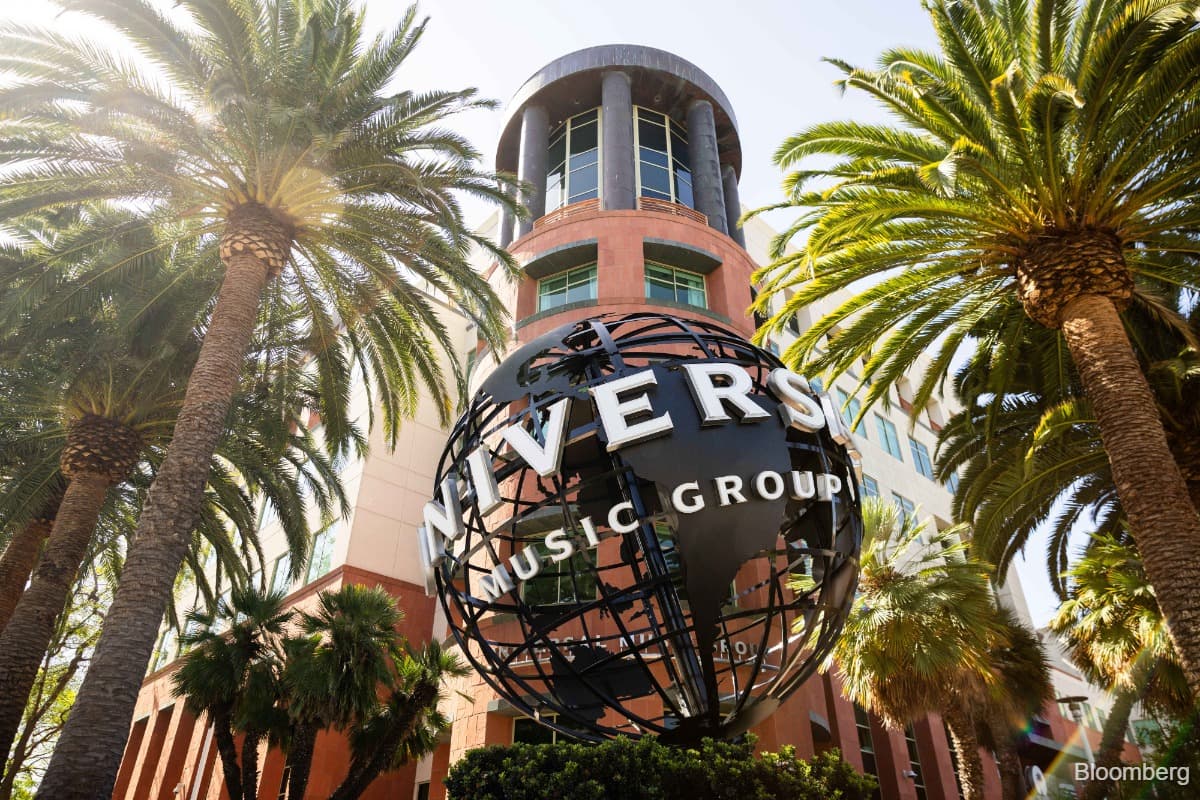
(Oct 27): Universal Music Group, the world’s largest record company, has discussed going private with a few prominent Wall Street firms, according to people familiar with the matter.
Universal’s management held preliminary conversations with private equity firms including Apollo Global Management Inc, TPG Inc and Blackstone Inc earlier this year, said the people, who asked not to be identified because the talks were confidential. The board of the company, with a market value of €29 billion (RM132.74 billion), is aware of the discussions, they added.
The conversations have not progressed nor has Universal, home to acts including Taylor Swift, The Weeknd and Kendrick Lamar, begun a sales process, the people said.
The company declined to comment, as did the private equity firms. Universal’s sagging share price has prompted many at the company and on Wall Street to wonder whether the music giant would be better off as a private firm.
Shares in Universal rose as much as 6% in Amsterdam trading on Tuesday, the biggest intraday gain since April. The stock has declined about 27% this year and trades below the price at which the company first went public in 2021. Catalogues and other music assets are trading at much higher multiples than Universal and rival Warner Music Group on the private market.
Universal, led by CEO Lucian Grainge, was already the target of one takeover attempt this year when shareholder Bill Ackman made an offer to buy the Amsterdam-listed company and move its listing to the US. Universal rejected the bid but the company’s largest shareholder agreed with Ackman that the firm is undervalued. Universal is the largest and most successful of the three major record label groups, the distributor of nine of the 10 best-selling acts in the world last year. Sony Group Corp is another major competitor.
“We think that the price is not right at all,” Cyrille Bollore, whose family owns a 30% stake in Universal Music Group, said at his firm’s shareholder meeting in May. Bollore praised Universal as one of his family’s best investments and a hedge against an economic downturn. “Perhaps we’ll sell a few per cent one day. We’ll see. But we can’t sell too early.”
Any deal would require the assent of the Bollore family, which owns more than 30% of the firm between the personal holdings of Vincent Bollore, Cyrille’s father, and Vivendi, their media company. Vivendi used to own Universal Music before the company was spun out as a separate public company.
The Bollores haven’t signalled interest in selling their full position. Nor has Chinese internet giant Tencent Holdings Ltd, which owns more than 11%. Taking Universal public was lucrative for the Bollores and a handful of senior leaders who had stock. The company has since struggled to satisfy investors.
Record labels have surrendered market share to independent distributors offering more artist-friendly terms. The streaming market that boosted sales for the last decade has slowed in the US and Western Europe over the last couple of years. The fastest-growing markets are in Latin America and Asia, regions where the major record labels are less dominant.
The biggest drag on the stock of Universal and Warner Music has been anxiety about artificial intelligence. AI has produced a surge in the number of songs getting uploaded to streaming services, which analysts and investors fear will dilute the labels’ share of listening and earnings.
Grainge has said Universal isn’t at risk of dilution. “We anticipated the rise of AI slop and we anticipated the potential for fraud,” Grainge said on a call with analysts in July. “Music platforms should reward creativity and guard against illegally trained AI models pumping AI slop or fraud designed to divert royalties from artists, songwriters, labels and music publishers.”
Universal has expressed concern about AI companies violating its copyrights, as file-sharing websites did during the internet boom. Universal sued Suno, the largest AI music company, as well as Anthropic.
Uploaded by Arion Yeow