

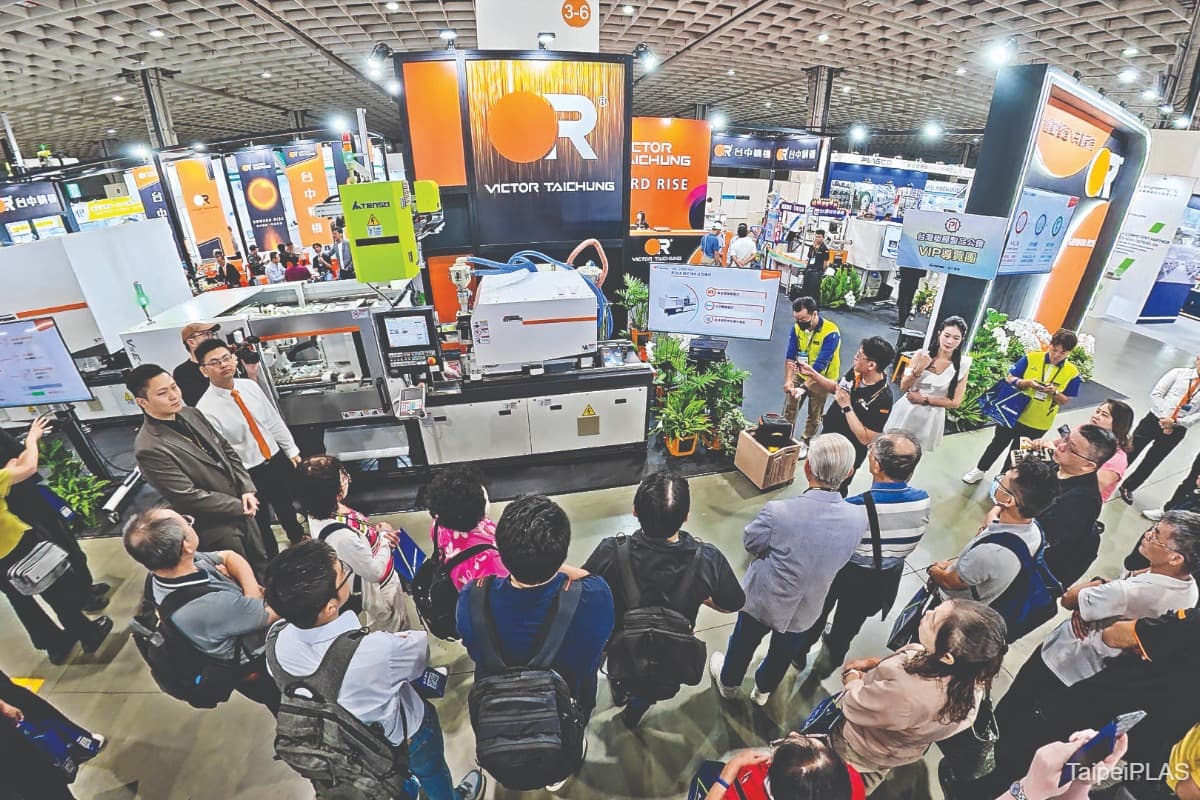
This article first appeared in The Edge Malaysia Weekly on October 26, 2026 - November 1, 2026
Inside Taipei’s Nangang Exhibition Center, rows of injection-moulding machines, extrusion lines, industrial chillers and automated production systems filled the exhibition floor. The machinery on display turns plastic pellets into everything from food packaging and household goods to medical components and precision industrial parts.
Yet, despite the rows and rows of equipment on display at TaipeiPLAS 2026, the mood appeared quieter than expected. Although the hall was packed with gigantic machines, the atmosphere among visitors moving between the booths was more subdued.
At the exhibition held from Sept 15 to 19, the common message conveyed by the machinery suppliers The Edge managed to engage with was that the plastics industry has changed rapidly over the past years, but that not every market, including Malaysia, is keeping pace.
Malaysia, in particular, has emerged as a market caught between its own established manufacturing base and struggling to scale up. Several suppliers described demand for plastics machinery in the country as broadly flat, with some reporting lower sales and more a cautious investment approach. Vietnam, by contrast, was repeatedly identified as a faster growing market.
“Many years ago, we could sell more than 50 machines a year [to Malaysia]. Now, it is about 20 to 30 a year only,” Stephen Ho, an area manager at Taiwanese injection-moulding machinery maker Fu Chun Shin Machinery Manufacture Co Ltd (FCS) told The Edge at the exhibition.
Its Malaysian agent had sold more than 500 machines over two decades, with the bulk of the apparatus used to make household products, and some serving the automotive sector. Ho identified Vietnam as FCS’ biggest Asian market, followed by Thailand and Indonesia. He said the company is still assessing the need to open additional offices in Malaysia, including one in Johor Bahru.
In Malaysia, the plastics industry is more than just a supplier of everyday consumer products. It is a downstream manufacturing sector that converts petrochemical resources into materials and components used in packaging, electrical and electronics (E&E), automotive, construction, medical devices and other industries.
Packaging service remains the industry’s largest segment, while E&E is a major export contributor, according to the Malaysian Investment Development Authority (Mida) website. The national investment agency describes the plastics industry as an “important contributor to the national economy”, supported by a developed petrochemical industry that supplies resins used in plastic products.
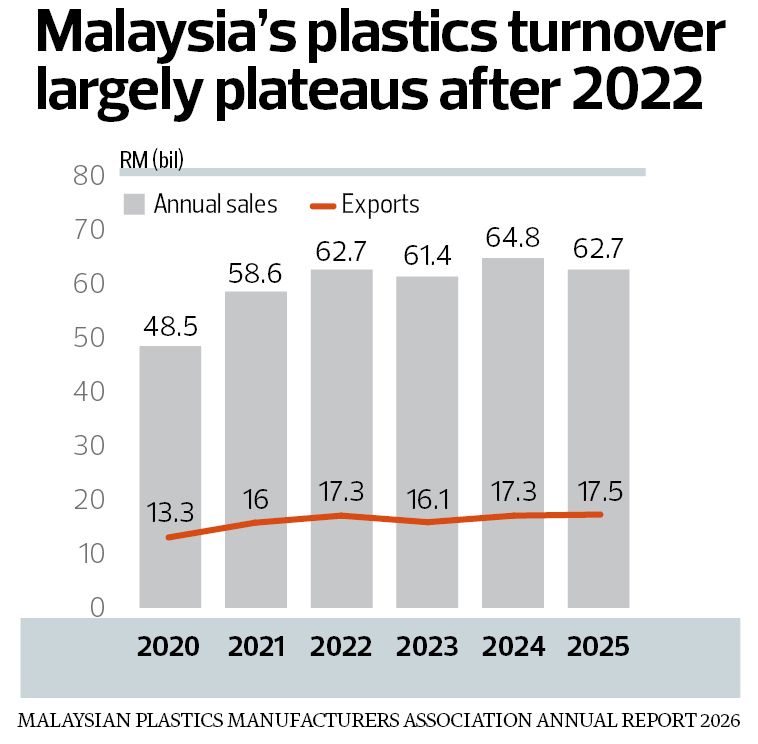
Yet, data from the Malaysian Plastics Manufacturers Association (MPMA) showed that the industry faces another year of stagnant growth in 2025 after its reported annual sales turnover slipped 3.24% to RM62.7 billion from RM64.8 billion a year ago. Export performance, on the other hand, rose marginally by 1.15% to RM17.5 billion from RM17.3 billion the previous year.
MPMA’s 2026 annual report puts the number of manufacturers at 1,400, employing 167,000 people. Some 800 companies are registered as members. The association was approached but declined to comment for this article.
Changing market
TaipeiPLAS, co-organised by the Taiwan External Trade Development Council (TAITRA) and the Taiwan Association of Machinery Industry, brought together 354 exhibitors across 1,366 booths. The organiser recorded 7,543 attendees, including 993 international buyers from 77 countries. The numbers were lower than those reported for the 2024 edition, which boasted 496 exhibitors, 1,844 booths and 12,672 visitors.
TAITRA said Vietnam, Indonesia and Thailand were among the key Southeast Asian source markets for buyers, with Malaysia also ranking among the top 10. However, the organiser said detailed data on orders, contracts and the estimated business value generated by the 2026 show were not yet available at the time of writing.
“Exhibition data alone may not be sufficient to draw broader conclusions about shifts in manufacturing capacity or investment across Southeast Asia. Nevertheless, the participation of buyers from Vietnam, Indonesia, Thailand and Malaysia reflects continued interest from these markets in Taiwan’s plastics and rubber industry,” the spokesman said.
Still, on the ground, conversations with machinery suppliers operating across Southeast Asia point to a recurring theme: that Malaysia is now not the market generating the strongest demand for new equipment.
German machinery maker Arburg, which established its Malaysian subsidiary in 1992, said its business in the country had increased over the longer term. It supports customers through sales, technical services, training and spare parts, rather than manufacturing machines locally.
Nevertheless, the family-run company described the broader Malaysian plastics market as being at a “constant level”, adding that there was more room for stronger growth for the country. In the earlier days, international companies had helped Arburg to sustain opportunities in Malaysia, including manufacturers seeking to diversify their production beyond China.
“I don’t think there’s a big growth in Malaysia currently [in terms of plastics manufacturing],” its international technical support team Uwe Haupt said. Its customers in Malaysia largely serve medical applications, for which electric injection-moulding machines are often preferred.
Marcel Bauer, an Asia-Pacific area sales manager at German extrusion machinery maker Reifenhäuser, agreed that Malaysia was “growing but was not necessarily the fastest-growing market in Southeast Asia”. Vietnam offered greater potential in his company’s assessment, supported by industrial expansion and demographic trends.
The tepid demand for machinery at the expo notwithstanding, Mida’s data shows that Malaysia’s approved investments in plastic products surged 174.8% to RM4.85 billion in 2025 from RM1.76 billion in 2024, while the number of projects rose to 115 from 91. Foreign investment itself nearly quadrupled to RM3.56 billion from RM900.9 million.
Labour squeeze and cheaper Chinese machinery
One of the main concerns that the exhibitors raised was labour availability. Most suppliers argued manufacturers were struggling to secure enough workers, while labour costs and operating expenses were influencing decisions about where to locate production, ultimately putting investment decisions in Malaysia on hold.
“The biggest problem for us is that it is not easy to find workers in Malaysia. I think they [Malaysians] want jobs like Uber or something — they want to work freely,” said Ho from FCS, adding his customers wanted better access to foreign labour and more effective communication with government agencies.
Meanwhile, Tung Sheng, a Taiwanese maker of rubber and footwear manufacturing machinery, also raised similar issues that some shoe factories had shifted production to Indonesia and Vietnam, mainly due to “labour and tax considerations concern” in Malaysia.
The second market pressure is competition from Chinese machinery manufacturers. Several Taiwanese suppliers said Malaysian customers were increasingly price-sensitive and were considering lower-cost Chinese equipment.
Victor Taichung, a Taiwanese machinery manufacturer, said some Malaysian buyers were choosing cheaper machines to control capital spending amid global uncertainties. Chuan Lih Fa Machinery Works, another Taiwanese injection-moulding machinery maker, said it prefers to compete by quality and reliability instead, and positions its products between cheaper Chinese equipment and more expensive German machinery.
“Price should not be the priority for any company who genuinely wants to scale up,” its representative said. “Firms should not focus on lowest initial price without assessing whether the equipment can support better productivity, more demanding customers or higher-value production over time,” he asserted.
For Malaysia, cheaper machinery can make automation more accessible to smaller manufacturers and help them upgrade older production lines. Coming from a related industry, Malaysian Rubber Products Manufacturers Association (MRPMA) president Yeaw Kok Kwey says manufacturers are increasingly considering Chinese equipment for its “pricing, automation, efficiency and ease of operation”.
“Malaysia’s rubber manufacturing base is not standing still — manufacturers are upgrading, modernising and preparing for the next stage of Industry 4.0,” Yeaw says.
He cites investment in automated inspection, cutting, injection moulding and measurement systems being done by local industry players over the years.
“At the manufacturing level, we are also seeing more rubber industry players progressively phase out ageing facilities and equipment and invest in new-generation machinery. Investment in modern machinery is not simply about replacing old equipment — it is about improving productivity, competitiveness, quality and long-term sustainability,” he adds.
Plans to move up value chain
Malaysia has set its sights on moving beyond commodity products and developing more sophisticated plastics and materials. Under the Chemical Industry Roadmap 2030, engineering plastics are identified as a strategic area, with the aim for Malaysia to supply 30% of Southeast Asia’s engineering plastics demand by 2030, up from a baseline of about 15%.
Engineering plastics are used in demanding applications such as automotive components, electronics and industrial equipment. Capturing more of this market requires not only investment in machinery, but also specialised materials, technical expertise, consistent quality control and close relationships with customers.
Malaysia and Taiwan occupy different but potentially complementary positions in the plastics and rubber supply chain, according to Federation of Malaysian Manufacturers deputy president Datuk Andrew Goh Boon Kim.
“For Malaysia and Taiwan, there are greater opportunities to deepen cooperation across manufacturing networks that are more resilient, more functional and more competitive,” Goh said in his presentation at the exhibition. “Opportunities emerge for companies to work together in advanced materials, machinery, automation, recycling technologies and supplier development.”
His remarks support the view that Malaysia has a substantial petrochemical base, access to raw materials and a manufacturing ecosystem serving various industries. Taiwan, meanwhile, is home to a well-developed machinery industry, with suppliers specialising in injection moulding, extrusion, automation, cooling systems and related technologies, even though some local residents regard plastics and rubber as traditional industries.
Taiwan’s machinery expertise and Malaysia’s manufacturing base could support the latter’s move up the value chain through closer technical cooperation and training, Goh pointed out. The opportunity is not simply to bring more advanced machines into Malaysian factories, but to build the technical capabilities needed to use them effectively long after installation, he observed.
Malaysia’s total trade with Taiwan reached a record RM233.02 billion in 2025, according to figures cited by the Ministry of Investment, Trade and Industry. The trade spans electronics, machinery, equipment and parts, along with many other products, providing a broader commercial foundation for cooperation between the two economies.
Save by subscribing to us for your print and/or digital copy.
P/S: The Edge is also available on Apple's App Store and Android's Google Play.