

This article first appeared in The Edge Malaysia Weekly on October 26, 2026 - November 1, 2026
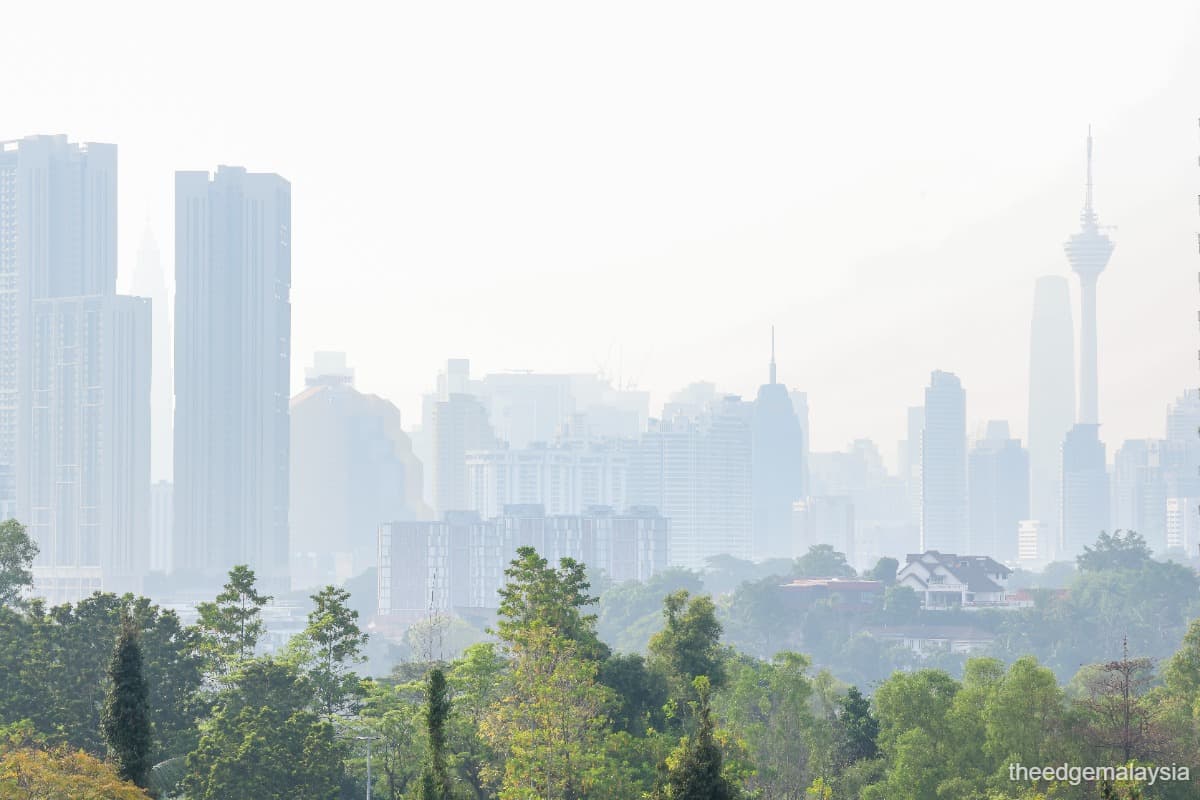
FOR a school canteen operator or a daily-wage worker, a day without business due to persistent dense haze could mean a day without income. Unlike the government, which can borrow or reallocate funds to absorb the economic fallout, these workers and small businesses have little room to cushion the impact.
This, Sunway University’s Jeffrey Cheah Institute Economic Studies Programme senior fellow and director Professor Yeah Kim Leng says, illustrates how the economic burden of the prolonged haze in Malaysia is being borne unevenly, with smaller businesses, lower-income households and outdoor workers among the most vulnerable.
The collective cost to the economy is substantial. Yeah estimates that the haze could be costing Malaysia RM20 million to RM50 million daily, or RM600 million to RM1.5 billion a month. Should the haze persist for 100 days, cumulative losses could reach RM2 billion to RM5 billion, equivalent to roughly 0.1% to 0.2% of annual gross domestic product (GDP), he predicts.
While he expects the impact on fourth-quarter and full-year GDP growth to amount to only a few basis points, the economic damage could deepen if the haze persists into 2027, particularly for agriculture and tourism, while adding to healthcare expenditure and lost wages.
Recent estimates by non-governmental organisations Engage and Projek Sama show that the closure of primary schools in Johor alone could result in productivity losses of about RM1 million a day, as working parents take leave and school-dependent businesses lose customers.
Yeah warns that Putrajaya could face a fiscal dilemma as rising healthcare expenditure, potential emergency support payments and forgone tax revenue complicate efforts to manage the fiscal deficit. The economic damage could also outlast the haze itself, with Yeah pointing to reports that vegetable and fruit yields in Johor have already halved, while the impact on oil palm yields could emerge only six to 12 months later.
MARC Ratings Bhd chief economist Dr Ray Choy has similar predictions, warning that the GDP impact would straddle 2H2026 and the early part of 2027, affecting GDP growth each year in the range of 0.1%-0.2% for each quarter that the problem lasts.
“Of the five quarters associated with notable haze episodes between 2015 and 2024, four recorded slower year-on-year GDP growth than their immediately preceding quarters, with the deceleration ranging from 0.2 to 0.5 percentage points,” Choy says.
Nevertheless, MARC sees no immediate need to revise its economic growth forecast unless the haze persists for two quarters, or six months.
The haze episodes of 1997 and 2013 were considerably more severe, with Sarawak the worst hit in 1997 when Air Pollutant Index (API) readings reached 860, while Johor, Melaka and Negeri Sembilan bore the brunt in 2013, with Muar recording an API of 746. In September this year, Serian, Sarawak, recorded an API of 521, while readings in Peninsular Malaysia peaked at around 211 in October.
The Asean Specialised Meteorological Centre has warned that El Niño conditions and below normal rainfall could sustain elevated haze risks through the final quarter of 2026, although increased rainfall during the inter-monsoon transition may provide some relief.
For businesses, the consequences are already uneven, with operators dependent on outdoor activities and pedestrian traffic bearing more of the burden than those able to shift operations indoors.
Outdoor businesses losing out, rising illnesses add to costs
Despite worsening air quality, Retail Group Malaysia (RGM) managing director Tan Hai Hsin tells The Edge that Malaysia’s overall retail sector appears relatively resilient, although businesses dependent on outdoor customer traffic are feeling the strain.
“Most retail shops in Malaysia are air-conditioned, except those in smaller commercial areas, towns and rural areas. Most shopping centres, department stores and grocery stores in affected areas are enclosed and air-conditioned, and continue to attract large crowds on weekdays and weekends,” says Tan.
“However, traditional coffee shops, hawker centres, roadside stalls and restaurants with substantial outdoor seating have suffered lower customer traffic as consumers avoid prolonged exposure to polluted air.”
Hilltop and rooftop restaurants have also experienced weaker sales, while some customers, particularly families with young children, elderly people and those with health concerns, have shifted to takeaway orders or food delivery, Tan says.
He observes that young consumers are still willing to queue, even outdoors, for popular cafés, artisanal bakeries, new electronic gadgets and collectibles. Outdoor markets and food fairs have also continued to draw crowds.
For affected street-level businesses, takeaway and delivery orders provide some relief but are unlikely to fully replace dine-in revenue. Tan estimates that the negative impact on affected retailers and food and beverage operators should not exceed 15%.
RGM is maintaining its retail sales growth forecasts of 3.9% for the fourth quarter and 3.8% for 2026, although Tan acknowledges that the projections have not incorporated the effects of the current haze because he considers rising living costs and declining purchasing power remain greater threats to retail growth than air pollution.
Meanwhile, the healthcare sector faces more immediate pressure, with the Ministry of Health reporting on Oct 10 an increase in respiratory infections and other haze-associated illnesses.
Data collected from 78 selected health facilities showed that upper respiratory tract infections rose 10.43% to 3,875 cases, from 3,509 the preceding week. Conjunctivitis cases increased 26.47% to 129, although asthma cases declined 13.64% to 462 over the same period.
Lost working hours, productivity
The haze has also raised concerns over lost working hours, absenteeism and productivity, particularly in industries reliant on outdoor labour.
Malaysian Employers Federation (MEF) senior adviser for Government, Media and International Engagement Datuk Syed Hussain Syed Husman observes construction, agriculture, plantations, logistics and certain manufacturing operations as most exposed to disruptions.
While MEF has yet to quantify haze-related absenteeism or productivity losses among its members, Syed Hussain says employers may have to shorten working hours, reschedule outdoor activities or temporarily suspend operations when air quality deteriorates, affecting output and delivery schedules.
“Businesses could also incur higher costs from protective equipment, improved ventilation and adjustments to working arrangements, with smaller enterprises less able to absorb the additional expenses. Meanwhile, school closures could compound productivity losses as working parents take leave or rearrange their schedules to care for their children,” he cautions.
Although it is understood that workers in manufacturing, construction, retail and healthcare cannot perform their duties remotely, MEF urges employers to adopt flexible working arrangements where feasible.
The Federation of Malaysian Manufacturing (FMM) in an Oct 9 statement warned that recurring haze episodes could undermine industrial productivity and competitiveness, with its president Jacob Lee Chor Kok urging Asean governments to accelerate implementation of the Asean Agreement on Transboundary Haze Pollution and the Asean Haze-Free Roadmap 2023–2030.
“Clean air is not a luxury,” stresses Lee, calling for stronger enforcement against illegal burning, more effective monitoring and early-warning systems, and greater investment in peatland restoration and fire prevention.
“Although some companies may be able to recover lost output through additional shifts or overtime, this would involve further expenditure, and not all lost production can necessarily be recovered within the required timeframe,” he tells The Edge.
Lee urges Asean governments to accelerate implementation of the Asean Agreement on Transboundary Haze Pollution and the Asean Haze-Free Roadmap 2023–2030, calling for stronger enforcement against illegal burning, improved early-warning systems and greater investment in peatland restoration and fire prevention.
To this end, Minister of Natural Resources and Environmental Sustainability Datuk Seri Arthur Joseph Kurup said Malaysia is developing new regional initiatives, including science-based cooperation and a proposed sustainable haze fund, to strengthen fire prevention and suppression efforts.
Clouding Visit Malaysia 2026 prospects
The prolonged haze poses another setback for Malaysia’s tourism industry, which is already grappling with weaker tourist arrivals amid higher airfares and a stronger ringgit as the sector recovers from flight disruptions linked to the US-Iran conflict earlier this year.
In fact, Malaysian Inbound Tourism Association president Mint Leong reportedly noted that inbound operators are experiencing cancellations for November and fewer group bookings, while overseas travel agents are seeking updates on air quality.
Sunway University’s Yeah warns that prolonged haze could continue to dampen arrivals during the peak year-end and Chinese New Year holiday periods, potentially extending the industry’s losses into early 2027.
“Deteriorating visibility can disrupt aviation through flight delays, cancellations and diversions, while weaker demand for outdoor attractions could lead to cancelled leisure activities and shorter visitor stays. And the effects tend to spill over into accommodation, transport, restaurants and other tourism-related services,” says MARC’s Choy.
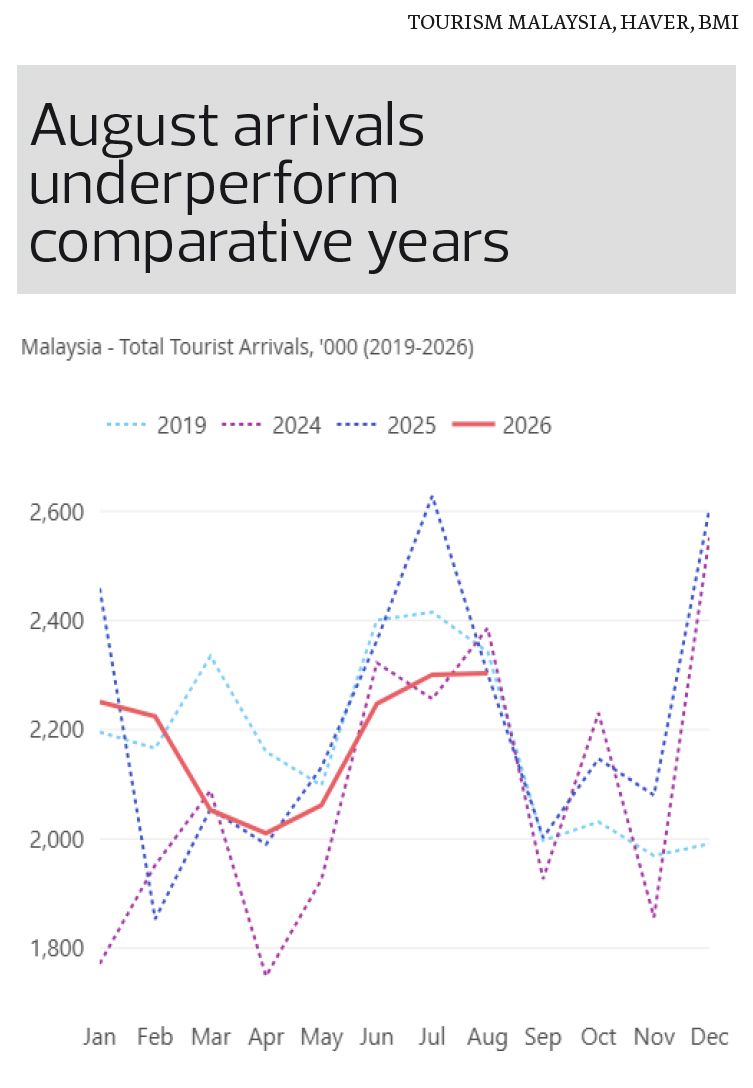
According to Tourism Malaysia data released on Oct 19, international tourist arrivals totalled 2.3 million in August, up just 0.1% year on year. For the first eight months of 2026, arrivals stood at 17.5 million, down 1.9% from the corresponding period last year.
Consequently, BMI (a Fitch Solutions company) revised its 2026 arrivals forecast from 0.5% growth to a 1.2% contraction, or 26.2 million tourists, compared with 26.6 million in 2025. This echoes Minister of Tourism Datuk Seri Tiong King Sing’s earlier observation that the 2.5% growth in international arrivals in the first half was the slowest rate for the period since the post-Covid-19 pandemic recovery began.
“A prolonged haze could depress tourism arrivals into the peak year-end and Chinese New Year periods,” cautions Yeah.
“That the Malaysian economy grew 5.5% in the first nine months of 2026, provides a buffer. However, a haze lasting through February would compound agricultural losses, particularly, palm oil which faces a six-to 12-month lagged impact, and vegetable and fruit yields are already reported to have halved in Johor.”
The economists and FMM have urged Putrajaya to treat recurring transboundary haze as a structural economic risk, prioritising prevention and closer cooperation with Indonesia on peatland fire management rather than repeatedly bearing the costs of each episode.
Domestically, Yeah recommends clear, science-based criteria for school closures and health advisories, alongside temporary income assistance for daily-wage earners and low-income parents, emergency aid for affected small businesses, and subsidised N95 masks and access to clean-air spaces.
“Finally, the government should build the fiscal buffer needed to absorb these recurring shocks without displacing development priorities, and should pursue a more effective, lower-cost and durable solution to cross-boundary haze under the Asean umbrella, given that climate-related disruptions are becoming increasingly frequent and costly,” he emphasises.
See also infographic, "Choking fumes sweep across Malaysia", on Page 68
Save by subscribing to us for your print and/or digital copy.
P/S: The Edge is also available on Apple's App Store and Android's Google Play.