


This article first appeared in The Edge Malaysia Weekly on October 26, 2026 - November 1, 2026
BUDGET 2027 will lift the minimum wage by 17.6%, from RM1,700 to RM2,000, starting in June 2027. This is the latest increase since Malaysia’s national minimum wage took full effect in 2013. Micro, small and medium enterprises (MSMEs) with annual sales below RM50 million are exempted to give them time to adjust. The government has not specified how long the exemption will last.
While the adjustment is intended to improve workers’ incomes, it raises questions about how businesses will absorb the additional cost. Smaller employers may now have to compete with larger firms for the same pool of workers under differing wage floors.
What the increase will mean for hiring, prices and wages further up the salary scale, and whether productivity gains can offset higher labour costs, remain open questions.
MSMEs account for almost half of employment
According to the Department of Statistics Malaysia (DOSM), MSMEs’ gross domestic product (GDP) grew 5.7% in 2025 — outpacing national GDP growth of 5.2% — and generated RM689.8 billion in value-added, accounting for 39.7% of the country’s GDP. They also employed 8.09 million people or 48.7% of total employment.
The exemption is based on annual sales, and the government has yet to publish full eligibility criteria, so the exempt group may not match DOSM’s definition of an MSME.
DOSM’s March 2026 figures show median monthly wages exceeded RM2,000 in every major formal-sector industry, although accommodation and food and beverage (F&B) (RM2,164), textiles, apparel and leather (RM2,245), and agriculture (RM2,327) were close to the floor.
These are median wages, meaning many employees can still earn less than RM2,000, even if the industry’s median exceeds that amount.
DOSM data also shows that about 25.9%, or 1.83 million of Malaysia’s 7.05 million formal employees, earned below RM2,000 as at March 2026. Some 7.9% earned less than RM1,700, while the overall median monthly wage stood at RM3,027.
The statistics, derived from administrative data including Employees Provident Fund and Social Security Organisation records, cover only formal-sector Malaysian employees. They do not establish how many workers will be affected by the new rate.
Mohammad Iesa Morshidi, director of workforce management at PwC Malaysia, believes most businesses will eventually move towards RM2,000, although the pace is likely to vary substantially between industries.
Semiconductor, renewable energy and digital economy businesses are relatively well positioned to accommodate the increase, he says, given their competition for talent and generally higher prevailing wages. Agriculture, hospitality and F&B operators, however, could remain at RM1,700 for longer.
The increase could also reach beyond workers on the current minimum. An employer raising a worker’s wage from RM1,700 to RM2,000 would face an additional RM3,600 annually before statutory contributions. The total payroll increase could be larger if employers also adjust salaries for experienced workers currently earning slightly above the new minimum.
Iesa identifies agriculture, hospitality and F&B among the industries with the least room to absorb the increase through margins or higher prices. Labour-intensive manufacturers, including garments, furniture, plastics and food processing businesses, may face similar pressures. Cleaning, security and other outsourced support services could also be affected, particularly where existing contracts prevent employers from immediately passing additional costs to clients.
The Malaysian Employers Federation has welcomed the exemption as a safeguard for business sustainability and employment, while the Small and Medium Enterprises Association of Malaysia (Samenta) says it provides smaller firms with breathing space to improve productivity and automate before absorbing higher wages.
The concern is what happens to hiring while the exemption lasts.
Opposition leader Datuk Seri Hamzah Zainudin warned that exempted firms could lose workers to larger employers offering higher pay. Samenta president Datuk William Ng acknowledged the concern that the exemption could create a two-tier system, though he said many SMEs in the Klang Valley are already paying above RM2,000.
Defining productivity
Whether Malaysian businesses can sustainably pay higher wages depends, in part, on their ability to generate more value.
Measuring productivity is more complex than it seems. Iesa notes that no single metric can capture industries as diverse as semiconductors and financial services.
“They have been cautious in terms of defining what productivity means,” he says of the government, warning that figures presented without context could mislead investors.
The Malaysia Productivity Corporation (MPC), an agency under the Ministry of Investment, Trade and Industry, defines productivity in terms of how efficiently resources such as labour, capital, land and technology are used to produce output.
DOSM, meanwhile, measures labour productivity through value added per employed person and per hour worked.
By the former measure, MSME labour productivity increased 4.1% to RM85,299 per person in 2025, from RM81,931 in 2024.
While such indicators provide a useful benchmark, Iesa argues they do not necessarily capture how individual businesses generate value or whether those businesses can sustain higher remuneration.
“Productivity looks different from one business to the next, so we don’t believe there is a single approach that suits every firm,” Iesa says in written responses to The Edge.
A semiconductor manufacturer, for example, may generate substantially higher value added per worker than a labour-intensive manufacturer because of greater use of machinery, technology and capital investment.
Iesa identifies four broad drivers of productivity: operational and process efficiency; technology and innovation; human capital and organisational structure; and the regulatory and market environment.
For MSMEs, higher productivity does not necessarily translate into additional earnings to support higher wages. Output per worker can also rise when headcount falls, without employees receiving higher salaries.
While the minimum wage can be raised by law, productivity improvements needed to sustain it may take years to materialise.
Raising the floor but not the ladder
The Ministry of Finance’s Economic Outlook 2027 acknowledges that previous minimum wage increases lifted the bottom of the wage distribution but had limited effects further up the pay scale.
Budget 2027 also announced plans for a RM2,500 minimum starting salary for graduates and semi-skilled workers, but legislative changes are required before that becomes mandatory.
DOSM’s 2025 salary survey puts average pay for semi-skilled workers at RM2,714 a month, only 1.2 times the RM2,184 earned by low-skilled workers, a narrow step up for those taking on more demanding roles.
Economic Outlook 2027 also found that 81% of industries remained in the same relative wage category between 2015 and 2024, including 35 industries that remained below the comparative median wage in both years.
Research by Farhana Roslan at the PNB Research Institute (PNBRI) suggests that Malaysia’s employment growth has been concentrated in lower-paying industries, which may be constraining wage progression.
She argues that improving workers’ qualifications and skills alone may not lead to substantially higher earnings if the economy fails to generate sufficient demand for higher-skilled, better paying employment.
The paper estimates that wholesale and retail trade, F&B and logistics — which generally offer modest wages — accounted for 34% net new jobs on average between 2022 and 2025.
Meanwhile, high-skilled roles made up less than a third of new jobs in 2025, down from the largest share in 2016, according to the paper.
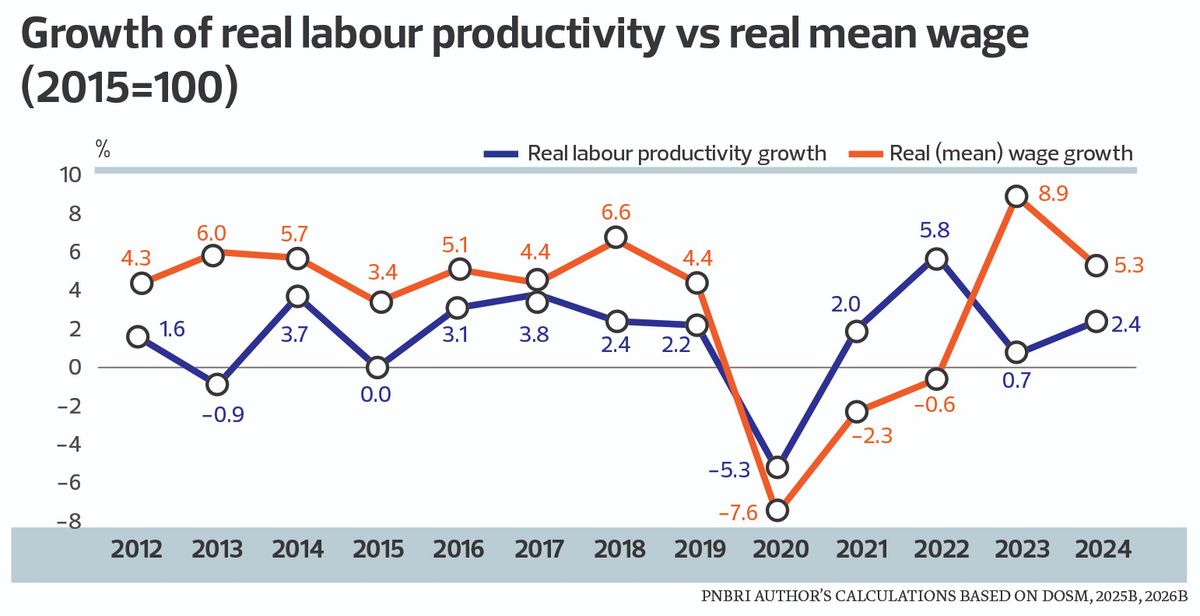
PNBRI’s analysis shows that real average wage growth exceeded labour productivity growth in every year between 2012 and 2024 — except from 2020 to 2022. But this does not necessarily mean employees are paid in proportion to the value they produce.
The paper cites a 2018 Bank Negara Malaysia study estimating Malaysian wages at about 34% of output per worker, compared with 51% in five benchmark economies.
Higher prices, slower hiring or greater efficiency?
Employers unable to absorb higher payroll costs through productivity improvements or lower margins may pass some of the increase to customers.
A representative from Aathaworld, a solutions provider for building, construction and engineering industries, believes higher labour costs can trigger price increases along the supply chain, with suppliers and customers passing additional expenses on to one another.
“Any cost rise anywhere in the supply chain will trigger a rise elsewhere,” he says.
Such adjustments could also affect exempted MSMEs, which may face higher costs for materials and services.
Another possibility is a change in hiring practices.
Iesa says employers facing higher labour costs may respond by slowing recruitment. This is done by not replacing workers when existing ones leave, while redistributing responsibilities among its remaining workers. “The easiest thing to do is to do more with fewer people. But that’s not sustainable long term,” he says.
Businesses need to rethink how work is organised and how employees can create more value, rather than relying solely on workforce reductions, he says.
Artificial intelligence (AI) could help raise output without necessarily adding workers. Aathaworld expects it to improve employees’ efficiency and justify higher salaries, while potentially reducing recruitment. Graduates will increasingly need to demonstrate genuine AI proficiency, the representative says.
At this juncture, AI’s effects on employment remain hard to measure, Iesa says. “Many businesses are still making the transition to AI-enabled operations, making the impact of AI on financial and workforce outcomes not yet measurable.”
Budget 2027 allocates RM30 million through the Malaysia Digital Economy Corporation to help 4,000 SMEs adopt AI and automation. Whether efficiency gains translate into higher wages or slower hiring remains uncertain. Iesa favours using AI to develop existing workers, alongside earlier AI education.
The RM50 million exemption spares smaller firms the increase to RM2,000, but not necessarily competition for workers or higher supply-chain costs. Whether they match the RM2,000 pay ultimately depends on their financial capacity and the pressure to retain workers.
Beyond the wage floor, the challenge is creating enough higher-value jobs for employees to progress up the salary scale.
Save by subscribing to us for your print and/or digital copy.
P/S: The Edge is also available on Apple's App Store and Android's Google Play.