

This article first appeared in Forum, The Edge Malaysia Weekly on October 26, 2026 - November 1, 2026
As an economist, one is a heavy user of macroeconomic data of the country one is studying. For a Malaysian, that generally means those put out by the Department of Statistics Malaysia (DOSM). The department has, as everyone knows, a new head, and when she made her first announcement of Malaysia’s trade statistics, I looked at the usual fact sheet that accompanies such announcements and saw the line, “Intermediate Goods”. My reaction was, “Well, hello, old friend.”
Intermediate goods were all the rage during and after the Asian financial crisis of 1997/98. Basically, with the rapid drop in the value of the Malaysian ringgit, industrialists, mainly foreign, wanted to know collectively what the total value of the production of such goods was in Malaysia and whether the country’s foreign exchange reserves were adequate to fund it. The reporting continued into the early 2000s until it mysteriously disappeared. There is some accounting controversy around that, but that is a subject for another time.
Let’s back up a bit. Intermediate goods mean “parts, components or raw materials used as inputs to produce other goods or services”, according to the US International Trade Commission. This is a staple of a country like Malaysia, which has built its industrial base largely through foreign direct investment (FDI), with foreign companies doing part of their manufacturing here rather than through the more traditional path of developing local companies with their own brands and finished goods, as South Korea, Taiwan and China have done.
The good bit about committing to intermediate goods manufacture is that the country is cemented in the global supply chain. That provides a measure of economic security. The bad bit is that one gets stuck in the middle-income trap. Technological transfer, going up the value chain and everything else trumpeted about it were just sweet, empty promises. They never happened.
The question one has to ask is, “Are all the resources spent for intermediate goods manufacture available for more optimal and profitable methods such as those that domestic final goods manufacture makes available?”
Why is this important? In a famous study of how much Foxconn earns from assembling each Apple iPhone, updated for the iPhone 16 Pro, the figures remain striking. Each iPhone costs US$568 to manufacture, yet Foxconn receives just US$8 to US$10 per unit, with a profit of around 20 US cents.
That is all the host country captures from a US$568 product: roughly 20 US cents. Let that sink in.
The question, then, is whether the resources committed by the host country justify such a meagre return.
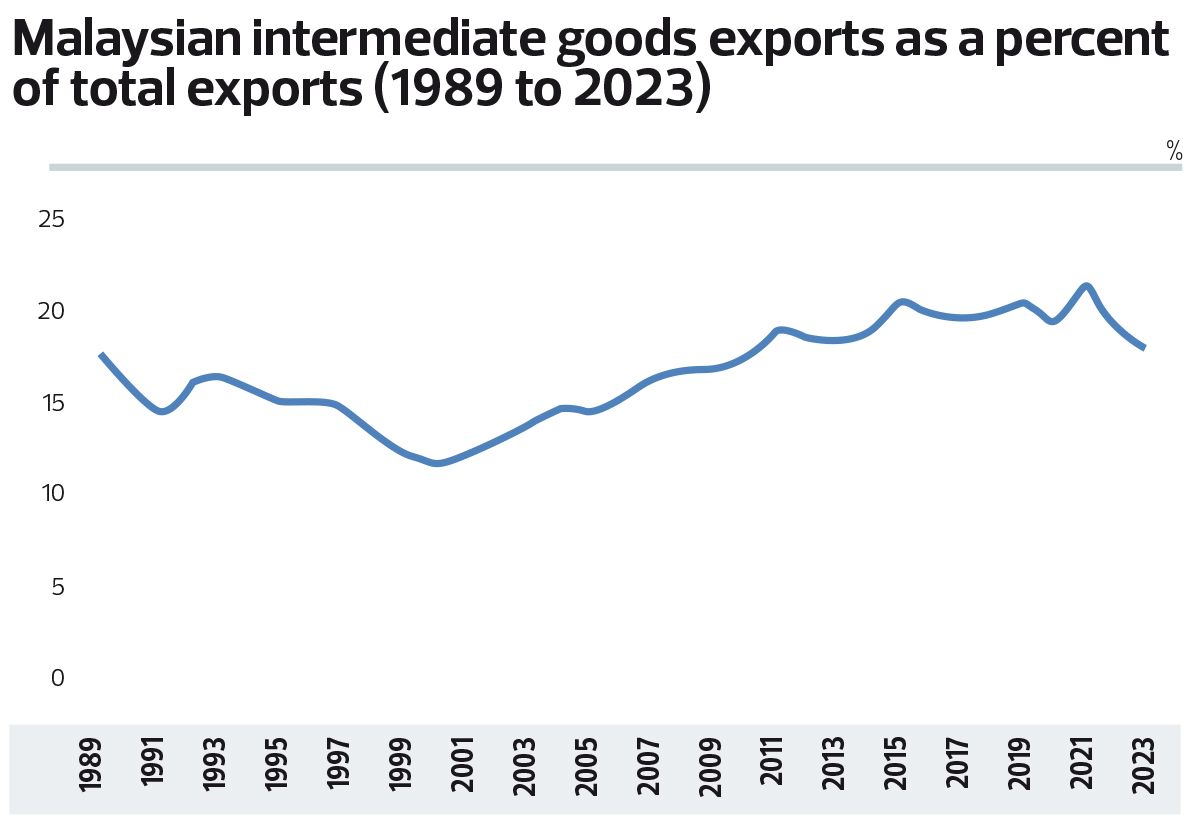
Is this kind of manufacturing a significant part of total Malaysian exports? Yes, they are and have been since 1989 (see chart).
Malaysia’s economic infrastructure has been tripping over itself trying to get FDIs, often at the expense of local industrial development. This blind drive to obtain FDIs just to drive an economy has a cost. One is immediately brought into the previous “hot” trend of recycling plastic waste. Entrepreneurs dreamt of making loads of money by recycling plastic waste; to scale up, one simply had to import some other country’s plastic waste. What happened? Malaysia started becoming a dumping ground for the world’s plastic waste, far more than it could recycle. Dozens of shipping containers were left at Malaysian ports with rubbish in them.
This is certainly an example of the kind of investment that can bring serious adverse consequences — much like the project that allowed strip-mining near a large town, and potentially the growing number of data centres. The experience, not merely the theory, from other countries shows that data centres can demand so much power and water that they accelerate resource depletion. In North Carolina recently, a data-centre project was cancelled after residents objected, focusing primarily on water depletion and pollution.
Economists might describe these as investments with diminishing or ultimately negative returns: The returns deplete until all that remains are the costs.
Then there is the “reshoring” drive, which is effectively pulling foreign companies back to their home countries. What happens, then, to host countries such as Malaysia? The FDI that promised so much today may not be there tomorrow. What happens to Malaysia when those investments leave? That is an enormous risk to take, isn’t it?
Fortunately, Malaysia can still turn things around for itself by industrialising. That means creating its own final goods and brands to meet local needs. Slowly but surely, and not all at once; otherwise, that would bring out the worst in the phrase, “import substitution strategies tend to collapse countries’ economies.” Indeed, one must learn to walk before one can run.
There is a host of tactics and techniques that can accomplish this; listing them as I tried the last time resulted in a book. Let’s just say that each country has to choose its bag of tricks, something one will become aware of if one compares the industrialisation paths of China, Japan and South Korea, or even any two countries.
Nonetheless, each tactic chosen has its own peculiarities and must be used with care. An example of this is tariffs, which were used by the US recently. Tariffs are seen as the first defence against the destruction of local industries that foreign imports bring. They are used in specific industries or against specific goods. The aim is to make foreign goods more expensive than local goods, thus allowing the manufacture of local goods to continue, rather than be subsumed. It is protection. If tariffs are applied against goods for which there are no local manufacturers supplying a competitive substitute, then all that has been accomplished is to raise inflation in the country. That is where the US finds itself today.
Now, reflect upon this fact: Malaysia’s general tariff level for industrial goods is around 6.1%. Given that US President Donald Trump was flinging around tariff levels of 25% to 200% or so, do Malaysia’s tariff levels actually provide adequate protection for local manufacturers?
Remember the old adage in economics: Free trade does not develop countries and never has. Even the US, as evidenced by its own actions, has abandoned free trade.
Huzaime Hamid is chairman and CEO of Malaysia’s financial macroeconomics think tank, Ingenium Advisors. He has written a full treatise on industrialisation in his book, The Formula For National Wealth
Save by subscribing to us for your print and/or digital copy.
P/S: The Edge is also available on Apple's App Store and Android's Google Play.