

(Oct 27): China’s unprecedented property crisis has just reached another flashpoint, as one of the country’s biggest local-government-owned conglomerates struggles with debt payments.
Based in the southern province of Guangdong, Zhuhai Huafa Group Co missed payments on two trust products that were due recently, people familiar with the matter said on Monday. The firm, which has helped build landmarks such as the 330m tall Zhuhai Tower skyscraper, has also been asking to extend loans from at least three banks.
That makes it the largest company heavily reliant on the property sector to try pushing back debt payments since China Vanke Co, once the country’s biggest developer, took similar steps about a year ago.
The development underscores how China’s years-long real estate debt woes are still spreading despite recent signs of stabilisation in the housing market. Huafa has developed over 200 residential projects across China. The conglomerate had RMB413 billion (US$61.93 billion or RM253.02 billion) of interest-bearing liabilities, including bank and trust loans as well as bonds, as of March, according to a company document this month.
“Huafa is facing the same challenges as other Chinese developers but it also plays such a crucial role in the local economy that local governments are highly likely to step in and support it,” said Yao Yu, CEO and founder of credit research firm RatingDog. “The eventual repayment outlook of Huafa’s bonds is not overly pessimistic.”
Still, the news this week sparked sharp declines in bonds and shares tied to the group, which had just priced a RMB1 billion note in the domestic market at the relatively low cost of 2.07% only a few days ago.
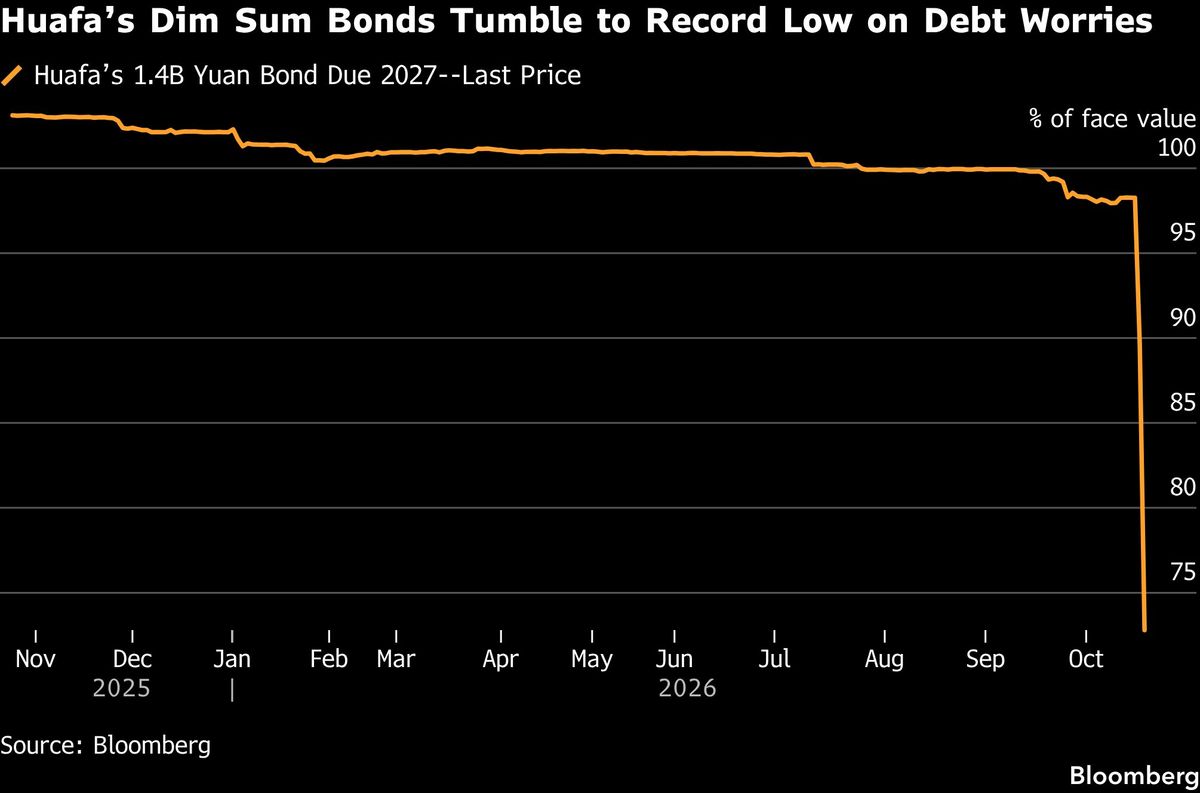
One of Huafa’s offshore yuan-denominated bonds was last indicated down by a record 17% Tuesday, bringing it to about 74% of face value.
Shares of Zhuhai Huafa Properties Co, the real estate arm of Huafa Group, fell as much as 8.9% in Shanghai Tuesday, to the lowest intra-day level in more than a month.
Unlike Vanke, which is only partially backed by a state-owned firm in Shenzhen, Huafa is wholly owned by the Guangdong government, with Zhuhai’s State-Owned Assets Supervision and Administration Commission holding about 93.5% and the provincial finance department owning the remainder.
Local rating firm China Lianhe Credit Rating affirmed Huafa’s AAA rating earlier this year, despite its heavy debt burden, weakening profitability and its high reliance on external financing. The credit assessor cited expectations of strong local government support, given Huafa’s status as a major conglomerate owned by Zhuhai.
After a downward spiral for five years, China’s home prices fell at a slower pace last month, fuelling hopes that the property market is turning a corner. China’s government recently turned to mortgage subsidies and changes to bank lending policies to step up efforts to support the economy.
Huafa, which derived about half of its revenue from property development and urban operations last year while also running businesses spanning financial services and technology, had blamed the property downturn as the main reason for its profitability swings.
It reported a total loss of RMB16.9 billion last year and had about RMB765 billion in total assets as of March.
“Local government-backed Chinese developers are likely to remain under pressure amid weak homebuyer sentiment, falling property sales and limited fiscal capacity at many regional governments,” said Andrew Chan, credit analyst at Bloomberg Intelligence. “Unlike centrally backed SOEs, they face weaker funding access and refinancing support.”
Uploaded by Arion Yeow