

KUALA LUMPUR (Oct 26): Mobilising private capital and preparing the national grid for more renewable energy are critical to meeting rising electricity demand while balancing economic growth, affordability and environmental protection.
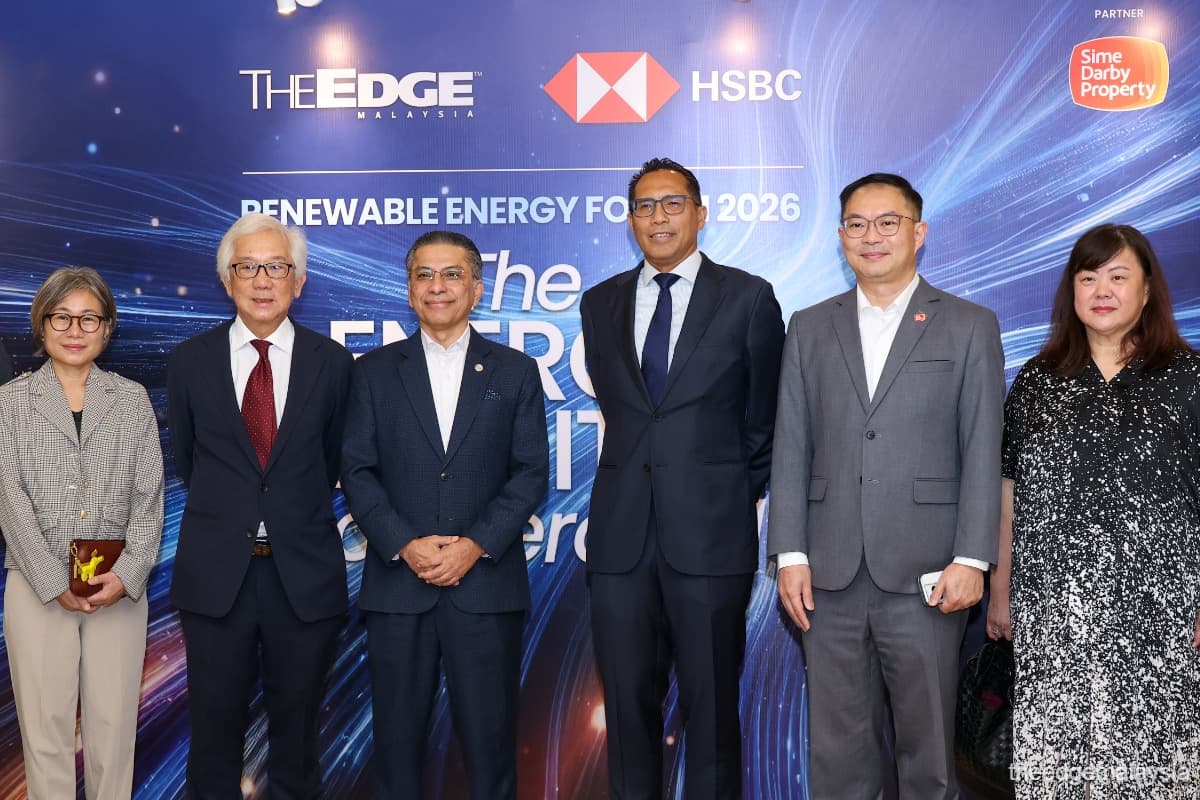
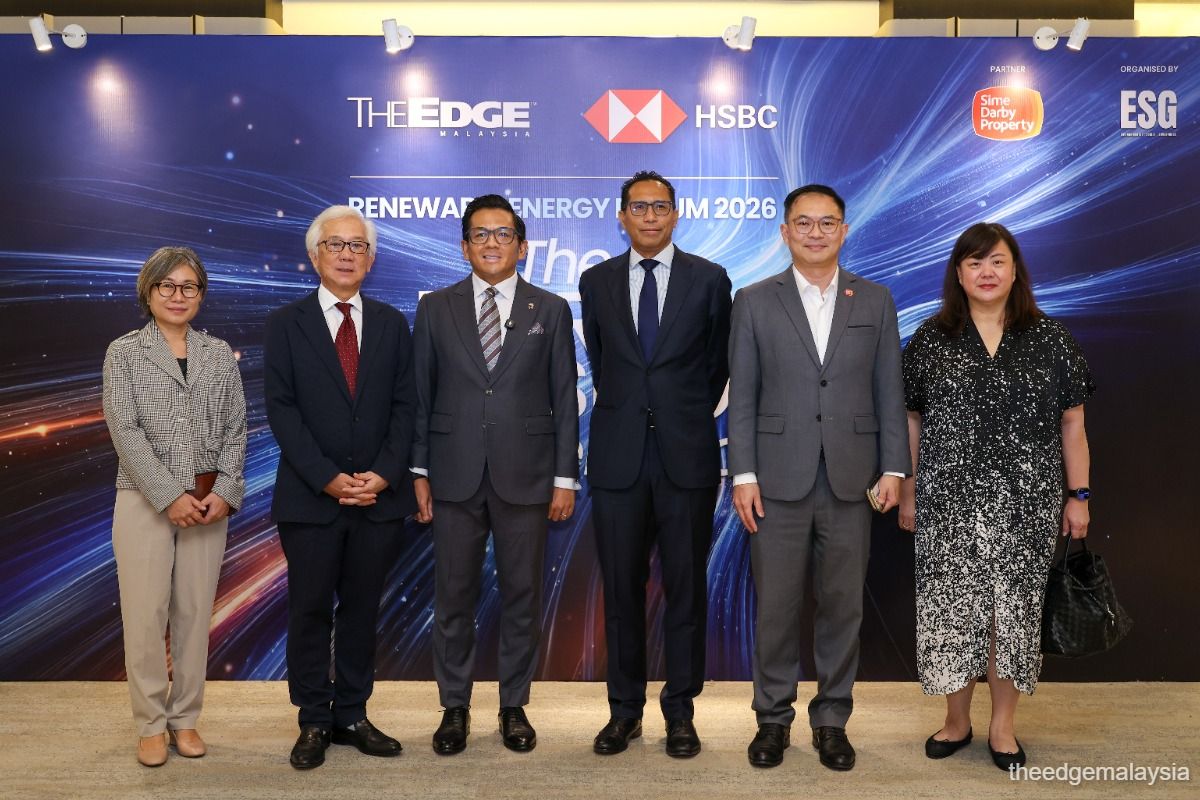
These were key themes at The Edge Malaysia Renewable Energy Forum 2026, held at KLGCC Convention Centre in Bukit Kiara on Monday, Oct 26.
Organised in collaboration with HSBC Bank Malaysia and Sime Darby Property, the forum, themed “The Energy Transition Accelerated”, drew 206 participants from various industries in person and nearly 120 online.
Deputy Natural Resources and Environmental Sustainability Minister Tuan Syed Ibrahim Syed Noh in his opening address said the energy transition is often discussed in terms of technology, investment and emissions targets.
An equally important question, he said, is how the country can sustain economic growth without compromising the environment on which that growth depends.
“For developing economies like Malaysia, the challenge is not simply to pursue cleaner energy, but to ensure that the transition remains practical, affordable and inclusive,” Syed Ibrahim added.
He said public resources alone would be insufficient to meet the scale of financing required, underscoring the need to mobilise private capital, attract foreign investment and expand access to sustainable financing.
Deputy Economy Minister Datuk Seri Mohd Shahar Abdullah in his closing speech said the National Energy Transition Roadmap (NETR) is projected to add up to RM220 billion to the country’s gross domestic product and generate approximately 310,000 high-income green jobs across engineering, construction, digital systems and finance.
“Capital deployment is already underway.This year’s Feed-in Tariff (FiT) initiative alone awarded 42 projects, generating approximately RM4.3 billion in investments,” he said in his closing speech.
The FiT scheme allows eligible renewable energy (RE) producers to sell electricity to the grid at a predetermined tariff for a specified period.
The scheme covers sources including solar, biomass, biogas and mini-hydro, with payments supported by the Renewable Energy Fund, or Dana Kumpulan Wang Tenaga Boleh Baharu (KWTBB).
Mohd Shahar also highlighted Tenaga Nasional Bhd’s (KL:TENAGA) RM15 billion investment in modernising the national grid.
Investments in solar installations, energy storage and transmission infrastructure, he said, will generate economic activity.
A reliable supply of clean electricity will also be crucial to attracting domestic and foreign investment as energy-intensive industries expand, said Mohd Shahar.
The government has outlined its energy transition goals through frameworks including the NETR, the National Energy Policy and the 13th Malaysia Plan.
Delivering on these ambitions, however, will require translating policies into viable projects that can attract investment.
HSBC Bank Malaysia chief executive officer Datuk Omar Siddiq said a key priority is ensuring that capital reaches viable RE projects as quickly as possible.
“Bloomberg recently reported that global available liquidity actively deployed towards energy transition reached a record US$2.4 trillion (RM9.8 trillion) approximately annually.”
“It is clear that there are investors around the world looking for bankable, resilient assets that offer reasonable returns,” he said.
Expanding the pool of investable projects requires credible economics, predictable revenues, clear risk allocation, and the permits and infrastructure needed to proceed.
Datuk Ho Kay Tat, CEO and group publisher of The Edge Media Group, warned of the financial consequences of energy insecurity, noting that the US-Iran war, which began in February and remains unresolved, had triggered a fuel crisis and driven oil and gas prices sharply higher.
The price surge has placed additional financial pressure on households, businesses and governments worldwide.
Ho acknowledged the impact of rising fuel costs on business earnings and commended the government for managing the unexpected crisis relatively well.
“What we are going through now underscores the urgent need for Malaysia to diversify our energy sources into more renewable forms. This will help Malaysia to not just achieve our climate targets but also attain energy security,” added Ho.
Balancing the energy trilemma
Balancing energy security, affordability and sustainability requires grid modernisation, bankable projects and clear carbon pricing frameworks, panellists said during the first session, titled “How can Malaysia accelerate its energy transition”.
They stressed the need to maintain a long-term policy direction while allowing flexibility in the pace of technology adoption amid geopolitical instability and fuel price fluctuations.
“The government has set a very clear policy and vision that is the compass and pathway towards energy transition. By having this clear vision, the initiatives and measures that come after that, it is incumbent upon the private sector in particular to work hand-in-hand with the government to identify projects that we need to drive, scale and accelerate,” said Omar.
He said the challenge was not necessarily a lack of capital, but the need for closer collaboration between the government and private sector to advance projects.
Tenaga Nasional chief strategy and ventures officer Dr Mohd Fadzil Mohd Siam stressed that accelerating the transition requires attention to the entire energy value chain, including grid readiness and changing customer demand.
“Can we accelerate? Yes, and we need to do it. Under the current regulatory period, we have ensured system readiness — that the grid must be ready and that we should be the right enabler to allow RE developers to connect.
But at the same time, as more demand comes in, how do we address it? We have energy efficiency [solutions] but in terms of more electric vehicles, for example, [but] how do we ensure that the charging points are available? Those are some of the things that need to be done and it can be done,” said Mohd Fadzil.
During the second panel, moderated by HSBC Amanah Malaysia CEO and chief sustainability officer of HSBC Bank Malaysia Raja Amir Shah Raja Azwa — titled “What’s next for Malaysia in the energy transition?” — panellists called for a resilient, diversified energy system to strengthen energy security and meet growing electricity demand.
“True energy security is when you don’t have to depend on foreign fuel. We’re talking about importing gas, importing coal…that’s not true energy security.”
“We need to develop our own domestic technologies, because energy security is not just about energy, it’s about the technology to produce that energy, and without that, we’re still going to be dependent on foreign geopolitical dynamics,” said Clean Energy Xpeditions Sdn Bhd (Cenergy) managing director Dr Azrudi Mustapha.
Azrudi, whose company develops small modular nuclear reactor technology, advocated nuclear power as another option for diversifying the energy mix.
Panellists also identified solar power and battery energy storage systems (BESS) as technologies that can be deployed immediately.
“Solar is still the one that we can deploy fastest in Malaysia, because we started with solar more than 10 years ago…second is energy storage, how it is important to integrate [it with] solar to provide stability and a firm supply, particularly when you have demand [from] data centres, manufacturing industries and so on,” said Syed Malek Faisal Syed Mohamad, head of renewables Malaysia at Gentari.
The panel also featured Cynthia Ong, chief executive facilitator and board director of Forever Sabah and LEAP, and Jack Tan Qi Jie, CEO at Solarvest Holdings Bhd (KL:SLVEST).
Full coverage of the forum will be published in a special issue in The Edge Malaysia weekly on Nov 9.