

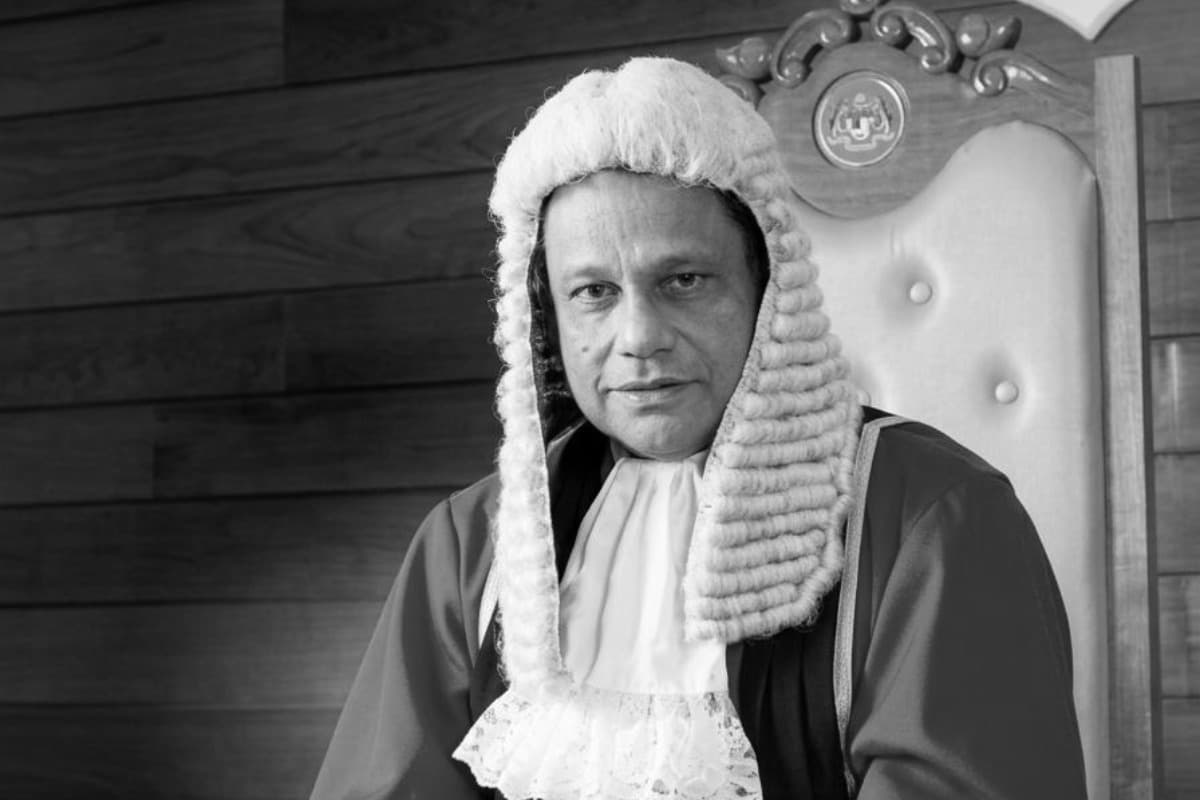
TODAY, Malaysia mourns the loss of Datuk Mahadev Shankar, one of its most distinguished jurists: a formidable advocate, an independent-minded judge and a man whose extraordinary intellect, integrity and commitment to public service left an indelible mark on the nation’s legal landscape.
Shankar belonged to a generation of lawyers and judges who helped shape the foundations of Malaysian jurisprudence. His was a life of remarkable achievement, spanning more than six decades of service to the law, the administration of justice, and the wider community. He was, in every sense, a towering figure of the Malaysian legal fraternity.
Born in Kuala Lumpur in 1932, Shankar’s early years were shaped by the hardships of the Japanese Occupation — experiences that helped instil the resilience, discipline, sense of fair play and capacity for hard work that would define his future. He distinguished himself academically at Victoria Institution before moving to England, where he was called to the Bar of the Honourable Society of the Inner Temple in 1955.
Upon his return to Malaya (as it then was), he was admitted to the Malayan Bar in July 1956 and commenced practice at Messrs Shearn Delamore & Co. His exceptional ability as an advocate and solicitor quickly became apparent. By 1961, at just 29 years of age, he had been made a partner of the firm.
Over the next two decades, Shankar established himself as one of the country’s foremost advocates. His practice encompassed broad aspects of civil and commercial litigation, as well as criminal law. He was renowned for his formidable intellect, mastery of the law, incisive advocacy and exceptional command of language. During his time at Shearn Delamore & Co, he also nurtured and shaped some of Malaysia’s leading advocates, particularly in the fields of commercial litigation and arbitration.
In 1979, he was among thirteen practising advocates selected as judicial commissioners to assist in clearing the backlog of cases before the High Court — the first appointments of their kind. On April 14, 1983, he became a Judge of the High Court of Malaya and served with distinction in Johor, the Federal Territory of Kuala Lumpur and Selangor. In 1994, he was elevated to the newly established Court of Appeal, where he served until his retirement in 1997.
Throughout his judicial career, Shankar approached the administration of justice with intellectual rigour, courage and an abiding respect for the law. He listened patiently and attentively to the arguments of advocates appearing before him. His judgements reflected not merely a profound understanding of legal principles, but also an appreciation of the human consequences of judicial decisions and a genuine commitment to the development of Malaysian jurisprudence.
His contributions extended well beyond the courtroom, placing his experience and judgement in the service of national inquiries, public institutions and the protection of fundamental liberties.
He brought his experience and independence of judgement to three Royal Commissions of Inquiry: the Royal Commission on the Reform of Marriage and Divorce Laws in 1971; the Royal Commission investigating the injuries sustained by Datuk Seri Anwar Ibrahim while in police custody in 1999; and the Royal Commission of Inquiry into the VK Lingam video clip in 2007.
These appointments placed him at the centre of some of Malaysia's most consequential questions concerning justice, institutional accountability and the integrity of public institutions.
Shankar was equally committed to the protection of fundamental liberties and human dignity. As one of the earliest Commissioners of the Human Rights Commission of Malaysia (Suhakam), he contributed to the development of the country's human rights framework. His commitment to constitutionalism, judicial independence and the rule of law remained unwavering.
Following his retirement from the Bench, he continued to serve the legal profession as an arbitrator, legal consultant and educator. He was an Honorary Fellow of the Malaysian Institute of Arbitrators and served on the panel of various international arbitral institutions. His considerable experience was also sought by institutions of legal learning, including the University of Malaya and Monash University.
Yet, to regard Shankar solely through the prism of his legal accomplishments would be to overlook the extraordinary breadth of the man.
He was an intellectual and a polymath. His knowledge and interest extended beyond the law to literature, history, philosophy, languages, music and the natural world. He possessed a remarkable memory, an inexhaustible curiosity and a dry wit that endeared him to generations of colleagues and friends. He was as comfortable discussing Shakespeare and the ancient scriptures as he was dissecting a difficult question of law.
His commitment to public service was equally remarkable. In the aftermath of the tragic events of May 13, 1969, he assisted in humanitarian relief and resettlement efforts, transcending communal divisions at a time when the nation most needed compassion and solidarity. He also served as a member of the National Emergency Fund and the National Goodwill Council, as well as in numerous civic, educational and professional organisations. Throughout, he was guided by the conviction that those privileged with knowledge and opportunity carried a responsibility to serve others.
In 2014, the Malaysian Bar conferred upon him its Lifetime Achievement Award, recognising his exceptional and enduring contributions to the legal profession and the nation.
This honour, distinguished as it was, only partly captures the measure of his achievements. The true measure of Shankar lies in the principles he upheld, the institutions he served, the knowledge he imparted and the example he set for those who followed.
He belonged to a generation that understood the legal profession not merely as a vocation, but as a calling. To him, the law was inseparable from justice, integrity and public duty. Judicial independence was not an abstract ideal, but an indispensable safeguard of the administration of justice. The standing of the legal profession depended not simply upon the brilliance of its practitioners, but upon their courage to uphold what was right.
For those of us who have spent our lives in the legal profession, Shankar represented the very finest traditions of the Bar and the Bench. He belonged to a generation of exceptional lawyers for whom intellectual excellence, professional integrity and independence of mind were not merely aspirations, but principles by which they lived. These are lessons that the current generation of practitioners and jurists ought to heed.
On a personal note, having been his pupil and junior on many a matter, I shall remember Shankar not only for his towering intellect and extraordinary command of the law, but also for his sharp wit and generosity of spirit. A man of immense learning and boundless intellectual curiosity, he could engage in conversation on almost any subject with characteristic humour and remarkable insight.
The passing of Shankar marks the loss of one of the great legal minds of his generation. His was a life extraordinarily well lived — rich in achievement, distinguished by service and guided by an unwavering commitment to justice.
Shankar leaves behind a loving wife and three devoted children. We shall remember him with admiration, affection and profound respect. His influence will endure not merely in the judgements he delivered or the institutions he served, but in the example he set for generations of lawyers and jurists.
Shankar lived a life of distinction, conviction and service. He leaves behind a legacy worthy not only of remembrance, but of emulation.
May he rest in eternal peace.
Tan Sri Cecil Abraham is a renowned advocate in dispute resolution with expertise in a wide range of fields.