

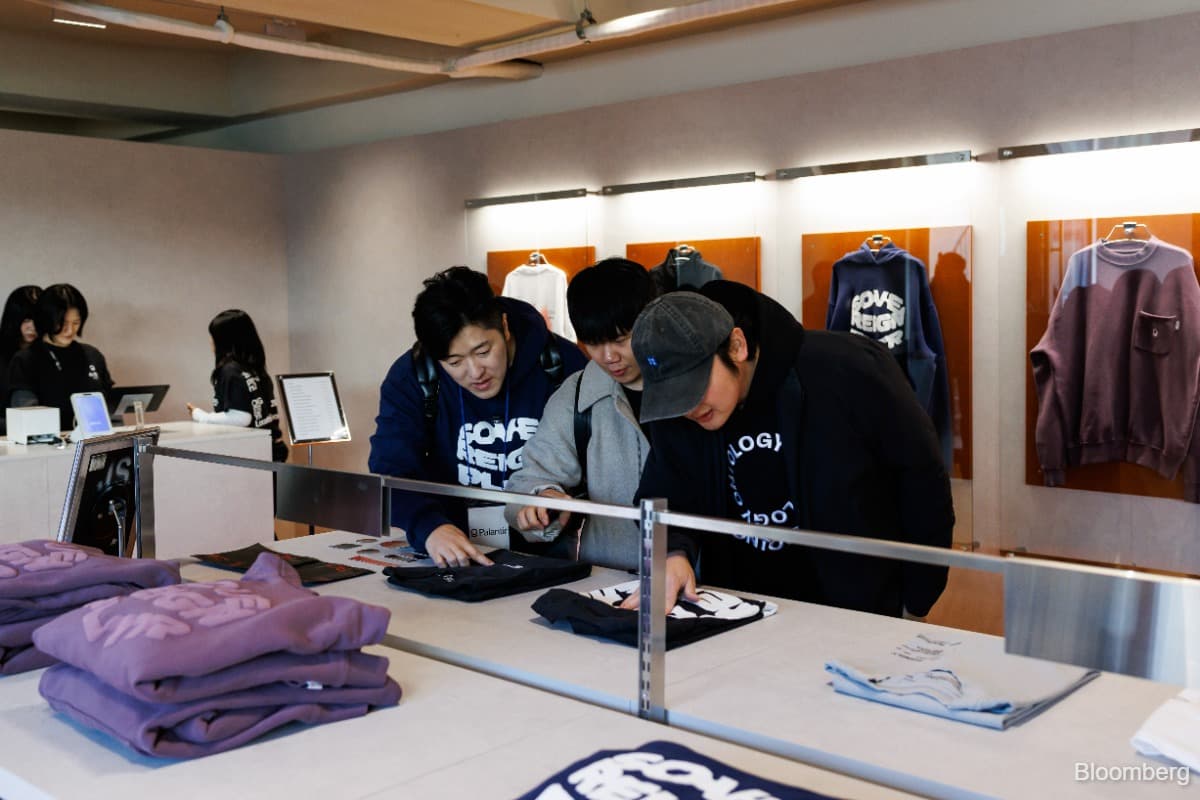
(Oct 26): Palantir Technologies Inc has spent years selling governments and companies its data analytics. In South Korea, it’s also selling US$170 (RM695) windbreakers — and they are flying off the shelves.
Thousands of fans descended on a two-storey pop-up store in Seoul last week to snap up hoodies, T-shirts and hats bearing Palantir’s logo, with a Korea-exclusive windbreaker selling out within hours.
The frenzy underscores an unusual level of enthusiasm for a company better known elsewhere as a secretive military and surveillance contractor that has faced protests over its work with the US military and immigration authorities.
Palantir has increasingly sought to cultivate that fandom. It has released everything from tennis whites to a US$239 French chore coat, using merchandise to build a more approachable public identity around a company whose core products most consumers will never encounter.
“We take the merchandise very seriously,” said Eliano Younes, Palantir’s head of engagement. “For a lot of these folks, the only time they’ll ever really get to touch Palantir is through the merchandise.”
That strategy has found greater success in South Korea where the government and some of its biggest industrial companies are pouring money into artificial intelligence. Sales from last week’s event jumped 30% from 2025, while the country has at times ranked as Palantir’s second-largest market after the US for online merchandise, according to Younes.
That enthusiasm matters because Korea is emerging as one of Palantir’s promising avenues for overseas growth. chief executive officer Alex Karp last year called the country the “second most interesting market” after the US.
The fandom also offers Palantir a way to cultivate a broader and more approachable public identity as it expands globally. The company has faced criticism over its handling of data and its ties to the Donald Trump administration.
But in Seoul, the company is making gradual inroads.
Since opening its South Korean office in 2022, Palantir has been expanding its presence. Last week, it signed a deal with Posco Future M to accelerate its AI-driven transformation. It also struck partnerships with Korean telecommunications giant KT in March 2025 and defence firm LIG Nex1 in March.
Dan Do, who works in the dental industry, has been a Palantir investor since it went public in 2020. Drawn initially to the company’s “defend the West” narrative and government business, he later saw potential in its Foundry commercial software. His frequent posts about Palantir on X earned him early access to the Seoul event, which he flew from Sydney to attend.
“The company puts a lot of effort into building community,” said Do, clutching an armload of streetwear to buy.
In Korea, public and corporate enthusiasm for AI is high. Seoul’s trend-driven consumer culture also gives Palantir an opportunity to present itself not simply as a defence contractor but as a technology brand with a devoted following, said Yoon Young-bin of OAAH Agency, an experience-curation service.
The country is home to globally important semiconductor, shipbuilding, automotive and manufacturing companies — all potential partners for Palantir, which is seeking to embed its AI and data software. The government is also accelerating spending on artificial intelligence, tripling its AI budget this year to 10.1 trillion won (US$7.6 billion or RM31 billion) as it embraces the concept of sovereign AI.
The latest merchandise to drop was a Korea-exclusive white nylon windbreaker that would “look really nice on the golf course”, said Younes, adding that the sport’s popularity in Korea factored into its development.
The inaugural Seoul pop-up last year attracted more than 5,000 fans over two days. The response prompted Palantir to increase inventory this time, impose limits on how many items each visitor can buy and introduce pre-registration. Even so, some products quickly sold out.
Brand strategists say merchandise can turn consumers into walking billboards, increasing exposure both in real life and online as people share photos of swag on social media. Flashing an emblem can also foster a shared identity, helping brands form and expand fandoms, said Kim Yong-seok, the CEO of Talksulting, a brand-strategy firm.
In Palantir’s case, “the main consumers are likely to be individuals who find the potential of Palantir’s technology to resonate, investors who have high hopes for the company’s future and fans who have developed an affinity for the brand itself”, Kim added.
Uploaded by Chng Shear Lane