

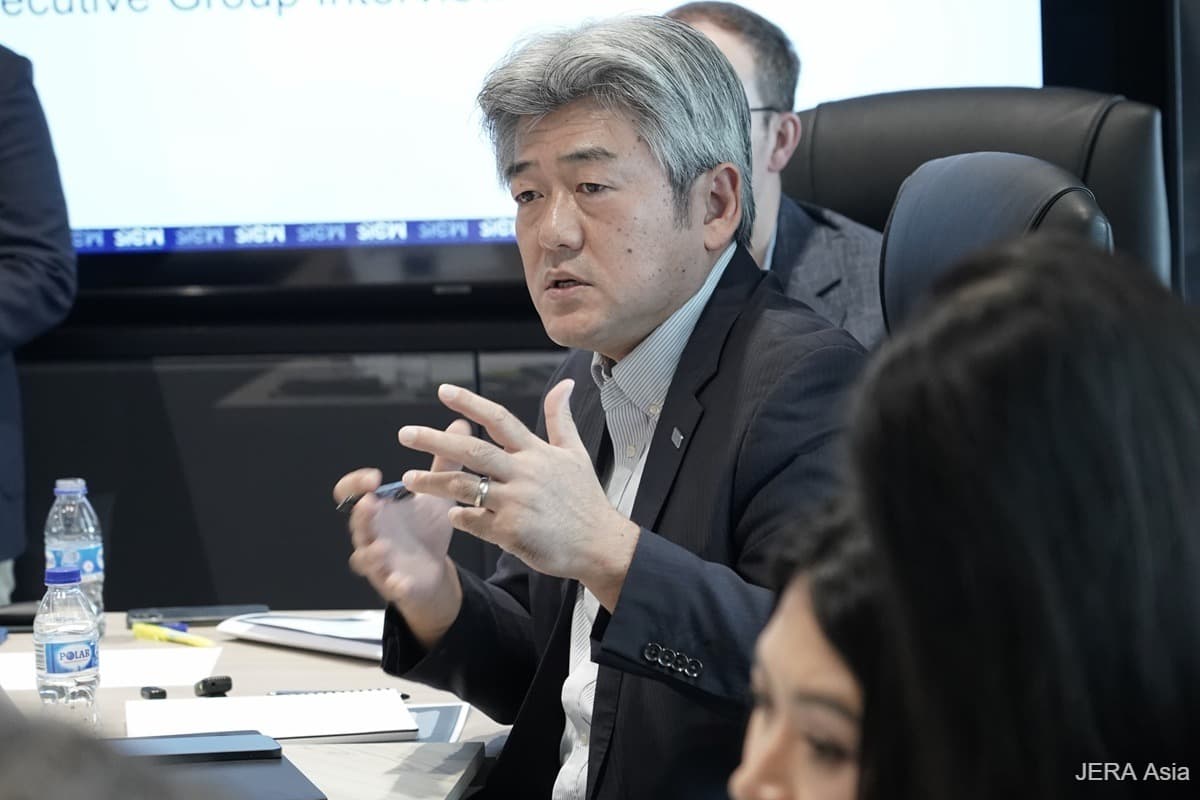
SINGAPORE (Oct 26): Gas-to-power projects cannot be developed in isolation and need to come together with certainty across the supply chain in order to meaningfully take off, said Jera Asia.
This includes arrangements on gas supply, availability of supporting pipeline infrastructure, and electricity offtake, said its CEO Izumi Kai.
Across the supply chain, a liquefied natural gas (LNG) regasification terminal operator needs sufficient gas throughput to recover its investment. A power plant developer needs certainty that gas will be available at an acceptable price. Meanwhile, an electricity buyer's commitment helps underpin the plant's revenue.
“LNG-to-power cannot be developed in silos. Supply, infrastructure and generation need to move forward together,” Kai said in a media briefing on Sunday in conjunction with Singapore International Energy Week (SIEW) 2026.
The world's largest LNG buyer, which has power infrastructure projects across Asia, sees ample opportunities in the sector across the region, including Malaysia, on the back of healthy long-term electricity demand growth.
However, investors need predictable returns and appropriate risk-sharing arrangements for such long-term infrastructure investments, Kai said. “The capital is available, but projects need to be bankable.”
In Malaysia, the need to coordinate investments across the gas-to-power supply chain is in the spotlight as the country emerges from its old gas procurement regime and prepares for new gas-fired generation capacity amid rising electricity demand and declining domestic offshore gas supply.
The Energy Commission, in a consultation paper issued in May, cited indicative new gas-fired power generation capacity of more than 8GW requiring nearly 1,600 million standard cubic feet per day (mmscfd) of gas between 2028 and 2031.
Against this backdrop, Peninsular Malaysia is seeing the development of its third and fourth LNG regasification terminals to accommodate growing dependence on imported gas.
The third terminal, to be set up in Lumut, Perak, is a 60:40 joint venture between Petroliam Nasional Bhd (PETRONAS) and utility group Tenaga Nasional Bhd (KL:TENAGA). The fourth, in Yan, Kedah, is led by Gas Malaysia Bhd (KL:GASMSIA), with Tokyo Gas Co Ltd and VTTI BV each holding 15%.
These investments are also taking shape ahead of potential reviews to existing gas supply and electricity pricing arrangements.
Gas-fired power plants in Peninsular Malaysia will see their existing gas supply agreements with PETRONAS' gas trading unit expire at end-2027.
The current electricity tariff regulatory period will also end in 2027, potentially allowing future tariffs to reflect any changes in the gas procurement arrangements.
How future gas supplies will be contracted, however, is still under review. The Energy Commission's May consultation paper sought feedback on future market arrangements for uncontracted gas volumes in Peninsular Malaysia.
Further policy direction may come from Peninsular Malaysia's natural gas roadmap, which the Ministry of Economy has said will be launched this quarter.